
You swallow a 10mg THC gummy expecting potent effects, but feel underwhelmed. Why? Bioavailability of oral THC ranges from 4% to 12%, meaning much less THC reaches your bloodstream than you expect. Understanding bioavailability explains why edibles vary in onset, intensity and duration. This guide reveals how your body processes THC, what enhances absorption and how to choose edibles that deliver predictable effects.
| Point | Details |
|---|---|
| Low THC Absorption | Only 4-12% of ingested THC reaches your bloodstream due to digestive breakdown and liver metabolism. |
| Delayed Onset | First-pass metabolism slows effects to 30-120 minutes but extends duration to 6-8+ hours. |
| Fats Boost Absorption | Consuming edibles with fats increases bioavailability 2-3 times compared to low-fat options. |
| Nanoemulsions Speed Effects | Advanced formulations reduce onset to 10-20 minutes with improved consistency. |
| Dosing Precision Matters | Understanding bioavailability prevents overconsumption and helps tailor your experience. |
Bioavailability measures the percentage of THC entering your bloodstream after you ingest an edible. For cannabis edibles, typical bioavailability range for oral THC is approximately 4-12%. This low and variable rate explains why two people taking identical doses experience wildly different effects.
When you swallow a gummy labeled 10mg THC, only 0.4-1.2mg may actually reach your bloodstream. The rest breaks down during digestion or gets filtered by your liver before circulating through your body. This biological reality affects dose effectiveness and timing.
Several factors determine your personal bioavailability:
Knowing how THC absorption dynamics work helps you set realistic expectations and choose products designed for better absorption. Reading bioavailability research on edibles reveals how food science improves product performance.
Your digestive system treats THC like any other ingested compound, subjecting it to harsh breakdown processes. When an edible reaches your stomach, digestive enzymes and stomach acid begin fragmenting the product. THC molecules dissolve and move through your intestinal lining into the bloodstream.
Before THC circulates throughout your body, it travels directly to your liver through the hepatic portal vein. This first-pass metabolism converts THC to 11-hydroxy-THC, a more potent metabolite that crosses the blood-brain barrier more efficiently. This transformation explains why edibles feel more intense than equivalent smoked doses.
The liver metabolism process creates the characteristic edible timeline:
Individual metabolism varies significantly. Fast metabolizers feel effects sooner but for shorter durations. Slow metabolizers wait longer but experience extended effects. Genetic variations in liver enzymes like CYP2C9 influence how quickly you process cannabinoids.
Understanding this biological journey explains why edibles require patience. Rushing to redose before effects peak leads to overconsumption and uncomfortable experiences.
Cannabinoids are lipophilic, meaning they dissolve in fats rather than water. This chemical property makes fat content crucial for absorption. Products formulated with appropriate fats increase THC bioavailability by 2-3 times compared to low-fat alternatives.

Not all fats perform equally. Long-chain triglycerides like sesame oil outperform medium-chain triglycerides (MCT) like coconut oil in cannabinoid bioavailability. Long-chain fats better mimic the body’s natural fat processing, facilitating THC transport across intestinal membranes.
Nanoemulsion technology represents a breakthrough in THC extraction and formulation science. This process breaks THC into microscopic droplets measuring 10-100 nanometers. The tiny particle size bypasses some digestive barriers, allowing faster absorption through different pathways.
Nanoemulsified products offer distinct advantages:
Pro Tip: Choose fast-acting nanoemulsified edibles when you want quick relief or effects. Traditional fat-based edibles work better when you prefer extended, gradual experiences.
The formulation science continues evolving. Manufacturers experiment with different lipid carriers, encapsulation methods and delivery systems. Reading fat impact on bioavailability studies helps you understand which products deliver superior performance.
Misunderstanding bioavailability leads to frustrating experiences and dosing errors. Clarifying these widespread myths helps you make informed choices.
Recognizing these misconceptions prevents common mistakes like premature redosing, inconsistent experiences and unexpected intensity. Understanding bioavailability mechanics helps you dose confidently.
Different consumption methods deliver vastly different bioavailability profiles, onset times and effect durations. Understanding these differences helps you choose the right method for your goals.
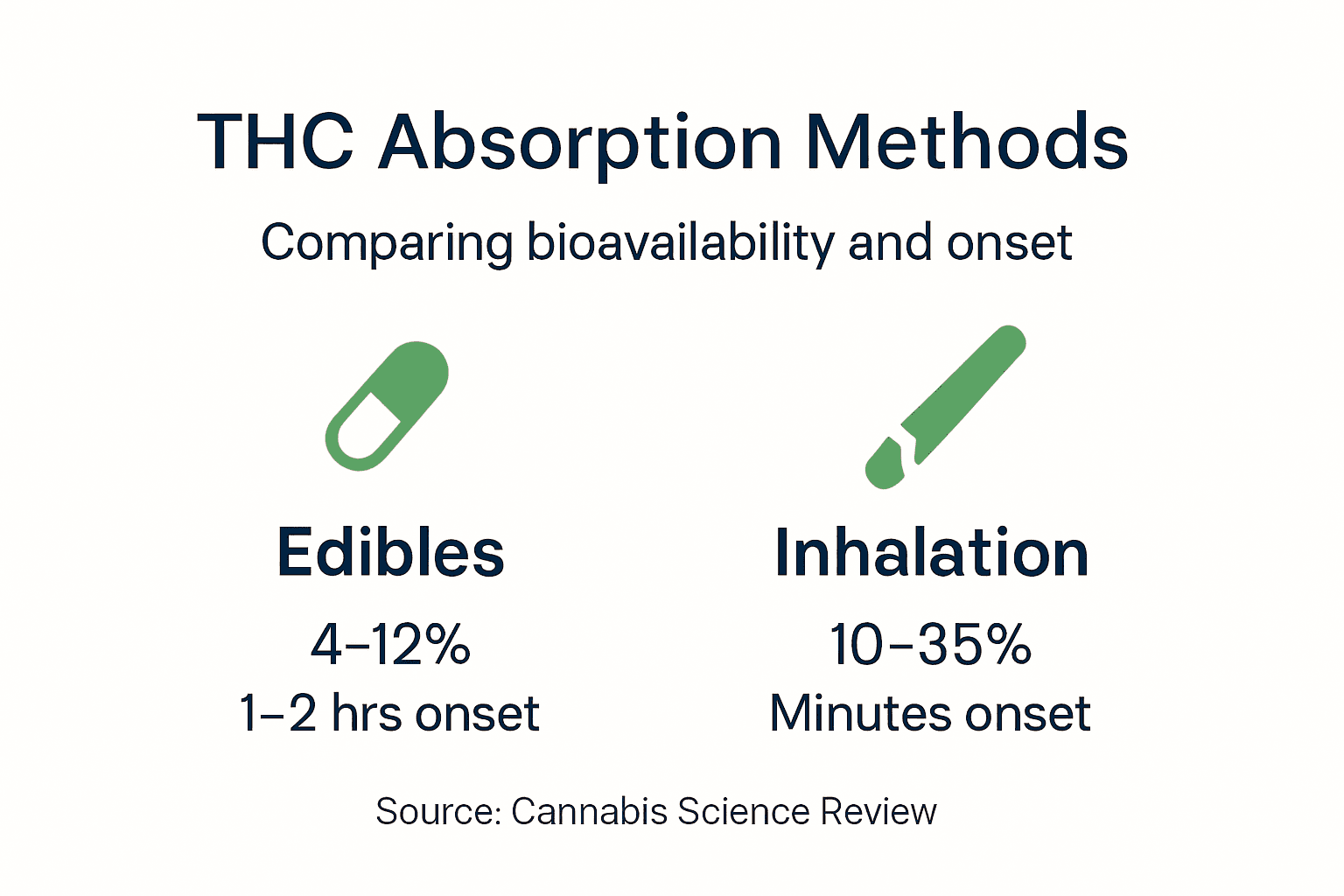
Inhalation bioavailability ranges 10-35%, with rapid onset and shorter duration. Smoking or vaping bypasses digestive breakdown and liver metabolism, delivering THC directly to your bloodstream through lung tissue. Effects begin within 1-5 minutes, peak around 15-30 minutes and decline over 2-4 hours.
Traditional oral edibles have low bioavailability (4-12%) but extended duration. The digestive journey and liver metabolism delay onset to 30-120 minutes. However, effects last 6-8+ hours due to sustained release of metabolites. This extended timeline suits users seeking long-lasting relief.
Nanoemulsified cannabis beverages provide faster onset with moderate bioavailability and duration. Advanced formulations split the difference, offering 10-20 minute onset while maintaining 4-6 hour effects. This middle ground appeals to users wanting quicker feedback without inhalation.
| Method | Bioavailability | Onset Time | Duration | Best For |
|---|---|---|---|---|
| Inhalation | 10-35% | 1-5 min | 2-4 hrs | Immediate relief, precise titration |
| Traditional Edibles | 4-12% | 30-120 min | 6-8+ hrs | Extended effects, overnight use |
| Nanoemulsified Products | 8-18% | 10-20 min | 4-6 hrs | Faster onset, moderate duration |
| Sublingual | 12-35% | 5-15 min | 3-5 hrs | Quick absorption, discreet use |
Choosing your consumption method depends on desired speed, duration and experience preferences. Reviewing comparison of consumption methods and beverage vs edible differences clarifies which option fits your lifestyle. Learn more about bioavailability across methods to understand the full spectrum.
Applying bioavailability knowledge transforms your edible experience from unpredictable to consistent. These strategies help you optimize absorption, avoid overconsumption and tailor effects.
Consume edibles with fats to enhance absorption and effect strength. Eating your edible alongside nuts, avocado, cheese, or a fatty meal increases bioavailability 2-3 times. This simple step maximizes your investment and reduces dose variability.
Start with low doses and wait sufficient time to gauge effects before redosing. New users should begin with 2.5-5mg THC and wait at least 2 hours. Experienced users can start higher but should still practice patience. Premature redosing causes accidental overconsumption.
Select nanoemulsified or fast-acting edibles to reduce waiting and improve onset predictability:
Be mindful of stomach contents since fasting or heavy meals alter onset and intensity. Empty stomachs speed absorption but may increase intensity uncomfortably. Full stomachs slow onset but smooth the experience. Find your personal sweet spot.
Pro Tip: Avoid accidental overconsumption by using predictable dose products and spacing sessions. Track your experiences, noting dose, timing, stomach contents and effects. This personal data reveals your optimal dosing strategy.
Understanding bioavailability allows you to tailor edible use to your wellness or recreational goals. Reviewing guides on choosing cannabis edibles, safe edible dosing and fast-acting dosing tips provides additional strategies for success.
Edwin’s Edibles & Elixirs offers a curated selection of premium cannabis edibles designed with bioavailability science in mind. Our proprietary TiME INFUSION® technology delivers fast-acting effects, reducing onset times while maintaining quality and consistency. Explore our collection of nanoemulsified beverages for rapid relief and traditional fat-optimized gummies for extended experiences.
Our comprehensive cannabis edibles guide and detailed edible consumption guide help you dose confidently and safely, avoiding common mistakes. Discover how science-backed formulations enhance your cannabis experience and wellness journey by choosing cannabis edibles that match your goals.
Product formulation (especially fat content), liver metabolism speed, stomach contents and individual genetics determine bioavailability. Long-chain fats and nanoemulsions improve absorption, while empty stomachs and efficient liver enzymes speed onset.
Full stomachs slow digestion, delaying onset by 30-60 minutes but smoothing the experience. Empty stomachs speed absorption to 20-40 minutes but may intensify effects uncomfortably. Fatty meals increase bioavailability 2-3 times regardless of timing.
Nanoemulsified products are safe, using food-grade ingredients to reduce THC particle size. Effects feel similar to traditional edibles but begin faster (10-20 minutes) with improved consistency. They do not increase potency, just speed and predictability.
Yes, consuming edibles with foods high in long-chain fats like nuts, avocados, cheese, or full-fat dairy increases absorption 2-3 times. Avoid low-fat meals or empty stomach consumption if seeking maximum bioavailability.
Start with low doses (2.5-5mg for beginners), wait at least 2 hours before redosing and track your experiences. Choose fast-acting products for quicker feedback. Never assume an edible is not working before sufficient time passes.
Liver metabolism converts THC to 11-hydroxy-THC, a more potent metabolite that crosses the blood-brain barrier more efficiently. This transformation, combined with extended duration, creates stronger psychoactive effects despite lower bioavailability.