
CBD is everywhere right now. It’s in gummies, beverages, skincare and even pet treats. But here’s the honest truth: most of what you’ve heard is a mix of real science and serious overreach. Wellness-focused adults deserve more than catchy marketing. You deserve clarity. In this guide, we cut through the noise, explain how CBD genuinely interacts with your body, show you what research actually supports, walk you through how to choose safe and effective products and flag the risks nobody talks about. Think of this as your science-first roadmap to making confident, informed CBD choices.
| Point | Details |
|---|---|
| CBD modulates, not intoxicates | CBD works with your body’s regulatory system for balance, without producing a high. |
| Benefits are evidence-filled but targeted | CBD is best supported for epilepsy, may help pain or anxiety, but broad wellness claims need more study. |
| Choose organic, fast-acting edibles | Nano-emulsified, broad-spectrum CBD products offer quicker, more reliable effects without unwanted THC. |
| Safety first with all CBD products | Know potential side effects, drug interactions and always verify third-party lab tests for purity. |
After understanding why the hype exists, it’s crucial to see what the science actually tells us about how CBD interacts within your body.
Your body already has a built-in system designed to maintain balance across mood, sleep, pain and immune response. It’s called the endocannabinoid system (ECS) and it runs on naturally produced compounds called endocannabinoids. CBD doesn’t flood this system with signals. Instead, it acts as a gentle modulator, nudging the system toward better regulation rather than forcing a dramatic response.
One of CBD’s most studied mechanisms is its ability to inhibit the FAAH enzyme (fatty acid amide hydrolase). Blocking FAAH slows the breakdown of your body’s own endocannabinoids, particularly anandamide, which plays a role in mood and pain regulation. According to endocannabinoid system research, CBD interacts as a modulator targeting the FAAH enzyme, with downstream effects on inflammation, mood and pain. It also interacts indirectly with CB1 and CB2 receptors, rather than binding to them directly the way THC does.
This is the key myth to bust: CBD does not work like THC. It won’t make you feel intoxicated, euphoric, or impaired. As confirmed by clinical reference data, CBD promotes general homeostasis without producing the intoxicating effects associated with THC. That’s a critical distinction, especially if you’re exploring hemp-derived CBD benefits for the first time.
“Think of CBD less as a magic pill and more as a gentle balancer, one that helps your body do what it already wants to do.” This framing, rooted in how the ECS actually functions, is far more accurate than most wellness headlines suggest.
Here’s a quick comparison to clear up some common confusion:
| Claim | Myth or fact? | What science says |
|---|---|---|
| CBD gets you high | Myth | No intoxicating effects; acts differently than THC |
| CBD fixes everything | Myth | Benefits are specific, not universal |
| CBD interacts with your ECS | Fact | Modulates ECS via FAAH and indirect receptor activity |
| CBD works instantly | Mostly myth | Onset depends on format and formulation |
| CBD is the same as hemp oil | Myth | Hemp oil is seed-derived; CBD is from the plant |
When you’re choosing organic CBD edibles, understanding this baseline science helps you make smarter decisions rather than falling for sweeping wellness promises.
Once you understand the science behind CBD’s action, it’s time to look at what real studies show about its actual benefits for wellness.
Let’s be direct. CBD has one FDA-approved use: treating specific rare forms of epilepsy (Dravet syndrome and Lennox-Gastaut syndrome) through the prescription drug Epidiolex. That’s not a small thing. It represents the strongest clinical evidence in the space. Beyond epilepsy, the picture gets more nuanced.
Research suggests modest pain and anxiety relief from CBD, with some positive anxiety studies adding real promise. Sleep and general wellness claims, however, are less supported by large-scale clinical trials. Here’s a snapshot of where the evidence stands:
| Wellness claim | Evidence strength |
|---|---|
| Seizure reduction (specific epilepsies) | Strong (FDA-approved) |
| Chronic pain relief | Modest |
| Anxiety reduction | Moderate (some clinical support) |
| Inflammation reduction | Early stage |
| Sleep improvement | Weak to modest |
| General wellness | Insufficient |
Users should be especially cautious about broad wellness claims, since FDA approval is highly specific and most products on the market make promises that go beyond current evidence.
When choosing high potency CBD options for targeted use, match your expectations to what research actually supports:
If you’re curious about using CBD gummies for wellness, start with realistic goals: supporting relaxation, easing occasional discomfort, or complementing an existing wellness routine.
Pro Tip: Focus first on products and dosages that align with the most heavily researched uses, such as pain and anxiety support, rather than chasing generalized “wellness” promises that outpace the science.
You’ll get more consistent results by treating CBD as a complement to healthy habits, not a replacement for them. That mindset, backed by real data from craft CBD edibles producers who prioritize transparency, leads to the best outcomes.
With clarity on evidence-backed benefits, you can now focus on how to choose safe, effective CBD edibles or beverages tailored to your needs.
One of the most exciting developments in CBD products is delivery technology. Traditional edibles pass through the digestive system, which means slow onset, often 45 minutes to 2 hours. Modern nanoemulsion technology changes that entirely. Nano-emulsified, water-soluble CBD breaks the compound into microscopic particles that absorb far more efficiently into your bloodstream. Nano-emulsified CBD in edibles and drinks can deliver effects within 10 to 30 minutes, making dosing more predictable and outcomes more consistent. That’s a game-changer for anyone who’s been frustrated with inconsistent edible experiences.
Next, understand your spectrum options:
Broad and full-spectrum formulas can augment the entourage effect without producing intoxication, though trace THC is something to factor in if you’re subject to drug testing.
Here’s how to evaluate any CBD product before buying:
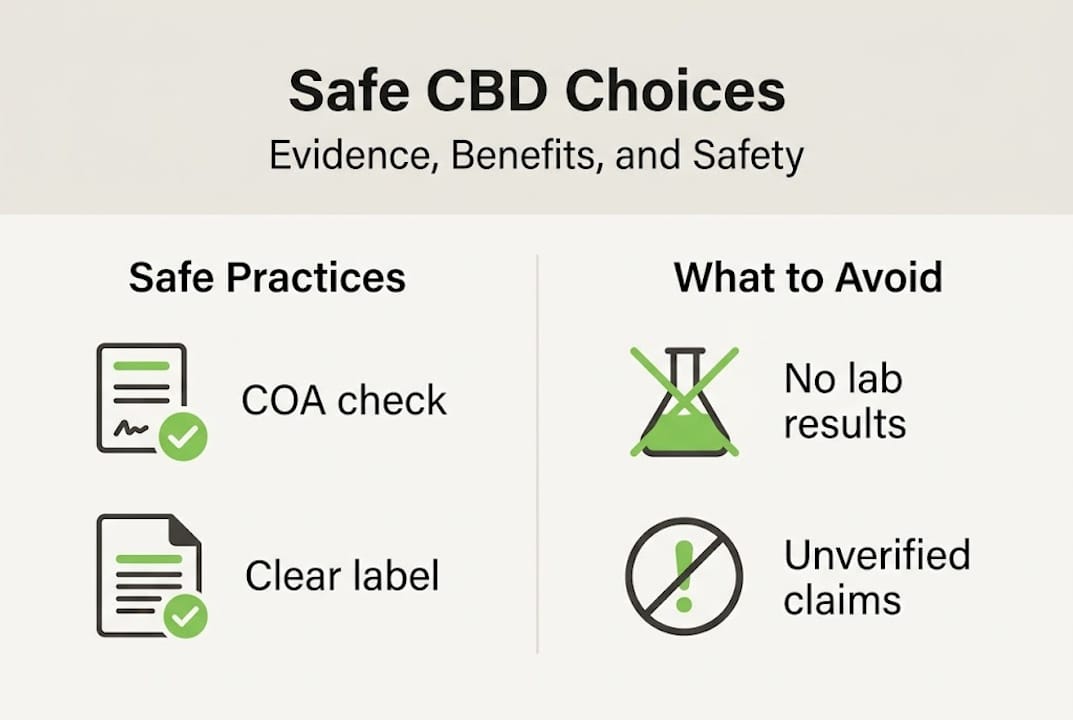
Pro Tip: Always request or look up the COA before purchasing any CBD product. If a brand won’t share lab results, that’s a red flag worth heeding. Find guidance on selecting organic edibles to make the process even simpler.
After choosing the right CBD products, it’s equally important to understand safety, potential side effects and when to proceed with caution.
CBD is generally well-tolerated, but “natural” doesn’t mean risk-free. The most commonly reported side effects include drowsiness, dry mouth, diarrhea, changes in appetite and risk of elevated liver enzymes. Those with liver disease, pregnancy, or who are taking CNS depressants (central nervous system suppressants) should exercise particular caution.

The liver interaction risk deserves serious attention. Clinical data shows a relative risk of 11.88 for elevated liver transaminase (enzyme) levels and a relative risk of 4.88 for sedation when CBD is combined with certain medications. That’s not a small number. If you take any drug processed by the liver’s CYP450 enzyme system, including blood thinners, antiepileptics, or antidepressants, CBD can alter how those drugs are metabolized.
Common mistakes to avoid when starting with CBD edibles:
For a detailed guide on safe consumption, our CBD gummies safety checklist walks you through every important step before your first purchase. And if you’re ready to explore trusted, tested options, premium CBD edibles from quality-focused producers set the standard for what responsible CBD looks like.
Who should consult a doctor before starting CBD? Anyone who is pregnant or nursing, taking prescription medications, managing a liver condition, or under 18 years of age.
We’ve watched the CBD conversation swing from radical skepticism to breathless hype and honestly, neither extreme serves you well. Real wellness use of CBD is more focused and more meaningful than the headlines suggest.
Influencers and clickbait articles overstate what CBD can do for general stress or sleep because those are the claims that resonate emotionally. But the evidence tells a quieter story. For specific epilepsies, CBD is a genuine breakthrough. For pain and some anxiety, it offers real but modest support. For everything else? Be skeptical, ask questions and demand proof.
Our perspective is that the best CBD outcomes come from informed choices rooted in transparency. That means knowing your source, reading lab reports and matching your expectations to what research actually supports. The craft cannabis perspective we believe in prioritizes small-batch integrity and honest communication over flashy promises. Wellness is built slowly, thoughtfully and with products that respect both science and your body.
Now that you have a solid, science-backed foundation, it’s time to put that knowledge to work. At Edwin’s Edibles & Elixirs, we believe every product should earn your trust before it earns your purchase. Our organic CBD gummies are crafted in small batches using carefully sourced, certified organic hemp, so you always know what you’re getting. Ready to go deeper on delivery technology? Our fast-acting CBD guide breaks down the science behind rapid-onset formats in plain language. And if you’re just getting started, our cannabis edibles guide covers everything from dosing to formats in one trusted resource.
Evidence is strong for epilepsy and modest for pain and some anxiety, but general wellness claims lack large-scale clinical confirmation and are not FDA-approved.
They use nano-emulsified or water-soluble CBD, which dramatically improves absorption speed; nano-emulsification typically delivers effects within 10 to 30 minutes compared to standard edibles.
Yes. CBD can alter liver enzyme levels and interact with drugs processed through the CYP450 liver enzyme system, so always consult your doctor first.
It refers to the synergy between multiple hemp plant compounds; broad and full-spectrum CBD enhance benefits without causing THC intoxication, though trace amounts of THC may remain.
Organic CBD avoids pesticides and soil contaminants that hemp readily absorbs; pairing organic sourcing with third-party lab testing ensures both safety and verified potency.