
Getting edible dosing wrong is one of the most common and frustrating experiences in the cannabis space. Too little and you feel nothing. Too much and you’ve got a very long, uncomfortable afternoon ahead. The tricky part is that the milligrams printed on a package don’t always tell the full story. Lab testing inconsistencies, individual biology and metabolic differences all play a role in how an edible actually lands. This guide is built to cut through that uncertainty. We’ll walk you through how to read potency data with confidence, verify what’s actually in your edibles and build a personalized dosing approach that works for your body and your goals.
| Point | Details |
|---|---|
| COA over label | Rely on verified Certificates of Analysis, not just package labels, to judge edible potency. |
| Personal factors matter | Your body, diet and tolerance will significantly change how potent an edible feels. |
| Start low, go slow | Begin with a small dose and only increase gradually to safely find your optimal effect. |
| Track and titrate | Keep a log of dose, timing and effects to systematically determine your best dosage. |
Potency, in the world of cannabis edibles, refers to the concentration of active cannabinoids in a product, most commonly Delta 9 THC (tetrahydrocannabinol, the compound responsible for psychoactive effects) and CBD (cannabidiol, associated with relaxation and wellness benefits). For edibles specifically, potency is measured in milligrams (mg) per serving or per package. A gummy labeled as “10mg Delta 9 THC” should contain exactly that amount in each piece.
The problem is that “should” does a lot of work in that sentence.
Why labels can mislead you
Regulatory requirements for cannabis edible labeling vary dramatically by state and product type. Some states require mandatory third-party testing before a product can hit shelves. Others have lighter oversight. This patchwork of rules means the label you’re reading may reflect an estimate, an internal test, or a single batch test done months ago, not the precise dose in your hand today.
Research makes this gap even clearer. Label accuracy varies significantly across product types, with flower and edibles frequently over-labeled, meaning the actual observed THC is lower than what the label states. In Colorado, for example, roughly 44% of flower samples were found to be inaccurately labeled. Meanwhile, potency labels systematically overstate THC levels in edibles and flower at measurably higher rates than concentrates, which tend to be far more consistent.
Concentrates, by comparison, perform much better, with approximately 96% of products landing within ±15% of their labeled potency. Edibles and flower don’t come close to that consistency.
Label accuracy by product type
| Product type | Approximate label accuracy | Notes |
|---|---|---|
| Concentrates | ~96% within ±15% | Most reliable |
| Edibles | Variable by state | Often over-labeled |
| Flower | ~56% accurate (CO data) | Least consistent |
What to look for when evaluating a product’s reliability:
“If a brand can’t show you its test results, that’s your answer about whether to trust the product.”
COA verification for edibles is the single most important step you can take before purchasing any hemp-derived Delta 9 or CBD product. No COA? Walk away.
Once you understand what to look for on labels, the next step is backing up that information with real lab data. A Certificate of Analysis, or COA, is a document issued by an independent, accredited testing lab confirming the actual cannabinoid content of a specific product batch. It’s the most reliable tool available to consumers who want to know what they’re actually consuming.
How labs measure potency
The gold standard method in cannabis potency testing is HPLC (high-performance liquid chromatography). Unlike older methods that use heat to convert THCA into THC (a process called decarboxylation), HPLC separates and measures cannabinoids in their natural state. This matters because it gives you accurate individual readings for both THCA and Delta 9 THC without artificially inflating the numbers.
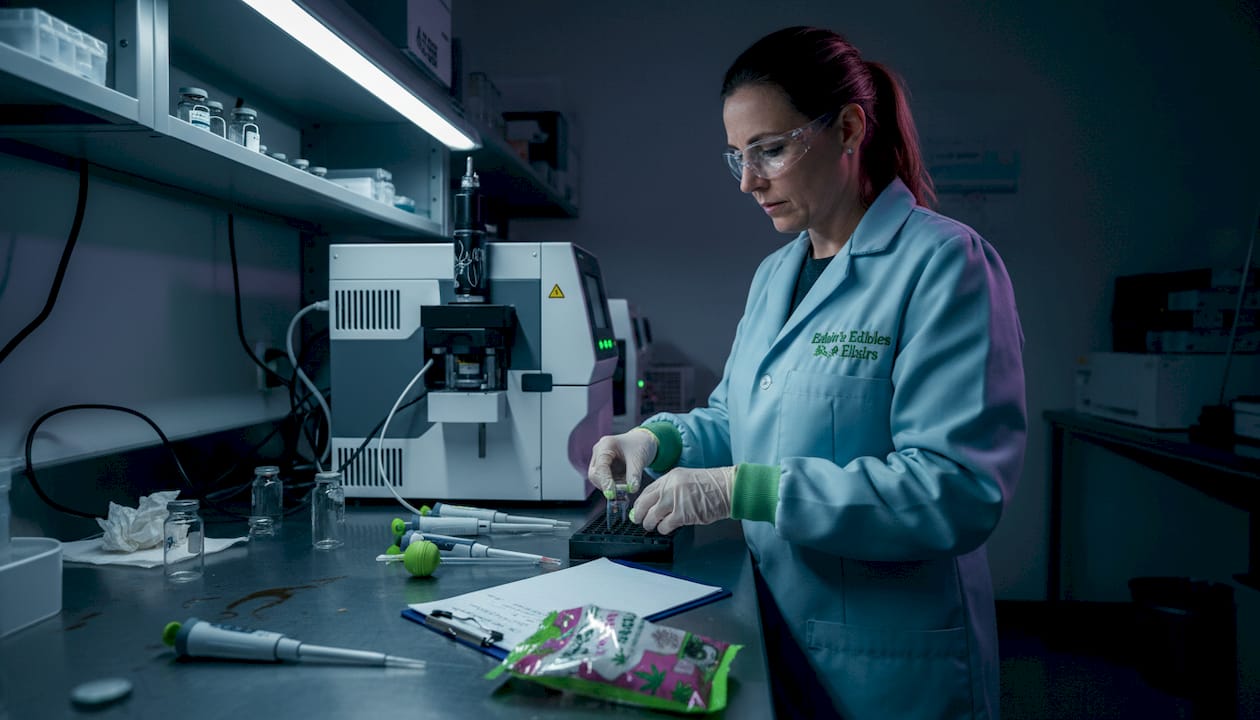
For solid matrix edibles like gummies and brownies, labs use an extraction technique called QuEChERS (Quick, Easy, Cheap, Effective, Rugged, Safe) to pull cannabinoids out of the food matrix before analysis. This step is essential because fat, sugar and binding agents in edibles can interfere with accurate readings if not properly removed first.
How to read a COA step by step
Pro Tip: Save the COA as a screenshot or PDF before purchasing. If a brand’s website removes or updates a COA link after you’ve bought a product, you’ll have permanent documentation for your records.
Understanding lab testing in edibles isn’t just for scientists or industry insiders. As a consumer, you have the right and the tools to check the data before it enters your body. Brands that make it easy to understand lab reports are the ones investing in your safety, not just their marketing.
COA quality indicators at a glance
| COA element | What good looks like | Red flag |
|---|---|---|
| Lab accreditation | ISO 17025 certified | No accreditation listed |
| Batch match | Lot number matches package | Generic or undated |
| Cannabinoid panel | Multiple cannabinoids listed | THC only |
| Contaminant testing | Pesticides, metals, microbials | Potency only |
Third-party lab data gives you a trustworthy starting point. But here’s the part that surprises a lot of people: two consumers can eat the same 10mg Delta 9 gummy from the same batch and have wildly different experiences. That’s not a flaw in the product. It’s biology.
Why your body changes the equation
Metabolism speed, body composition, liver enzyme activity and prior THC exposure (tolerance) all shape how intensely and how quickly you feel an edible. The liver enzyme CYP2D6 is central to converting Delta 9 THC into its more potent metabolite, 11-hydroxy-THC. People with fast CYP2D6 activity feel stronger effects. People with slow activity may feel very little, regardless of dose.
In fact, up to 20% of people cannot metabolize edibles efficiently and may feel weak or no effects even at relatively high doses. If that’s your experience, it doesn’t mean you need a higher dose immediately. It means your evaluation process needs to account for your specific metabolism.
The fat factor
What you eat before or with an edible changes your experience significantly. High-fat meals intensify and prolong THC edible effects because cannabinoids are fat-soluble. They bind to dietary fats and absorb more completely into the bloodstream. Eating a greasy burger before a 5mg gummy can feel like taking a 10mg dose. That’s not an exaggeration.
Smart practices for personalizing your evaluation:
“The ‘start low, go slow’ rule prevents the overwhelming majority of negative edible experiences. Patience is the most underrated dosing tool you have.” — The Well, Northwell Health
One more thing worth repeating: THC tolerance impact is real and accumulates faster than most people expect. Taking tolerance breaks, even just two or three days off, can reset sensitivity meaningfully. This is especially useful when evaluating whether a new product is genuinely weaker or whether your tolerance has climbed.
Choosing between CBD vs THC effects also shapes your evaluation framework. CBD-dominant products behave very differently from Delta 9 THC products, even when the mg count looks similar. Factor in which cannabinoid you’re working with before comparing experiences across product types.
Always purchase regulated dispensary or licensed hemp products with accessible COAs over homemade or unlabeled options. Homemade edibles carry enormous dosing risk because potency distribution is uneven, even in the same batch of brownies.
Now that you know how to account for individual differences, here’s how to systematically find your personal sweet spot. This process is called titration, a word borrowed from pharmacology that means gradually adjusting a dose until you reach the desired effect with the fewest side effects.
Your titration protocol
Follow this method and you’ll have a reliable, repeatable record of how your body responds to edibles at different doses.
Pro Tip: Keep a dedicated notes app or physical journal for your titration sessions. Even after you’ve found your sweet spot, having records helps you troubleshoot if a new product behaves differently than expected.
Sample titration tracking table
| Session | Dose (mg) | Meal before | Onset time | Effects at 2hrs | Effects at 4hrs |
|---|---|---|---|---|---|
| 1 | 2.5mg | Light meal | 45 min | Mild relaxation | Faded |
| 2 | 5mg | No meal | 30 min | Clear calm, mild euphoria | Gentle, sustained |
| 3 | 7.5mg | High-fat meal | 20 min | Stronger euphoria | Prolonged, check comfort |
Understanding why dose matters at each step is what separates a satisfying experience from an overwhelming one. Once you’ve established your threshold, you can also explore high potency edibles with proper context and realistic expectations, rather than guesswork.
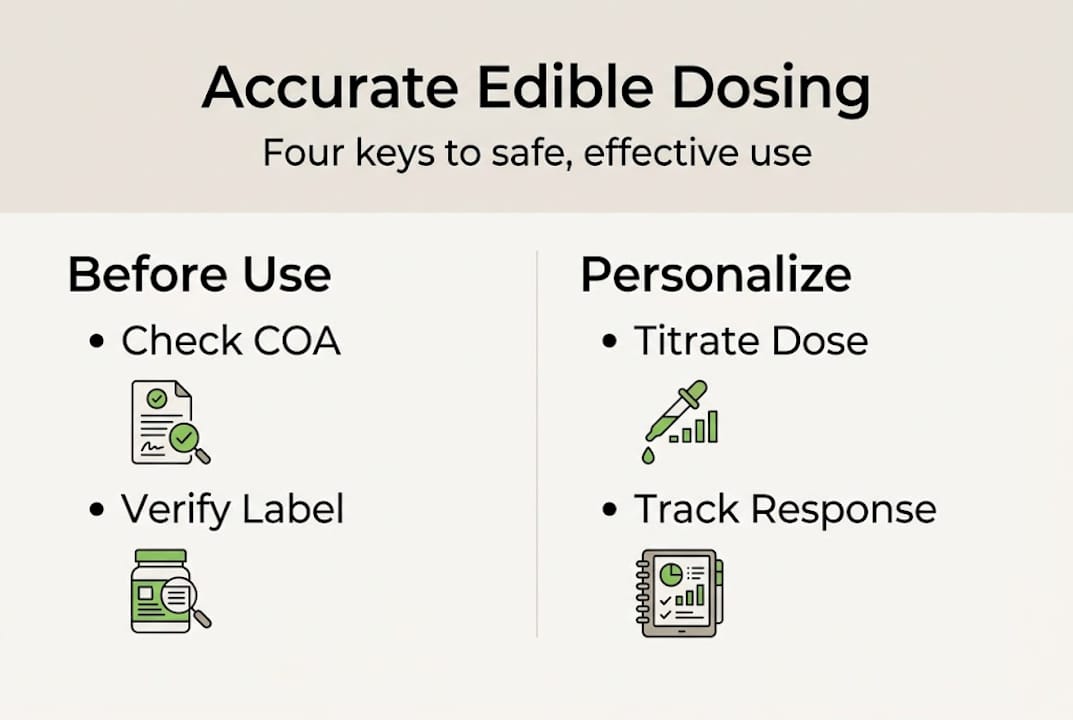
The ceiling effect is also worth noting here. Some consumers find that beyond a certain dose, adding more mg doesn’t add more desirable effects. It just adds side effects. That personal ceiling is your data and it’s just as important as finding your threshold.
We’ve seen this pattern consistently in the cannabis edible space. A well-informed consumer reads labels carefully, chooses a reputable brand and still ends up confused or overconsumption. The gap isn’t usually knowledge. It’s impatience combined with a false sense of certainty from a number on a package.
Most negative edible experiences come from redosing too soon because the first dose “didn’t kick in.” Two hours feels like forever when you’re waiting. But the importance of edible dosing patience is hard to overstate. The edible is working. Your body just needs time.
The other consistent failure point is skipping the COA entirely, even when it’s readily available. Many consumers assume a professional-looking package means a tested product. It doesn’t. We built our product philosophy around transparent lab-tested safety because we believe you deserve to know exactly what’s in every bite, not just what the wrapper promises.
The cannabis market is maturing fast. Consumers who treat edible evaluation as a science rather than a gamble will consistently get better results. You don’t need a chemistry degree. You just need a COA, a journal and a little patience.
At Edwin’s Edibles & Elixirs, we built our entire product line around transparency and verified quality. Every one of our hemp-derived Delta 9 THC and organic CBD products comes with a full cannabis edibles guide so you always know what you’re working with. Our team has developed resources to help you master optimizing edible use from your very first dose. Whether you’re new to edibles or refining a routine that already works, we make it easy to choose the right edible for your goals and biology. Every batch, tested. Every label, honest. That’s the Edwin’s Edibles & Elixirs promise.
Check for an available Certificate of Analysis from a licensed third-party lab. Label accuracy varies widely across product types, with many edibles over-labeled, making COA verification the most reliable way to confirm actual potency.
Start with a low dose, record your effects for at least four hours and increase only in small increments every 24 hours. Following a structured titration protocol prevents overconsumption and helps you identify your personal threshold accurately.
Yes. High-fat meals intensify and prolong THC edible effects because cannabinoids are fat-soluble and absorb more completely into your bloodstream when consumed alongside dietary fats.
Up to 20% of people cannot metabolize edibles efficiently due to differences in liver enzyme activity, resulting in weak or absent effects even at higher doses. If this applies to you, consult with a healthcare professional before significantly increasing your dose.