
Edible shelf life is the period during which cannabis-infused foods remain both safe to consume and potent enough to deliver their intended effects. This definition matters because two separate timelines govern every edible you buy: food spoilage driven by microbial growth and THC degradation driven by chemical oxidation. A gummy can still be microbiologically safe weeks after its THC has faded to almost nothing. Conversely, a baked good can lose potency slowly while mold renders it unsafe far sooner. Understanding both timelines is the foundation of smart edible storage and it’s exactly what we at Edwin’s Edibles & Elixirs want every customer to know before they open a package.
The format of a cannabis edible is the single biggest predictor of how long it stays fresh and effective. That comes down to a food science concept called water activity, abbreviated as aw. Water activity below 0.65 inhibits the bacteria and mold responsible for spoilage, which is why gummies outlast brownies by months. Baked goods trap moisture in their crumb structure, pushing their aw well above that threshold and creating a welcoming environment for microbial growth.
Here is how the most common edible formats compare on shelf life and storage needs:
| Edible type | Room temp shelf life | Refrigerated | Frozen | Key storage note |
|---|---|---|---|---|
| Gummies (commercial) | 6 to 12 months | Not required | Up to 6 months | Keep airtight; avoid humidity |
| Baked goods | 5 to 7 days | 2 to 3 weeks | 3 to 6 months | Wrap tightly; freeze for long storage |
| Chocolates | 6 to 12 months | Optional | Up to 6 months | Avoid temperature swings to prevent bloom |
| Homemade edibles | 2 to 4 weeks (refrigerated) | Recommended | 3 months | No preservatives; spoil faster |
Commercial gummies last 6 to 12 months because manufacturers use preservatives like citric acid and potassium sorbate to regulate microbial growth and control water activity precisely. Homemade edibles lack those additives entirely, cutting their usable life to 2 to 4 weeks refrigerated at best. That gap is not a minor difference. It is the reason we always recommend purchasing from brands with consistent manufacturing standards when potency and safety both matter to you.
Pro Tip: If you make homemade edibles with dairy or eggs, treat them like perishable food first and a cannabis product second. Refrigerate immediately and consume within one week for safety.
THC does not simply disappear with age. It converts. Oxidation transforms Delta 9 THC into CBN (cannabinol) or delta-8 THC, both of which are significantly less psychoactive than the original compound. Temperature above 77°F accelerates this conversion and light exposure compounds the damage by adding photodegradation on top of thermal stress. Industry experts confirm that ambient temperature control is the single most impactful factor in preserving edible potency over time.
The key environmental threats to your edibles, ranked by impact:
Food spoilage and potency loss are separate processes that do not warn you about each other. A chocolate bar stored in a warm drawer may smell and taste fine while delivering a fraction of its labeled dose. A baked good left out too long may still feel potent while carrying mold spores you cannot see. Food safety professionals emphasize that consumers must evaluate both dimensions independently rather than assuming one indicates the other.
Pro Tip: Sour or citric-acid-heavy gummies degrade faster than standard gummies even under identical storage conditions. If you love sour varieties, consume them within the first half of their labeled shelf life for the best potency.
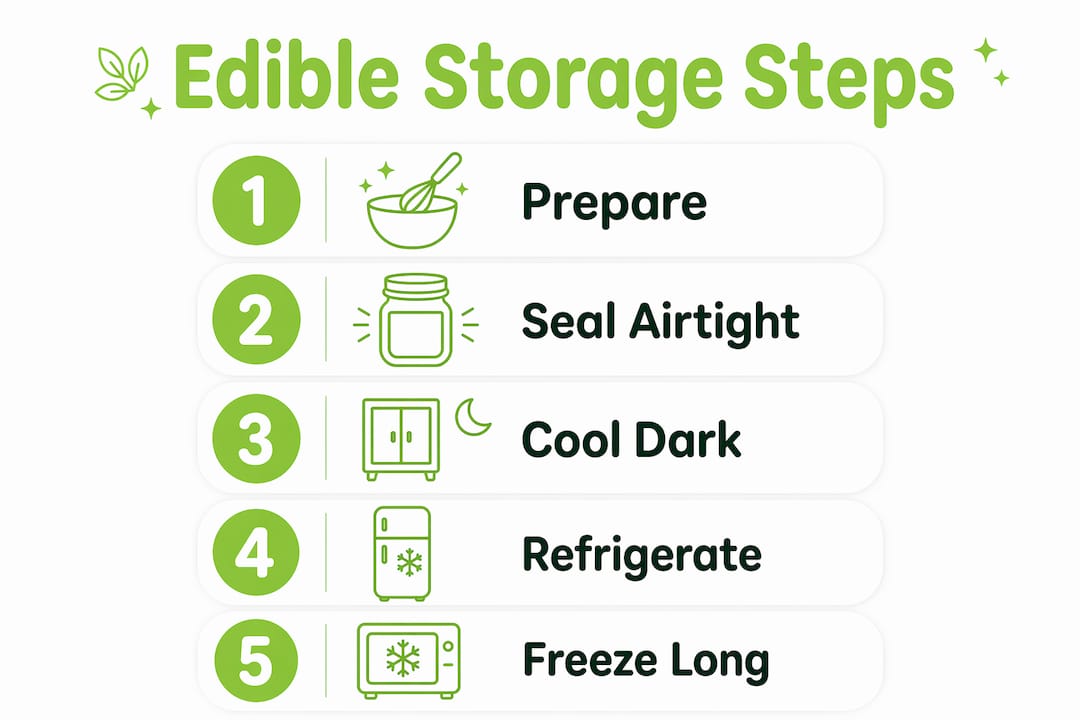
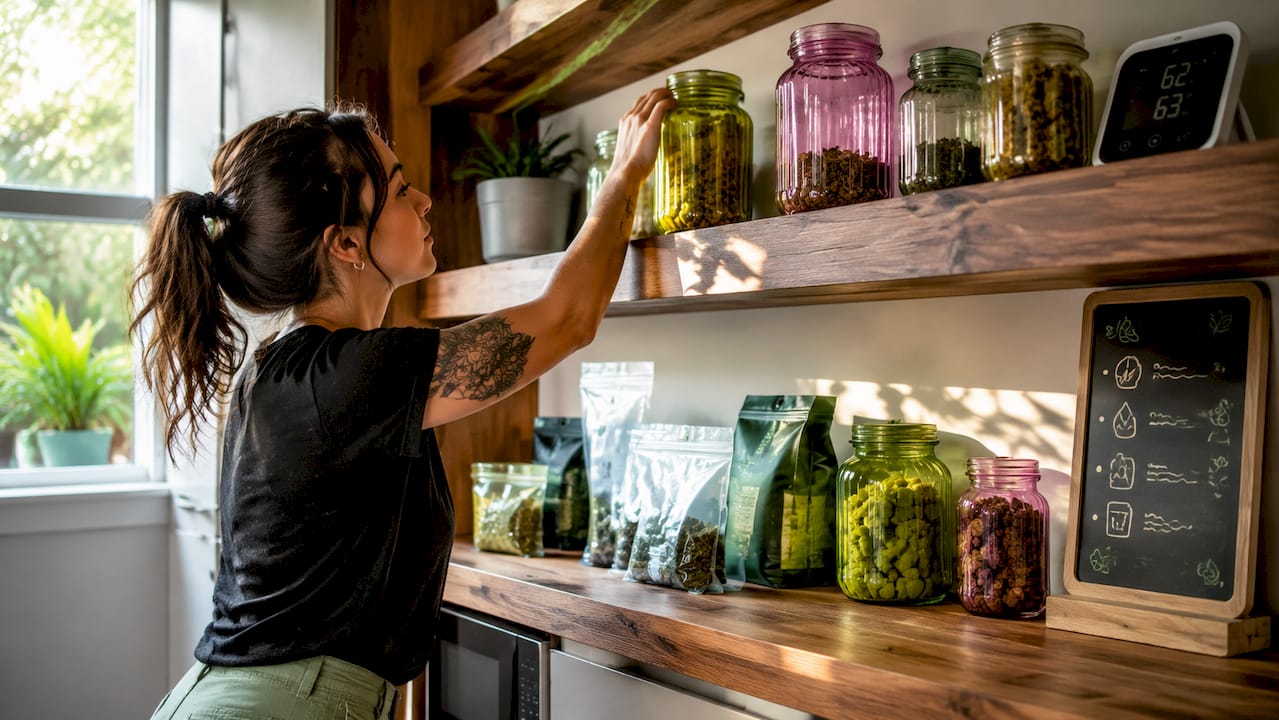
Good storage is not complicated, but it requires consistency. Airtight containers in cool, dark environments are the baseline recommendation for every edible format and that principle holds whether you are storing a $5 brownie or a premium Delta 9 THC gummy from Edwin’s Edibles & Elixirs. The goal is to limit oxygen exposure, block light and keep temperature stable.
Follow these steps to maximize the safe food consumption period for your edibles:
For gummies specifically, you can find deeper guidance on storing THC gummies to preserve cannabinoid potency through every season and storage environment.
Knowing when to discard an edible is as important as knowing how to store one. The labeling on your product gives you a starting point, but it does not tell the whole story.
Use-by dates indicate the safety limit for perishable products, meaning the manufacturer cannot guarantee microbial safety beyond that date. Best-before dates, by contrast, signal quality decline rather than a hard safety cutoff. For cannabis edibles containing dairy, eggs, or other perishables, the use-by date is the one that matters most. Treating a use-by date like a best-before date on a homemade brownie is a genuine health risk.
Beyond the label, your senses are reliable tools:
One thing to keep in mind: weakened effects alone do not mean the product is unsafe. And a product that still tastes fine does not mean it is still potent. Evaluate safety and potency as two separate questions every time.
Cannabis edible shelf life is governed by two independent processes, food spoilage and THC degradation and managing both requires format-specific storage habits applied consistently from the moment you open the package.
| Point | Details |
|---|---|
| Dual degradation timelines | Food spoilage and THC potency loss follow separate paths; never assume one indicates the other. |
| Format determines baseline shelf life | Gummies last 6 to 12 months; baked goods last 5 to 7 days at room temperature without refrigeration. |
| Temperature is the top priority | Keeping edibles below 77°F is the single most effective way to preserve THC potency over time. |
| Homemade edibles spoil faster | Without preservatives, homemade products last only 2 to 4 weeks refrigerated versus months for commercial products. |
| Use-by vs. best-before dates | Use-by dates signal a safety limit; best-before dates signal quality decline. Treat them differently. |
I have talked with a lot of cannabis consumers who treat their edibles like a bag of chips. They check the date, shrug if it has passed and eat it anyway because it looks fine. That habit works fine for shelf-stable snacks. It does not work for cannabis edibles, especially anything homemade with eggs, butter, or cream.
The part that surprises most people is the potency side of the equation. You can do everything right on food safety and still end up with a gummy that delivers half the experience you paid for, simply because it sat in a warm car for a few hours or was stored in a clear bag on a sunny shelf. THC is more fragile than most people realize. The chemistry is not forgiving.
What I have found actually works is treating edibles the way you would treat a quality supplement or a fine chocolate. You would not leave either in a hot glove compartment or a bathroom cabinet. The same logic applies here. Airtight, cool, dark and dated. That four-part habit protects both your safety and your investment.
The other misconception worth addressing is that freezing is always the answer. Freezing is excellent for long-term potency preservation, but the thawing process is where people go wrong. Pulling a frozen gummy out and leaving it on the counter creates condensation that can trigger mold growth within hours. Patience during thawing is not optional. It is part of the storage practice.
— Jamison
At Edwin’s Edibles & Elixirs, we craft every product with shelf life and potency in mind from the start. Our small-batch, hemp-derived Delta 9 THC gummies and organic CBD gummies are formulated with controlled water activity and quality ingredients that support a full 6 to 12 month shelf life when stored correctly. We also believe an informed customer is a happy customer, which is why our cannabis edibles guide covers everything from edible types and effects to dosing and storage in one place. Whether you are new to edibles or looking to get more from every product you buy, Edwin’s Edibles & Elixirs is your trusted source for quality, transparency and the kind of experience that lingers in your memory for all the right reasons.
Cannabis gummies typically last 6 to 12 months when stored in an airtight container in a cool, dark place. Commercial gummies with preservatives like citric acid and potassium sorbate maintain this range; homemade gummies without those additives last only 2 to 4 weeks refrigerated.
Yes. THC degrades through oxidation and heat exposure, converting into less psychoactive compounds like CBN. Temperatures above 77°F accelerate this process, meaning improper storage can reduce potency significantly before the food itself shows any signs of spoilage.
Best-before dates indicate when quality begins to decline, while use-by dates mark the limit of food safety. For cannabis edibles containing perishable ingredients like dairy or eggs, the use-by date is the critical one to follow.
Freezing preserves THC potency for up to 6 months and extends the safe food consumption period for baked goods to 3 to 6 months. Always thaw frozen edibles in the refrigerator rather than at room temperature to avoid condensation and mold risk.
Discard any edible showing visible mold, an off or rancid smell, significant texture changes, or an unusual taste. Weakened effects signal potency loss but not necessarily spoilage. Evaluate safety and potency as separate questions using both the label and your senses.