
Not every hemp edible on the shelf is as safe or legal as it looks. Many consumers assume that because hemp is federally recognized, any product derived from it is automatically fine to buy and enjoy. That assumption can lead to real health and legal consequences. Compliance with federal law, testing standards and labeling requirements is what separates a genuinely safe product from one that could expose you to harmful contaminants, unexpected psychoactive effects, or even legal risk. This guide breaks down exactly what compliance means, why it is changing fast and how you can use it as your most powerful shopping filter.
| Point | Details |
|---|---|
| Compliance is essential | Only compliant hemp edibles guarantee safety, legality and reliable effects for consumers. |
| 2026 law changes everything | Most current hemp edibles will be banned, making product verification even more important. |
| Testing protects you | Always look for third-party lab reports and COAs to confirm potency, purity and compliance. |
| Non-compliance is risky | Non-compliant edibles can cause health or legal problems due to unsafe ingredients or mislabeling. |
| Shop smart for the future | Use compliance as your filter to find legal and high-quality hemp edibles, especially after 2026. |
Compliance is not just a legal checkbox. For hemp edibles, it is the full set of rules a product must follow to be legally sold and safely consumed in the United States. It covers everything from how the hemp plant is grown to how the finished gummy or drink is labeled on the shelf.
At the federal level, the foundation is the 2018 Farm Bill overview. That law established the legal definition of hemp as cannabis containing no more than 0.3% delta-9 THC on a dry weight basis. Any product that exceeds that threshold is legally considered marijuana, regardless of how it is marketed.
Beyond THC limits, compliance also means following FDA guidelines. The FDA does not currently approve cannabinoids like CBD or Delta 9 THC as food additives and products that include them in edibles without proper authorization can receive warning letters and federal guidance from the agency. Non-compliance here is not a minor issue. It can result in product seizures, mandatory recalls and serious reputational damage for producers.
Here is what full compliance covers for hemp edibles:
“Compliance in hemp edibles ensures products meet the federal hemp definition under the 2018 Farm Bill and avoids FDA classification as unauthorized food additives, which can trigger enforcement action.”
State laws can add another layer. California, New York and several other states have their own testing and labeling requirements that go beyond federal minimums. When you buy from a compliant brand, you are getting a product that has cleared all of those hurdles, not just the easiest ones.
With compliance established, it is crucial to understand how quickly the ground is shifting under new federal rules. The legal landscape for hemp edibles is about to change more dramatically than at any point since 2018.

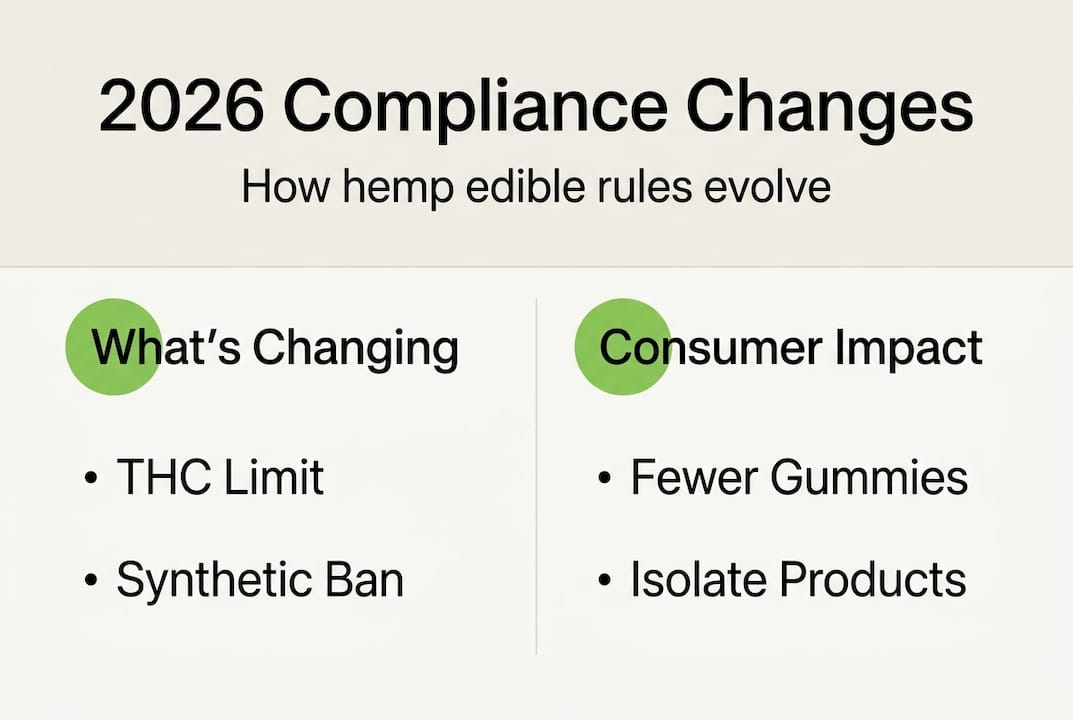
A Federal hemp redefinition 2026 signed into law in 2025 and taking effect in November 2026 rewrites the definition of hemp using a new total THC formula. Under the new rules, total THC includes delta-9 THC plus THCA multiplied by a conversion factor, along with other similar cannabinoids. For finished edible products, the limit drops to just 0.4mg total THC per container, not per serving.
To put that in perspective, most current hemp gummies contain between 2.5mg and 10mg of THC per piece. That means the overwhelming majority of products on the market today will not qualify as legal hemp edibles after November 2026.
| Product type | Typical THC per container | Compliant post-2026? |
|---|---|---|
| Standard Delta-9 gummy (5mg) | 5mg per piece | No |
| Full-spectrum CBD gummy | 2.5mg or more | Likely no |
| Isolate CBD gummy (no THC) | 0mg THC | Yes |
| Low-dose hemp edible (<0.4mg total) | <0.4mg total | Yes |
| Synthetic Delta-8 product | Varies | No (excluded entirely) |
Synthetic cannabinoids like Delta-8 THC are excluded from the new hemp definition entirely, regardless of potency. This is a significant shift for consumers who have relied on Delta-8 as a legal alternative.
Pro Tip: If you are stocking up on your favorite hemp edibles before the November 2026 deadline, check the hemp edibles law changes in 2026 to understand exactly which products will remain available and which will not.
For consumers, this means full-spectrum products will largely disappear from the legal market. Isolate-based products and those with very low total THC will be the primary compliant options. Reading labels carefully will matter more than ever.
With regulations tightening, let us see how compliance translates to protection where it matters most: your health. A compliant product is not just legal. It is verifiably safer because it has been tested, documented and held to measurable standards.
The cornerstone of safety compliance is third-party lab testing. Cannabis edibles lab testing by ISO-accredited laboratories checks for three critical categories:
Homogeneity is often overlooked but critically important. In New York, for example, regulations require that individual servings in a package fall within ±25% of the stated dose. Without this standard, one gummy in a bag could contain twice the THC of another, making safe dosing nearly impossible.
Every compliant batch should come with a Certificate of Analysis, or COA. Reading COAs for cannabis edibles is a skill worth developing. A COA shows the exact cannabinoid profile, contaminant results and the date of testing. If a brand cannot produce a current COA, that is a serious red flag.
| Testing category | What it checks | Why it matters |
|---|---|---|
| Potency | THC, CBD, total cannabinoids | Confirms legal limits and accurate dosing |
| Pesticides | Residual agricultural chemicals | Protects against toxic exposure |
| Heavy metals | Lead, arsenic, mercury, cadmium | Prevents long-term health damage |
| Microbials | Mold, bacteria, yeast | Ensures product is safe to consume |
| Homogeneity | Dose consistency per piece | Guarantees predictable effects |
Pro Tip: Always check the date on a COA. CBD product testing importance is ongoing and a COA that is more than 12 months old may not reflect the current batch you are buying.
The USDA requirements for hemp testing set the methodology for how total THC is calculated, using the formula THC + (THCA x 0.877). This ensures a consistent, science-based approach across all accredited labs.
Even with strong compliance practices, the FDA plays an outsized role in what is allowed on the market. The agency has been increasingly active in sending enforcement actions to hemp edible producers who step outside the lines.
The FDA’s primary tools are warning letters and import alerts. FDA warning letters and enforcement activity have been issued to dozens of companies between 2023 and 2025 for using Delta-8, Delta-9 THC, or CBD as food additives without authorization, making unproven health claims and marketing products that appeal to children.
“The FDA prioritizes enforcement actions based on safety risk, focusing on edibles with unapproved cannabinoids, misleading health claims and products accessible to children.”
For consumers, the risks of buying non-compliant products are very real. Here is what you could encounter:
Knowing how to spot red flags protects you. Check our compliance checklist for hemp edibles for a practical walkthrough and review the legal requirements for hemp edibles to understand exactly what the law demands from every product you buy.
Now that you know what is at stake, here is how to safeguard your health and stay compliant when buying and using hemp edibles. Practical knowledge is your best protection, especially with major changes arriving in November 2026.
When you are shopping today, use this checklist:
Post-November 2026, the market will look very different. Most current edibles will be reformulated or pulled from shelves. Isolate-based products with no detectable THC will be the safest bet for staying fully compliant. Full-spectrum products, which many consumers prefer for the entourage effect, will be extremely rare in legal form.
Pro Tip: Start getting started with hemp edibles using isolate products now so you are already familiar with compliant options before the 2026 transition hits the market hard.
If wellness is your goal, explore our organic hemp edibles guide and learn about the benefits of compliant edibles to make choices that serve your health long-term.
Here is an honest take: most consumers treat compliance like fine print. They assume if a product is on a store shelf or a reputable website, someone else already checked the boxes. That assumption is increasingly dangerous.
The market risk and scale of change is staggering. Roughly 95% of current hemp edibles will not meet the post-2026 federal standard. The hemp edibles market, valued between $11 billion and $28 billion, faces a near-total reset. The FDA has already sent warning letters to dozens of firms between 2023 and 2025. This is not a slow-moving regulatory trend. It is a fast-approaching wall.
What we believe, from everything we have seen in this industry, is that compliance is not red tape. It is the clearest signal that a brand respects both the law and the people consuming its products. After November 2026, the brands that invested in compliance will be the ones still standing and their customers will be the ones with safe, effective and legal products in hand.
Smart consumers use compliance as their top shopping filter, not an afterthought. Check our real-life legal hemp tips to build that habit before the market shifts beneath your feet.
At Edwin’s Edibles & Elixirs, we are proud to craft small-batch, hemp-derived products that meet the highest compliance and quality standards available today. Every product we make is third-party tested, clearly labeled and built with your safety in mind. Whether you are new to hemp edibles or preparing for the 2026 legal shift, we have the resources and products to guide you. Explore our complete guide to cannabis edibles, get expert advice on choosing compliant cannabis edibles and learn about Delta 9 and compliance so you are always one step ahead.
A compliant edible meets the federal hemp definition of no more than 0.3% delta-9 THC on a dry weight basis, is tested by an accredited lab and contains no unauthorized additives or misleading health claims.
After November 2026, the new federal standard limits finished edibles to 0.4mg total THC per container, which means most current Delta-9 and full-spectrum CBD edibles will no longer qualify as legal hemp products.
Request a current COA from a third-party ISO-accredited lab and confirm that THC levels, contaminant results and homogeneity data all meet federal standards for the batch you are purchasing.
Non-compliant products can contain excess THC, harmful pesticides or metals, or inaccurate labels and the FDA actively enforces against producers who put unsafe or mislabeled products on the market.
Yes, but high-potency options will be rare. Compliant edibles may deliver less THC per serving, yet properly tested isolate products can still deliver meaningful CBD wellness benefits when labeled and dosed accurately.