
Walk into any wellness store or scroll through any health-focused website and you’ll find shelves and pages packed with “hemp oil,” “CBD oil,” “hemp seed oil,” and “full-spectrum extract.” Most people use these terms interchangeably and that’s where the confusion starts. Full-plant hemp extract is genuinely different from the rest and that difference has real consequences for how it works in your body. Recent clinical research shows full-spectrum extract significantly reduced chronic low back pain versus placebo, with open-label studies reporting pain, anxiety and insomnia relief in more than 50% of participants. This guide breaks down exactly what full-plant hemp extract is, how it works and how to use it wisely.
| Point | Details |
|---|---|
| Whole-plant synergy | Full-plant hemp extract combines cannabinoids and terpenes for enhanced effects compared to isolates. |
| Science supports benefits | Recent clinical research backs its use for pain, sleep and overall wellness. |
| Check labels and COAs | Always look for third-party lab results to ensure safety and potency. |
| Legal but varies | Full-plant hemp extract is federally legal if under 0.3% THC but check your local laws first. |
| Personal response matters | Start low, go slow and track your results—everyone responds differently. |
Not all hemp products are created equal. This is one of the most important things we want you to walk away understanding. The label on a product can be misleading and knowing the difference between extract types puts you firmly in control of your wellness choices.
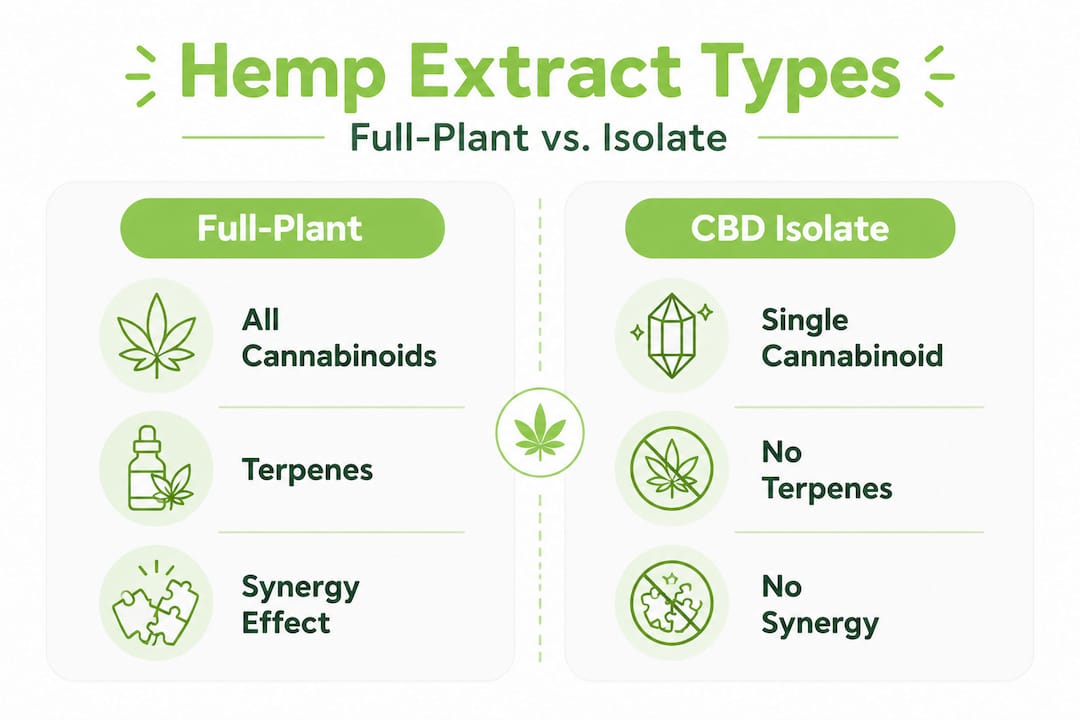
Full-plant hemp extract, sometimes called full-spectrum hemp extract, uses the entire hemp plant to capture all of its naturally occurring compounds. That means cannabinoids (like CBD, CBG, CBN and trace amounts of Delta 9 THC), terpenes (the aromatic compounds that give plants their scent and contribute to their effects) and flavonoids (plant pigments with antioxidant properties). Nothing is stripped away. The goal is to preserve the plant’s natural complexity.
Compare that to the other major product categories you’ll encounter:
| Product type | Contains cannabinoids? | Contains terpenes? | Contains THC? | Notes |
|---|---|---|---|---|
| Full-plant (full-spectrum) extract | Yes | Yes | Trace amounts (<0.3%) | Most complete plant profile |
| Broad-spectrum extract | Yes | Yes | No (removed) | Good middle-ground option |
| CBD isolate | CBD only | No | No | Purest single compound |
| Hemp seed oil | No | No | No | Nutritional product only |
That last row is critical. Hemp seed oil contains no cannabinoids and is simply a cooking or skincare oil pressed from hemp seeds. It’s nutritious, but it will not produce any of the wellness effects associated with hemp extract. Many brands blur this line intentionally, so reading labels carefully matters enormously.
Common misconceptions worth clearing up right now:
Our hemp terminology guide goes even deeper on these distinctions if you want a complete reference. Understanding the vocabulary is your first line of defense against misleading marketing.
With the basics clarified, let’s look at how full-plant hemp extract interacts with your body to bring about its reported effects.

Your body has a built-in system called the endocannabinoid system (ECS). It’s a network of receptors, enzymes and naturally produced compounds that help regulate mood, sleep, pain perception, appetite and immune response. Cannabinoids from hemp interact with this system, primarily through CB1 and CB2 receptors found throughout your brain and body.
Here’s where full-plant extract gets genuinely interesting. When you consume a CBD isolate, you’re delivering one compound to your ECS. When you consume full-plant hemp extract, you’re delivering dozens of compounds simultaneously and they work together in a way that researchers call the entourage effect. The idea is that cannabinoids, terpenes and flavonoids amplify and modulate each other’s effects, producing a result that’s greater than any single compound could achieve alone.
Think of it like a symphony. A single violin can be beautiful. But an entire orchestra, with each instrument playing its part, creates something richer and more complete. Full-plant hemp extract is the orchestra.
Here’s a quick look at how some key compounds contribute to the overall experience:
| Compound | Type | Reported effect |
|---|---|---|
| CBD | Cannabinoid | Calm, reduced anxiety, anti-inflammatory |
| CBG | Cannabinoid | Focus, mood support |
| CBN | Cannabinoid | Relaxation, sleep support |
| Myrcene | Terpene | Sedating, muscle ease |
| Limonene | Terpene | Uplifting, mood elevation |
| Linalool | Terpene | Calming, stress relief |
| Beta-caryophyllene | Terpene | Anti-inflammatory, pain modulation |
“The entourage effect represents one of the most compelling arguments for whole-plant formulations. Individual compounds interact in ways that are difficult to predict or replicate with isolates alone.”
Understanding terpene effects and types can genuinely help you choose a product profile that matches your specific goals, whether that’s winding down after a long day or finding a calm focus during a busy afternoon.
Pro Tip: If you’re new to full-plant hemp extract, pay attention to the terpene profile listed on a product’s lab report. A product rich in myrcene and linalool will lean more sedating, while one high in limonene may feel more energizing. Matching the terpene profile to your intention makes a real difference.
It’s worth noting that individual responses vary significantly and more randomized controlled trials are still needed to fully map how different plant profiles affect different people. The science is growing fast, but personalization remains essential.
Understanding the science helps clarify expectations. Here’s what the most recent studies reveal.
The evidence base for full-plant hemp extract has expanded considerably in recent years. We’re no longer in the era of anecdote-only conversations. Rigorous clinical research is catching up to what many users have reported for years.
Here are the most significant findings, ranked by strength of evidence:
A note on realistic expectations. Clinical studies are growing, but the field is still young. Results vary between individuals based on body chemistry, metabolism, dosing and product quality. Full-plant hemp extract is not a cure for any condition. It’s a wellness tool and like any tool, its effectiveness depends on how you use it and whether you’re using a quality product.
Explore our guide on hemp edibles for wellness to see how edible formats specifically can support your routine in ways that other delivery methods may not.
Armed with the evidence, it’s essential to know how to choose and use a quality full-plant extract safely and effectively.
The market is crowded and not every product lives up to its label. Here’s how to navigate it with confidence.
What to look for in a quality product:
Safety and legal considerations:
Full-plant hemp extract is non-intoxicating at under 0.3% THC and is federally legal under the 2018 Farm Bill. However, state regulations vary, so it’s worth checking your local laws before purchasing. Mild side effects like dry mouth or slight drowsiness are possible, especially at higher doses, but the compound is generally very well tolerated.
Smart dosing strategies:
Pro Tip: If you’re using full-plant hemp extract for sleep, take it 60 to 90 minutes before bed rather than right at bedtime. The onset window for edibles, in particular, means you want it active in your system when you’re ready to wind down.
Red flags to watch for:
Our CBD wellness benefits resource and hemp extract guide are great next steps for building your product knowledge before you buy.
Here’s what most guides won’t tell you: the biggest barrier to getting results from full-plant hemp extract isn’t the science. It’s unrealistic expectations combined with poor product choices.
We see it constantly. Someone tries a low-quality product once, feels nothing and concludes that hemp extract “doesn’t work.” What they actually experienced was a poorly made product with inaccurate labeling, not a failure of the plant itself. The extract is only as good as the plant it came from, the process used to make it and the accuracy of what’s on the label.
The second most common mistake is expecting uniform, immediate results. Full-plant hemp extract doesn’t work like an over-the-counter painkiller. It works with your endocannabinoid system over time. Some people feel a noticeable difference after the first use. Others need two to three weeks of consistent use before they notice anything meaningful. Both experiences are completely normal, because individual responses vary significantly based on genetics, metabolism and existing ECS tone.
We also think people undervalue the role of plant profile in shaping their experience. Choosing a full-plant extract with no attention to terpene or cannabinoid ratios is like ordering “food” at a restaurant without looking at the menu. The details matter. An indica-leaning profile rich in myrcene will feel very different from a sativa-leaning profile high in limonene, even if both products are labeled “full-spectrum CBD.”
Our honest take: approach full-plant hemp extract as a personal experiment. Start low, track your response and be willing to try different profiles and formats before drawing conclusions. The science is genuinely exciting and the potential is real. But getting there requires patience and quality products. Learn more about hemp-derived THC legal insights to make sure you’re starting from a fully informed place.
Ready to try or learn more? Here’s how to confidently take the next step with trusted sources.
At Edwin’s Edibles & Elixirs, we’ve built everything around one core belief: you deserve products that are honest, high-quality and actually do what they say. Our small-batch, organic hemp edibles and infused beverages are crafted with full transparency, third-party lab testing and our proprietary TiME INFUSION® technology for fast-acting effects that you can actually feel. Whether you’re exploring hemp for the first time or looking to refine your routine, our cannabis edibles guide is a great place to start. Browse our curated selection of best hemp-based edibles or follow our step-by-step resource to start with hemp edibles with confidence. We’re here to make your experience delightful, informed and worth remembering.
Full-plant extract contains the complete range of cannabinoids, terpenes and flavonoids from the hemp plant, while CBD isolate is pure CBD with everything else removed and hemp seed oil contains no cannabinoids at all. They serve very different purposes, so the label matters enormously.
It is federally legal under the Farm Bill as long as it contains less than 0.3% THC, but individual state regulations can differ, so checking your local laws before purchasing is always a smart move.
No. Products that comply with the federal THC limit of under 0.3% are non-intoxicating, meaning you will not experience a high from a properly formulated full-plant hemp extract.
Look for explicit “full-spectrum” labeling, a third-party Certificate of Analysis that breaks down individual cannabinoids and terpenes and a brand that makes those lab results easy to access. If the COA is missing or vague, treat that as a serious red flag.
Mild side effects such as dry mouth, mild drowsiness, or slight changes in appetite can occur, particularly at higher doses, but full-plant hemp extract is generally very well tolerated by most people.