
Most people assume that anything from the cannabis plant will get you high. That assumption is wrong and it’s keeping a lot of health-conscious adults from experiencing real wellness benefits. Hemp-derived CBD supports mood, sleep and pain regulation without any psychoactive effects. The plant is legal in most of the United States, widely accessible and backed by a growing body of clinical research. In this guide, we walk you through how hemp works, what the science actually says, how to use it safely and where the hype ends and the real results begin.
| Point | Details |
|---|---|
| Hemp is non-intoxicating | Hemp products provide wellness benefits without the psychoactive effects of marijuana. |
| Science supports targeted benefits | Best evidence for hemp is found in anxiety, some pain and sleep, but not all wellness claims. |
| Safety and quality are critical | Always use products with third-party lab testing and follow safe dosage guidelines. |
| Regulatory gaps exist | Not all hemp products are equal—look for legal, compliant and well-tested options. |
Hemp and marijuana both come from the Cannabis sativa plant, but they are not the same thing. The critical difference is THC content. Hemp contains less than 0.3% THC, the compound responsible for the classic cannabis “high.” That tiny amount is not enough to impair your thinking, alter your motor skills, or produce any intoxicating effect. Marijuana, by contrast, typically carries 10% to 30% THC. This is not a minor distinction. It changes everything about how the plant behaves in your body and how it fits into your daily life.
Federally, hemp is protected under the 2018 Farm Bill, which removed it from the Controlled Substances Act. That legislation opened the door for hemp-based products to be grown, processed and sold commercially across most of the country. As CBD from hemp is federally legal and non-impairing, it has become one of the most sought-after natural wellness ingredients in the market today. Understanding hemp compliance explained helps you navigate what products are actually legal where you live.
| Feature | Hemp | Marijuana |
|---|---|---|
| THC content | Less than 0.3% | 10% to 30% |
| Legal status (federal) | Legal | Controlled substance |
| Psychoactive effect | None | Yes |
| Primary wellness compound | CBD | THC or CBD |
| Availability | Widely available | State-restricted |
Wellness users are drawn to hemp for several clear reasons:
The legal status of hemp edibles is also shifting positively, with more states clarifying their frameworks. This makes hemp one of the most practical, accessible wellness tools available right now.
Once you understand why hemp is favored for wellness, the next question is obvious: what does it actually do inside your body? The answer involves a system most people have never heard of.
Your body contains the endocannabinoid system (ECS), a network of receptors spread across the brain, immune system and nervous system. The ECS helps regulate mood, pain perception, inflammation and sleep cycles. CBD from hemp interacts with this system, but not in the same way THC does. It does not bind directly to the main receptors. Instead, it modulates how those receptors respond, supporting balance without producing a high.
Research shows that CBD interacts with ECS receptors, serotonin pathways, ion channels and liver enzymes known as CYP450. This wide range of biological targets is why hemp can address so many different wellness needs at once.
Main biological mechanisms of CBD:
| Health condition | Evidence level | Notes |
|---|---|---|
| Seizure disorders | Strong | FDA-approved medication (Epidiolex) |
| Anxiety | Moderate to strong | 70% of studies show improvement |
| Sleep disruption | Moderate | Most useful at higher doses |
| Chronic pain | Mixed | Stronger for nerve-related pain |
| General inflammation | Preliminary | Promising but needs more trials |
“CBD activates multiple biological pathways simultaneously, making it a versatile but complex wellness compound that rewards careful, informed use.”
Pro Tip: When shopping, look for “full-spectrum” on the label if you want the full range of hemp’s natural compounds working together. “Isolate” products contain only CBD. Both have value, but they work differently. Explore hemp CBD wellness benefits to understand which format fits your goals.
For a broader view of how hemp fits into your overall cannabis wellness choices, start with the science and let the evidence guide your decisions.
With a clearer view of the science, now let’s explore the practical ways hemp helps and where its claims have limits.
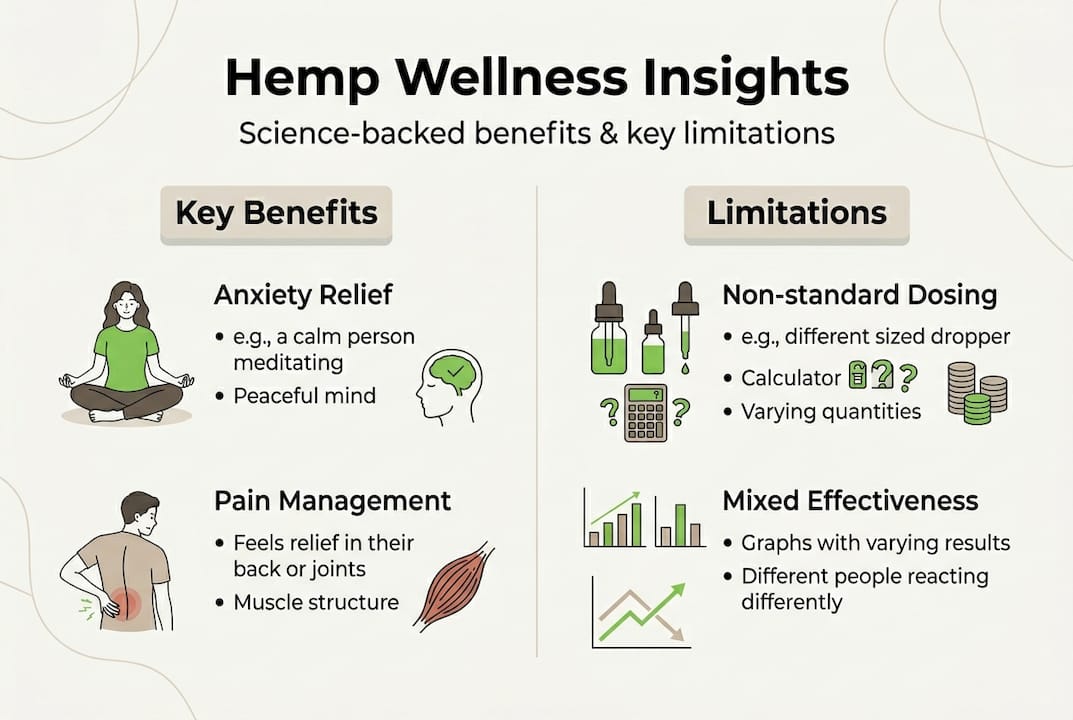
Anxiety relief is where hemp CBD shines brightest. Multiple high-quality clinical reviews confirm that CBD reduces anxiety symptoms across a range of conditions, including generalized anxiety, social anxiety and PTSD. The anxiety evidence for CBD is more consistent than almost any other health claim attached to the plant.

Pain relief is more nuanced. CBD and THC combinations show meaningful improvement for chemotherapy-induced nerve pain (CIPN) and full-spectrum cannabis extracts reduce certain types of chronic pain. But general aches and minor soreness? Results are mixed. Hemp is not a reliable replacement for targeted pain medication in those cases.
Sleep and nausea have some clinical support as well. CBD appears most useful for sleep when anxiety or pain is the root cause of disruption. For nausea, particularly in clinical settings, the evidence is more consistent. If you’re curious how it compares to conventional options, our guide on CBD vs melatonin for sleep breaks that down clearly.
Here is how the evidence stacks up by category:
The limitations are real and worth taking seriously. Not every user sees results. Dosing is not yet standardized. And the wellness industry has a bad habit of making claims that go far beyond what the research supports. Before choosing hemp-derived edibles, it helps to know whether the condition you’re targeting has strong scientific backing. You can also compare Delta 9 vs CBD differences if you’re weighing both options.
Pro Tip: Prioritize products backed by clinical trials and transparent labeling. If a product promises to cure everything, trust nothing on the label.
Understanding what hemp can do is only part of the picture. Knowing how to use it safely matters just as much.
Current scientific guidance recommends a provisional upper intake of 10mg CBD per day for adults, or approximately 0.15 mg/kg of body weight. This figure reflects caution around liver health and long-term effects. Going higher without medical supervision is not advised, especially if you take other medications. The safe upper intake of 10mg CBD daily was established to reduce risks of liver stress, hormonal disruption and unwanted drug interactions.
Known risks to take seriously:
Product quality is another serious concern. Many hemp products are contaminated, mislabeled, or contain far less CBD than advertised. Regulatory oversight is still catching up to the market.
Steps to ensure safe, effective hemp use:
Pro Tip: Always consult your doctor before adding hemp if you are on medication or pregnant. This is not optional guidance. The cannabis wellness risks are real and manageable, but only when you approach them informed.
For deeper detail on what to look for before you buy, our guide on CBD wellness benefits covers ingredient standards and what actually matters in a quality product.
We have read a lot of hemp wellness content and here is the honest truth: most of it either oversells the benefits or dismisses them too quickly. Neither extreme serves you.
The real picture is more interesting. Hemp works well for certain people with certain conditions, particularly anxiety, sleep tied to stress and nerve-related pain. But it is not a universal fix and the market is flooded with products that would not survive rigorous scrutiny. More randomized controlled trials are needed and researchers are clear that third-party tested, full-spectrum hemp with under 0.3% THC offers the best foundation for wellness outcomes.
The “entourage effect” is real, meaning the natural combination of cannabinoids, terpenes and plant compounds in full-spectrum hemp works better together than any single compound alone. But that only holds true for products that are actually full-spectrum and actually clean.
Our advice? Ignore the miracle claims. Focus on brands that publish batch lab results, list their ingredient sources and do not make promises the science cannot back. Choosing hemp-derived edibles from transparent producers is the single highest-impact decision you can make for your hemp wellness experience.
Pro Tip: Look for brands that publish batch lab results and ingredient sourcing. Transparency is the clearest signal of a brand that actually cares about your wellness.
Now that you know exactly what to look for in a hemp wellness product, the next step is finding one you can actually trust. At Edwin’s Edibles & Elixirs, we craft small-batch, organic hemp products built on transparency, quality and real results. Our organic CBD gummies are made with clean, certified organic ingredients and backed by third-party lab testing on every batch. If you are new to hemp edibles, our edibles explained guide walks you through everything from formats to effects. And when you are ready to make the most of your experience, our edible consumption tips cover dosing, timing and everything in between. We believe great wellness starts with great ingredients.
Yes, hemp-derived CBD with less than 0.3% THC is federally legal under the 2018 Farm Bill, but individual state laws may add restrictions, so always verify local rules before purchasing.
Scientific guidance sets a provisional safe intake of no more than 10mg CBD per day for adults (0.15 mg/kg body weight), which helps protect against liver and hormonal side effects.
Evidence is strongest for anxiety relief, where CBD improves outcomes in a majority of high-quality studies, while pain relief evidence is more mixed and varies significantly by condition.
Yes, known hemp product risks include potential liver enzyme elevation, drug interactions, drowsiness and real concerns about mislabeled or contaminated products on the market.
Always choose brands that provide third-party lab-tested results and publish full ingredient sourcing, as transparency is the most reliable indicator of product safety and efficacy.