
Most people assume cannabis edibles work on a simple dial: more THC equals more high, more CBD equals more calm. That assumption misses nearly everything happening inside your body. Cannabinoids interact through multiple receptor systems, competing pathways and deeply personal metabolic variables that make each experience genuinely unique. Whether you reach for an organic CBD gummy for evening wind-down or a fast-acting Delta 9 THC edible for weekend recreation, understanding what’s actually happening at the cellular level helps you make smarter choices, set realistic expectations and get the results you’re truly after.
| Point | Details |
|---|---|
| CB1 and CB2 basics | Cannabinoids interact with CB1 and CB2 receptors, which shape mood, stress and relaxation effects. |
| Beyond the endocannabinoid system | Cannabinoids influence neurotransmitters and even drug metabolism by acting beyond CB1/CB2 receptors. |
| Pharmacokinetics matter | Edible effects depend on absorption, metabolism, food and formulation—not just labeled dosage. |
| Synergy is nuanced | The ‘entourage effect’ is often overstated; multi-cannabinoid and terpene interactions are more complex than popular myths suggest. |
| Personal factors rule | Individual factors like metabolism, food and medications can dramatically alter your edible experience. |
The starting point for any honest conversation about edibles is the endocannabinoid system, or ECS. This network of receptors, enzymes and signaling molecules exists throughout your brain, organs, immune tissue and nervous system. Its job is to maintain balance, regulating everything from pain perception and mood to appetite and sleep. Your body actually produces its own cannabinoids naturally, called endocannabinoids and the plant-derived cannabinoids in edibles essentially borrow the same pathways.
Two receptor types sit at the center of this system: CB1 and CB2.
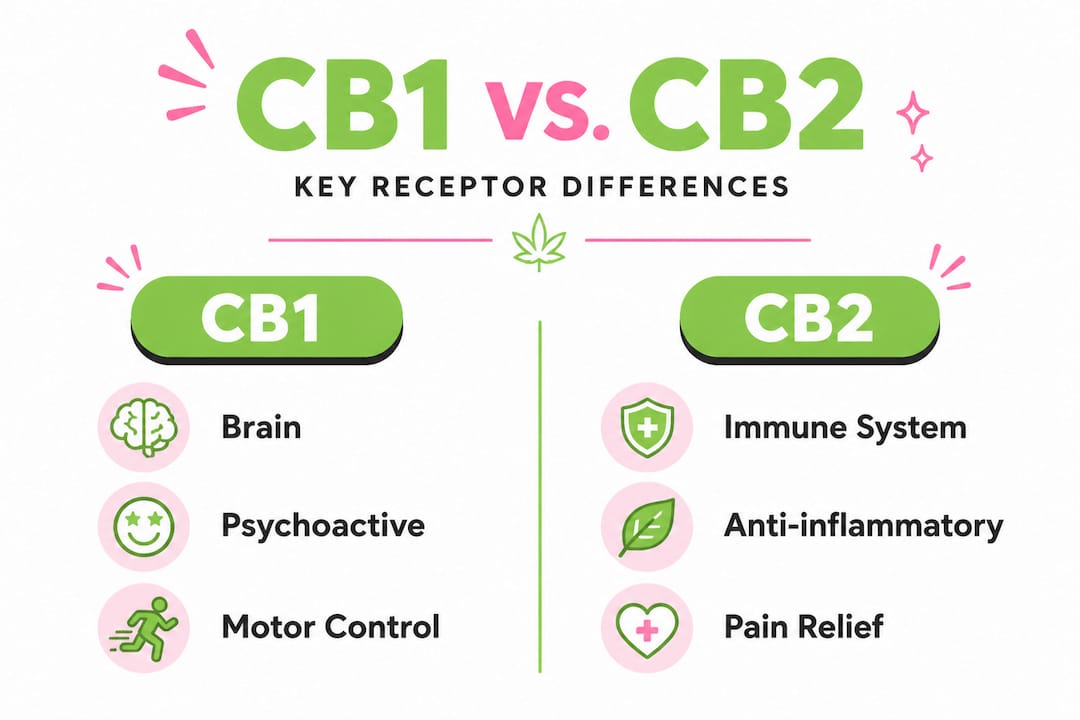
| Receptor | Primary location | Key functions |
|---|---|---|
| CB1 | Brain, central nervous system | Mood, memory, appetite, sensation, psychoactive effects |
| CB2 | Immune cells, peripheral tissue | Inflammation, immune regulation, pain modulation |
Endocannabinoids regulate physiology by binding CB1 and CB2 and activating Gi/o signaling, which sets off a cascade of downstream cellular events. This is not a single switch being flipped. It is a complex ripple effect across entire signaling networks.
THC binds directly to CB1 receptors and partially to CB2, which is why it produces psychoactive effects alongside physical relaxation. CBD behaves very differently. It has low direct affinity for CB1 and CB2, yet it still produces meaningful effects because it acts through additional targets. CB1 receptors function as presynaptic retrograde regulators of neurotransmitter release, meaning they work backward across the synapse, fine-tuning signals before they fire. This retrograde action directly shapes mood, stress response and physical sensation.
CBD’s additional receptor targets include:
CBD interacts with TRPV1 and serotonin receptors alongside its indirect ECS activity, which explains why CBD’s effects on anxiety and discomfort can’t be reduced to a simple CB1/CB2 story. For a deeper look at how these two cannabinoids compare, our guide on CBD vs THC differences breaks it down in practical terms.
Understanding these distinctions is genuinely powerful. When you know CBD is hitting serotonin receptors, it stops being mysterious why a well-dosed CBD gummy can ease a stressful evening without producing any psychoactive effect.
Understanding receptor binding is one piece. Now let’s unravel how cannabinoids ripple through other bodily systems and practical consequences you need to know.
One of the most fascinating and underappreciated mechanisms is retrograde signaling. When CB1 receptors activate, they don’t just passively receive signals. They send messages backward across synapses, effectively telling the presynaptic neuron to slow down or speed up its activity. CB1 affects the release of GABA, glutamate, acetylcholine, serotonin and noradrenaline. This means a single cannabinoid can simultaneously alter arousal, anxiety, muscle tension and cognitive clarity depending on where in the brain or body that signaling occurs.
Here is how THC and CBD compare in their neurotransmitter influence:
| Effect | THC | CBD |
|---|---|---|
| GABA modulation | Indirect via CB1 | Indirect via multiple targets |
| Serotonin activity | Indirect, minor | Direct 5-HT1A agonism |
| Dopamine release | Increases in reward pathways | May buffer excessive release |
| Glutamate suppression | Yes, via CB1 | Partial, via multiple systems |
| Anxiety at high dose | Can increase | Generally reduces |
There is another layer that many edible users overlook entirely: drug metabolism. Cannabinoids interact with the CYP450 enzyme family, the liver’s primary toolkit for breaking down medications. THC and its metabolites can act as inhibitors of several P450 isoforms, which means they may slow down or speed up how your body processes other substances. If you take blood thinners, antidepressants, or even common over-the-counter medications, cannabinoid edibles could shift those drug levels in meaningful ways.
Worth knowing: The interaction between cannabinoids and CYP450 enzymes is not hypothetical. It is the same reason grapefruit juice carries medication warnings. Cannabinoids can behave similarly. Always review your medication list before adding edibles to your wellness routine.
Key practical considerations include:
For a side-by-side comparison of how CBD and THC edibles differ in these real-world effects, our article on CBD vs THC edibles differences offers clear, actionable guidance.
Pro Tip: Before starting any new edible routine, especially with CBD at meaningful doses, review your current medications with a pharmacist or physician. This isn’t overcaution. It’s smart wellness.
Once you grasp the broad range of cannabinoid targets, it becomes clear why the route and formulation of edibles matter just as much as the dose printed on the label.

When you eat a cannabinoid edible, it doesn’t go straight into your bloodstream. It travels through your digestive tract, gets absorbed in the small intestine and passes through the liver before reaching systemic circulation. This is called first-pass metabolism and it is why edibles behave so differently from inhalation. The liver converts a portion of Delta 9 THC into 11-hydroxy-THC, a metabolite that crosses the blood-brain barrier more efficiently and often produces stronger, longer-lasting effects.
CBD terminal elimination half-life exceeds 134 hours in many users, oral bioavailability is highly variable and nonmonotonic and both food intake and delivery route substantially alter exposure and onset. “Nonmonotonic” here means a higher dose doesn’t always produce a proportionally higher effect. This is one of the most important and poorly understood facts in edible pharmacology.
Several factors shape your actual experience:
Understanding edible THC absorption is genuinely the foundation of having a consistently good experience. Many users who report “edibles don’t work for me” are simply experiencing poor bioavailability due to formulation or timing issues, not a genuine non-response. And for those maximizing edible effects, timing your dose around a light, balanced meal (rather than a completely empty or very full stomach) often produces the most predictable results.
If you want a practical framework for reading your own experience, our guide on how to identify edible effects walks through what to expect at different dose ranges and timeframes.
All of this leads us to the central concept that shapes most marketing in the edibles world: the entourage effect. Let’s separate the compelling idea from the actual evidence.
The entourage effect is the theory that cannabinoids, terpenes and other plant compounds work together synergistically, producing effects greater than any individual compound alone. It’s a beautiful idea and it’s shaped enormous consumer preference for full-spectrum and whole-plant products. But the science is more complicated than the marketing suggests.
The “entourage effect” is oversimplified. In receptor signaling experiments, terpene-cannabinoid synergy is not strongly or consistently supported. Some terpenes do interact with receptor systems, but the evidence that they meaningfully amplify cannabinoid effects in the doses present in most edibles is weak. Many of the most-cited studies used concentrations far higher than what you’d encounter in any real product.
What is real and genuinely supported by research:
“CBD’s actions involve multiple receptor systems and modes,” note researchers examining CBD’s complex receptor activity, making real synergy more nuanced than a simple “more plant = better results” story.
The practical takeaway for edible users: choose products based on their actual cannabinoid content, dosing transparency and formulation quality rather than primarily on “full spectrum” labeling alone. To see how this plays out in real-world use, our piece on edibles vs smoking effects covers how delivery method shapes the synergy you actually experience.
Here’s the perspective we hold firmly at Edwin’s Edibles & Elixirs and it’s grounded in both the research and thousands of conversations with real customers: the label is the starting point, not the answer.
Most articles focus on the science of cannabinoid receptors and leave you with the implicit impression that if you understand the mechanisms, you can predict your experience. But no two people share identical ECS receptor density, metabolic enzyme expression, gut microbiome, or baseline endocannabinoid tone. These differences are biological and they are significant.
Dose on the label alone doesn’t predict onset or intensity. Formulation and deeply personal factors, including what you ate, your current stress load, your medications and your recent cannabinoid history, all play meaningful roles. Consider two people taking the same 10mg Delta 9 THC gummy from the same batch. One person, who ate a fatty lunch, feels full effects within 45 minutes. Another, who ate nothing and takes a common antidepressant, may feel a delayed and altered experience entirely.
Fast-acting formulations genuinely close this gap. Technology like TiME INFUSION® narrows the variability by improving absorption consistency, but even these innovations can’t override the full range of individual metabolic factors. They improve predictability. They don’t eliminate biology.
Our honest guidance, refined over years of product development:
The most informed edible users we know treat their experience like a personal experiment, iterating thoughtfully rather than chasing the highest dose or the most buzzword-heavy product. That mindset, combined with genuinely clean and well-formulated products, produces the kind of wellness experiences that actually linger in memory for the right reasons.
If today’s deep dive has sparked your curiosity, we’d love to help you take the next step with confidence. At Edwin’s Edibles & Elixirs, we’ve built our entire product line around transparency, organic ingredients and formulations that deliver on their promise. Start with our edibles explained guide for a clear overview of what to look for in a quality edible. When you’re ready to refine your routine, our edible consumption guide walks through practical dosing strategies for both wellness and recreation. And if you’re drawn to the calming, therapeutic side of cannabinoids, our carefully crafted organic CBD gummies are a delightful place to begin.
THC binds directly to CB1 and CB2 receptors to produce psychoactive and physical effects, while CBD interacts with multiple targets beyond CB1 and CB2, including serotonin receptors, potentially modulating THC’s intensity and character through indirect pathways.
Yes, they can. Cannabinoids modulate CYP450 enzymes that are central to drug metabolism, which means regular edible use could alter how your body processes certain prescription or over-the-counter drugs, sometimes significantly.
Onset depends on absorption rate, first-pass liver metabolism, what you’ve eaten and the edible’s specific formulation. CBD’s oral bioavailability and food intake alter exposure substantially and a long terminal half-life means effects can persist well beyond what most users expect.
It’s real in concept but often overstated in practice. Some cannabinoid interactions are genuine, particularly CBD modulating THC, but entourage effect claims for terpene-cannabinoid synergy are not strongly supported in controlled receptor signaling research at typical edible dose levels.