
You took the same gummy as last week, in the same amount and somehow the effects were completely different. Too strong, barely noticeable, or hitting at the worst possible moment. If this sounds familiar, you’re not alone. Edible effects are famously unpredictable and that inconsistency keeps a lot of people from getting the wellness or relaxation they’re actually after. The good news: most of the variability is controllable. This article walks you through the science, the smart product choices, the timing workflow and the safety practices that turn unpredictable sessions into experiences you actually enjoy.
| Point | Details |
|---|---|
| Meal impacts onset | Eating edibles after a meal, especially one with fat, both delays effects and increases total exposure. |
| Formulation matters | Nanoemulsion edibles produce faster, more reliable outcomes than traditional oil-based products. |
| Dosing workflow | Accurate dosing, careful timing and food management are key to consistent edible experiences. |
| Tolerance management | Regular breaks and starting low after abstinence help avoid overconsumption and negative effects. |
| Choose tested products | Regulated, lab-tested edibles support both safety and reliable results. |
Let’s start with the science, because understanding why edibles behave the way they do makes every other step click into place. When you eat an edible, cannabinoids like Delta 9 THC don’t go straight to your bloodstream. They travel through your digestive system first, get processed by your liver and then enter systemic circulation. That journey is sensitive to a lot of variables, including what’s already in your stomach.
Stomach contents materially change onset and intensity for oral cannabinoids. Eating with food, especially higher-fat meals, generally shifts absorption later and can increase total exposure compared to an empty stomach. This is why the same 10 mg gummy can feel mild on a full stomach at dinner and overwhelmingly strong on an empty Sunday morning.
Your metabolism also plays a major role. Liver enzyme activity varies person to person, affecting how quickly THC gets converted and how much reaches your brain. Body composition, hydration and even gut microbiome health all add subtle layers of variability on top of that.
Here’s a quick look at how key factors interact:
| Factor | Effect on onset | Effect on intensity |
|---|---|---|
| Empty stomach | Faster (30–60 min) | Can feel stronger, less predictable |
| High-fat meal | Slower (60–120+ min) | Higher total exposure over time |
| High metabolism | Faster processing | May feel shorter duration |
| Traditional oil edible | Moderate onset | Variable absorption |
| Nanoemulsion formulation | Faster onset | More predictable curve |
Factors that influence how your edible experience unfolds:
Understanding THC edibles onset time is genuinely the first step toward more consistent sessions. Once you see how these variables stack up, you stop blaming the product and start optimizing the context. That shift in mindset is everything.
With the science explained, let’s consider how your product choices influence consistency and safety. Not all edibles are created equal and the differences go far beyond flavor.
Formulation technology is one of the biggest factors most people overlook entirely. Traditional oil-based edibles rely on your digestive system to break down and absorb fat-soluble cannabinoids, which is why they’re so sensitive to what you’ve eaten. Nanoemulsions, by contrast, break THC down into tiny water-compatible droplets that absorb faster and more uniformly. Research shows that self-emulsifying oral delivery systems can meaningfully increase total cannabinoid exposure and shift onset timing compared to standard oil-based formats. That’s not a minor tweak. It’s the difference between an experience that creeps up unpredictably at the 90-minute mark and one that follows a reliable, manageable curve.
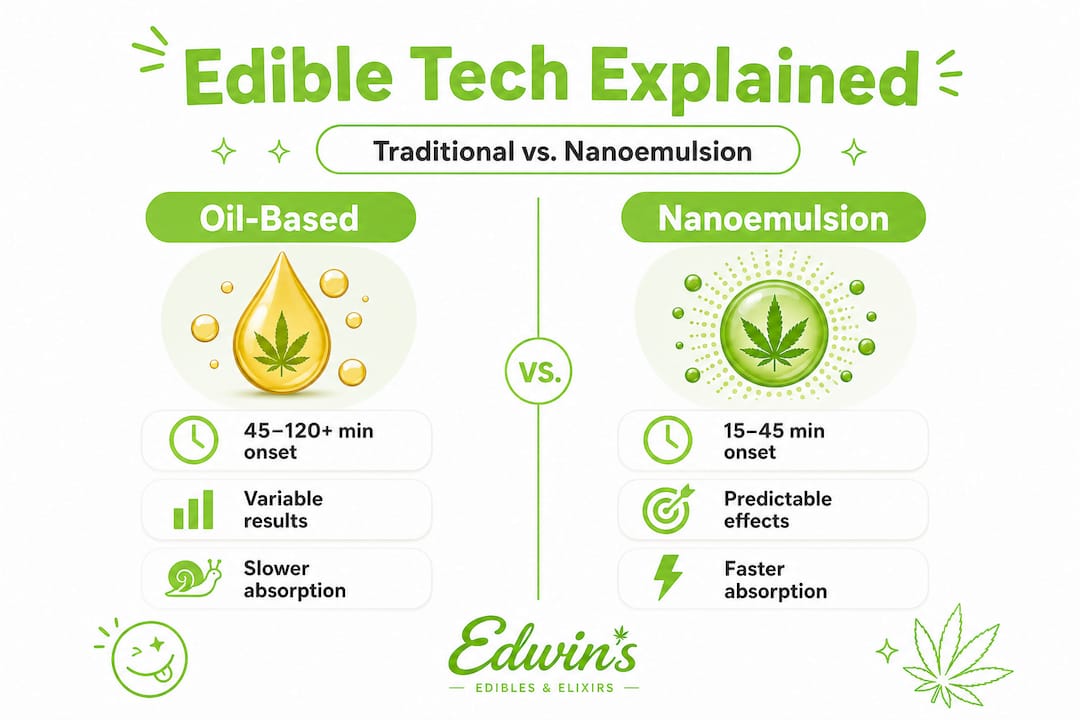
Here’s a direct comparison of the two main formulation categories:
| Feature | Traditional oil-based | Nanoemulsion/enhanced |
|---|---|---|
| Onset time | 45–120+ minutes | 15–45 minutes |
| Absorption consistency | Highly variable | More predictable |
| Food sensitivity | High | Moderate to low |
| Peak effect timing | Difficult to predict | More consistent |
| Ideal for | Experienced users comfortable with variability | Anyone prioritizing reliability |
Beyond formulation, labeling transparency is non-negotiable for consistent results. A product that lists “THC per serving” clearly, backed by verified third-party testing, lets you dose accurately every single time. Sketchy labeling or unclear cannabinoid content is one of the most common reasons people overshoot or undershoot. The role of lab testing in cannabis edibles is not just a regulatory formality. It’s your guarantee that what’s on the label is actually in the product.
When evaluating products, look for:
Learning how to read cannabis lab reports gives you real confidence at the point of purchase. And when you choose organic CBD edibles, you’re also filtering out pesticides and contaminants that can affect how you feel beyond the cannabinoids themselves.
Pro Tip: For the most consistent session-to-session results, prioritize premium regulated edibles with nanoemulsion formulations and third-party COA verification. These two features alone eliminate most of the variability people blame on “tolerance” or “bad luck.”
You’ve chosen your edible. Now here’s how to maximize the experience with smart timing and dosing. This is where intention meets execution.
Edibles can’t be “fine-tuned” in real-time the way inhaled cannabis can. Once you’ve consumed a dose, the process is in motion. Your job beforehand is to set the conditions correctly.
The mechanics of edible optimization are primarily about controlling variability before it starts. Dose-per-serving accuracy, timing and food-state management are the three levers you actually control.
Follow this step-by-step workflow for optimized results:
For edible dosing for wellness, the most important concept is that small increments build toward your ideal experience far more reliably than guessing. The cannabis edible consumption guide we’ve developed reflects years of real consumer feedback and the pattern is consistent: people who treat edibles like a workflow rather than a gamble get the results they’re looking for.
Pro Tip: Waiting at least 90 minutes before considering a second dose isn’t just a safety rule. It’s what separates a great experience from an overwhelming one. Edibles absorbed on a fuller stomach can take up to two hours to reach peak effect. Patience here pays off every time.

Prioritizing regulated, lab-tested products with clear mg labeling and delivery systems designed for more predictable absorption is the single most actionable thing you can do to get reliable outcomes across sessions. Formulation technology demonstrably changes how your body absorbs cannabinoids. That science is in your favor when you choose wisely.
After nailing your workflow, avoid unpleasant surprises with these safety-driven optimization tips. Even experienced users get caught off guard, especially around tolerance changes.
Tolerance management is a major edge case in both wellness and recreational optimization. Using the same dose repeatedly over weeks can gradually reduce the effects you feel, which is actually a signal that your endocannabinoid system is adapting. But the flip side is equally important. Returning from even a short break can make your previous “usual” dose feel significantly stronger, increasing the chance of an unpleasant experience.
Returning to edibles after a break? Always start with a lower dose than you were using before. Your tolerance resets faster than most people expect.
This isn’t just a precaution for beginners. Seasoned users who take a one or two week break often report that their previous baseline dose felt overwhelming on return. The safest approach is to treat any break longer than five to seven days as a tolerance reset and dose accordingly.
Practical safety strategies for ongoing optimization:
Understanding THC tolerance is key to long-term enjoyment. Tolerance cycles are normal and manageable. We recommend periodic intentional breaks to keep your sensitivity in a comfortable range, especially if you’re using edibles for consistent wellness benefits. When you come back to safe THC dosing after a break, the experience can feel refreshingly effective again at much lower doses. That’s a win for both your wallet and your wellness.
Here’s our honest perspective after working with thousands of edible consumers: most people obsess over dose and ignore everything else. They chase a specific number of milligrams while eating a random meal, grabbing a random product, at a random time of day. Then they wonder why their experience is unpredictable.
The real culprit isn’t the dose. It’s uncontrolled variability. Dose is just one variable in a system that includes food state, formulation type, personal metabolism and current tolerance level. If you fix the dose but leave everything else to chance, you’re still rolling the dice.
What we’ve seen work, consistently, is a shift in mindset from “how much should I take?” to “how can I control the conditions?” That means choosing a product with transparent labeling and an advanced delivery system. It means being intentional about whether your stomach is full or empty. It means logging your responses so you build a personal dataset rather than starting fresh every session.
The first-time edible workflow we recommend is the same foundation we come back to regardless of experience level. The fundamentals don’t change. What changes is how confidently and precisely you execute them.
The phrase we come back to is this: control the variables you can and respect the ones you can’t. Your metabolism is not fully in your control. Your liver enzymes are not in your control. But your product quality, your timing, your food state and your patience absolutely are. Focus your energy there and the optimal edible consumption you’re chasing becomes much more achievable. Long-term, consistent enjoyment comes from this kind of disciplined, evidence-based approach. And the confidence that builds from predictable, positive sessions is genuinely one of the best things about getting your edible practice right.
Ready to put these strategies into action? At Edwin’s Edibles & Elixirs, we’ve built our entire product line around the principles covered in this article. Our small-batch, hemp-derived Delta 9 THC edibles and organic CBD gummies are crafted with clear mg-per-serving labeling and third-party lab verification, so you’re never guessing what you’re getting. Our proprietary TiME INFUSION® technology is our answer to the formulation challenge, delivering fast-acting, predictable effects that align with the science of enhanced delivery systems. Explore our cannabis edibles guide to understand your full range of options, use our optimal consumption guide to apply the workflow in your life and learn more about how nanoemulsion edibles work to your advantage.
Consuming edibles with food, especially higher-fat meals, usually delays onset but increases total cannabinoid exposure compared to taking them on an empty stomach.
Nanoemulsion formulations are absorbed faster and more predictably than oil-based edibles and comparative pharmacokinetic studies confirm they increase total cannabinoid exposure and shift onset timing favorably.
Wait at least 90 minutes to two hours before considering a second dose, because edible pharmacokinetics are not real-time-adjustable and onset can be significantly delayed depending on your food state.
Cannabis tolerance drops during abstinence and previous “usual” doses can feel much stronger when you return; starting with a lower dose after any break is the safest approach.
Choose regulated, lab-tested products with clear mg labeling and formulation technology designed for predictable absorption, then follow an evidence-based timing and dosing workflow consistently.