
Choosing the right cannabis edible sounds simple until you are standing in front of a wall of options, each promising something different. Knowing how to pick edible effects that actually match what you want — whether that is deep relaxation, focused creativity, or restful sleep — requires more than grabbing the first gummy that looks good. The delayed onset, varying cannabinoid ratios and wide range of product formats all play into the experience you end up having. This guide cuts through the noise and gives you a clear, practical framework for making confident choices every time.
| Point | Details |
|---|---|
| Start with a low THC dose | Beginners should start at 2.5 to 5 mg THC and wait at least two to three hours before considering more. |
| Match cannabinoids to your goal | THC drives psychoactive effects while CBD supports calm and wellness with minimal intoxication. |
| Product format shapes onset | Gummies and chocolates take 30 to 90 minutes to kick in; sublingual tinctures can work in 15 to 30 minutes. |
| Avoid the redosing trap | Most negative experiences happen when users redose before the first dose fully sets in. |
| Read the lab report | Always verify potency through a third-party certificate of analysis before buying any edible product. |
Before you can pick the right effect, you need to understand what is actually creating it. Cannabis edibles work through two primary cannabinoids: THC (delta 9 tetrahydrocannabinol) and CBD (cannabidiol). They interact with your body’s endocannabinoid system in very different ways and that difference matters a lot when selecting your product.
THC is the psychoactive compound. It binds directly to CB1 receptors in the brain, producing the classic “high” associated with cannabis. Depending on the strain and dose, THC effects can include euphoria, heightened sensory perception, relaxation, increased appetite and in some cases, anxiety or paranoia at higher doses. You can read more about how THC and CBD differ to understand the full picture before choosing.
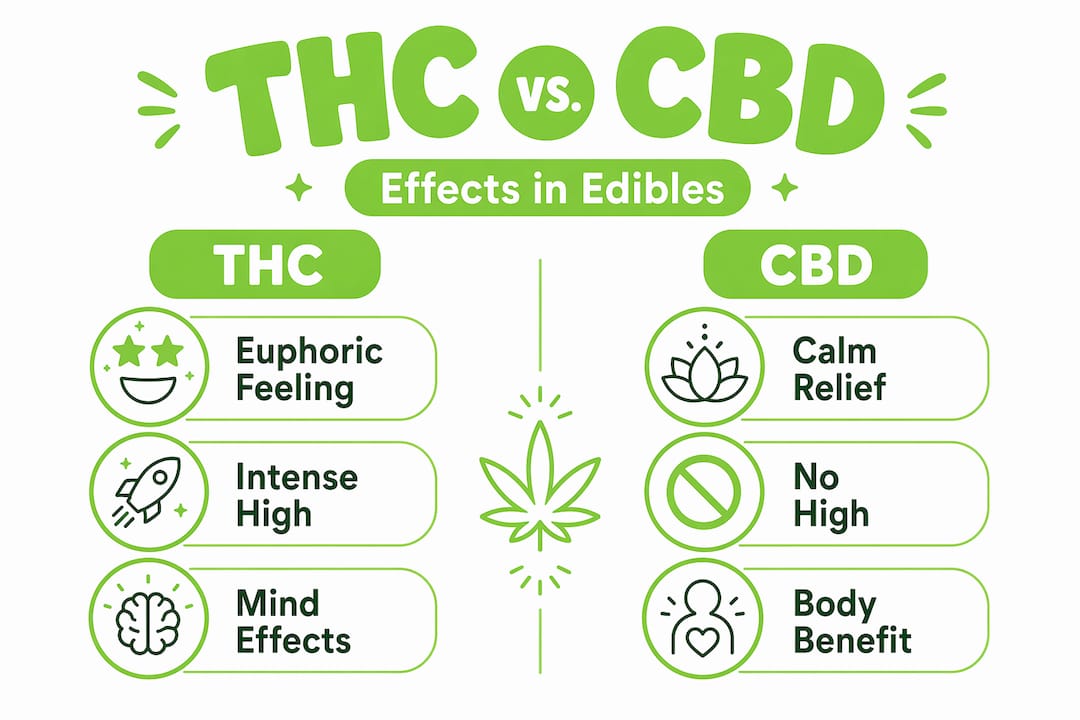
CBD, on the other hand, does not produce intoxication. It tends to moderate anxiety, support sleep and relieve discomfort without the mind-altering effects. For wellness-focused users, especially those managing pain, inflammation, or sleep disruption, balanced CBD:THC products are often preferred because they deliver therapeutic benefits with reduced risk of negative side effects.
The ratio of THC to CBD shapes the whole experience. A 1:1 CBD:THC edible will feel noticeably different from a product that is pure THC. The CBD softens the intoxicating edge, making the experience more manageable for many people. A higher CBD ratio leans toward clarity and calm. A higher THC ratio leans toward euphoria and intensity.
Pro Tip: If you are new to edibles or sensitive to THC, choosing a product with CBD included is one of the smartest moves you can make. The CBD acts as a buffer, taking the sharp edge off the high and keeping the experience much more pleasant.
Dosing is the single most influential factor in how your edible experience unfolds. Get it right and the effect matches your intention. Get it wrong and even a well-made product can feel overwhelming.
Beginners should start between 2.5 and 5 mg THC and first-timers with zero tolerance are sometimes better off starting at 1 to 2 mg. Standard recreational doses are typically around 10 mg and experienced users may work up to 25 mg or more per serving. The key word here is gradually. There is no rush.
Timing is where most people go wrong. Edibles typically onset between 30 and 90 minutes, peak around two hours and the total experience can last four to eight hours. That is a long ride compared to inhaled cannabis, which hits in minutes and fades faster. Your body processes edibles through digestion, converting THC in the liver into a more potent form called 11-hydroxy-THC, which crosses the blood-brain barrier more readily.
What you have eaten also plays a significant role. High-fat meals delay onset but can increase overall THC absorption, making effects stronger but slower to arrive. An empty stomach brings faster onset but a sharper, shorter peak. This explains why the same gummy can feel completely different on a Tuesday lunch versus a Saturday morning.
“Patience is the most underrated edible skill. The majority of difficult experiences trace back to a single decision: taking more before the first dose has done its job.” — experienced users consistently say this and the data backs it up.
Individual biology significantly affects edible experiences, including your metabolism, recent food intake and baseline tolerance. Effects vary from person to person and even day to day for the same person. Keeping a simple log where you note dose, timing, food consumed and effects can build surprisingly useful personal data over time.
Pro Tip: Write down every edible session for your first month: the product, dose, time taken, whether you had eaten and how you felt at 30 minutes, 60 minutes and 2 hours. After four or five sessions, patterns emerge that make future dosing far more predictable.
The product format you choose affects not just how fast you feel something, but the quality and character of the experience. Here is a practical breakdown of what the major formats offer:
| Format | Onset time | Duration | Best for |
|---|---|---|---|
| Gummies | 30 to 90 minutes | 4 to 8 hours | Consistent dosing, portability, variety |
| Chocolates | 30 to 90 minutes | 4 to 8 hours | Taste preference, social occasions |
| Tinctures (sublingual) | 15 to 45 minutes | 3 to 6 hours | Faster onset, precise micro-dosing |
| Infused beverages | 15 to 45 minutes | 2 to 4 hours | Social drinking substitute, quicker effect |
| Capsules | 45 to 90 minutes | 4 to 8 hours | Discreet wellness use, no taste |
Sublingual products offer faster, more predictable onset compared to swallowed edibles, making them valuable when timing matters. THC-infused beverages, especially those using fast-acting emulsion technology, can onset in as little as 15 to 30 minutes, bridging the gap between the immediacy of inhalation and the long duration of traditional edibles.
Extract quality is another dimension worth your attention. Distillate-based gummies lack the full terpene profiles found in live resin or full-spectrum extracts. Terpenes contribute meaningfully to the character of the experience, from the sedating pinene in Indica profiles to the energizing limonene in Sativa-forward products. Full-spectrum and live resin options deliver what is often called the entourage effect, where cannabinoids and terpenes work together for a richer, more nuanced result.
When thinking about how to choose hemp edibles that align with your lifestyle, consider these real use cases:
This is where intention meets execution. Following a clear process takes the guesswork out of choosing edibles and dramatically reduces the chance of a bad experience.
Pro Tip: Avoid mixing edibles with alcohol. Alcohol increases THC absorption and can amplify effects unpredictably, especially in those still learning their personal threshold.
Even well-informed users run into trouble. Understanding where things typically go wrong helps you sidestep the most common pitfalls.
The dosage trap is the most frequent offender. A user takes a dose, feels nothing at 45 minutes and takes more. By the time both doses hit, the experience is overwhelming. Edibles can cause anxiety, paranoia and a racing heart when consumed in excess, particularly in those who are less experienced. If this happens, remember that no one has died from a cannabis overdose. Find a calm space, stay hydrated and the experience will pass. Having CBD on hand can help ease a THC experience that feels too intense.
Other common errors include:
If you ever feel uncertain about whether edibles are right for you given your health history or current medications, consulting a medical professional is always the right call.
I have watched the edibles market evolve from barely-labeled brownies in plastic bags to beautifully crafted, lab-tested gummies and infused beverages that could sit on any premium food shelf. The improvement in quality is real. But the marketing has also gotten more sophisticated and that creates its own challenge.
In my experience, the biggest gap between a good edible experience and a bad one is not product quality. It is expectation management. New users often expect to feel something dramatic within 30 minutes, redose when they do not and then find themselves completely sideways two hours later. I have seen this pattern repeat endlessly and it almost always comes back to not respecting the onset curve.
What I find genuinely exciting about where the market is today is the emergence of fast-acting edible technology and high-quality full-spectrum products. These formats give users much more control over timing, which is the key variable most people struggle with. When the onset is predictable and the potency is verified, the whole experience becomes something you can actually plan around and enjoy.
My honest advice: treat your first few edible sessions as research. Go low, go slow and pay attention. The patience you invest early on pays enormous dividends once you understand how your body responds.
— Jamison
At Edwin’s Edibles & Elixirs, we believe that an informed consumer is the best kind of consumer. We have built our whole approach around giving you the tools to choose confidently and then delivering products worthy of that trust. Our small-batch, hemp-derived Delta 9 THC gummies and organic CBD gummies are formulated for specific effects, clearly labeled and backed by third-party lab testing. Our proprietary TiME INFUSION® technology makes fast-acting onset a reality rather than a promise. Whether you are just beginning or refining a routine you already love, our cannabis edibles guide is the place to deepen your understanding and find products that truly fit your needs. Come explore what we have crafted for you.
Most first-time users should start between 2.5 and 5 mg of THC and wait at least two hours before considering any additional dose. Tolerance, body weight and metabolism all affect how strongly you feel the effects.
Edible effects typically last four to eight hours, with peak intensity around the two-hour mark. Sublingual products have a shorter overall duration of three to six hours.
Full-spectrum and live resin edibles preserve the plant’s natural terpene profile, contributing to richer, more nuanced effects. Distillate-based products are cleaner tasting but lack those terpene-driven qualities.
Yes and many users prefer it. CBD tends to moderate the intensity of THC, reducing anxiety and making the experience more manageable, especially at higher THC doses.
Always check the product’s certificate of analysis from a licensed third-party lab. This document confirms exact THC and CBD content and screens for pesticides and heavy metals.