
Edible potency is defined as the concentration of active cannabinoids, primarily Delta 9 THC and CBD, measured in milligrams per serving of a cannabis-infused product. Knowing how to determine edible potency is the difference between a pleasant, controlled experience and an unexpectedly overwhelming one. Two reliable methods exist: reading batch-specific Certificates of Analysis (COAs) from third-party labs and applying a step-by-step potency calculation for homemade edibles. Both approaches require understanding cannabinoid conversion chemistry, extraction efficiency and the real limits of label accuracy.
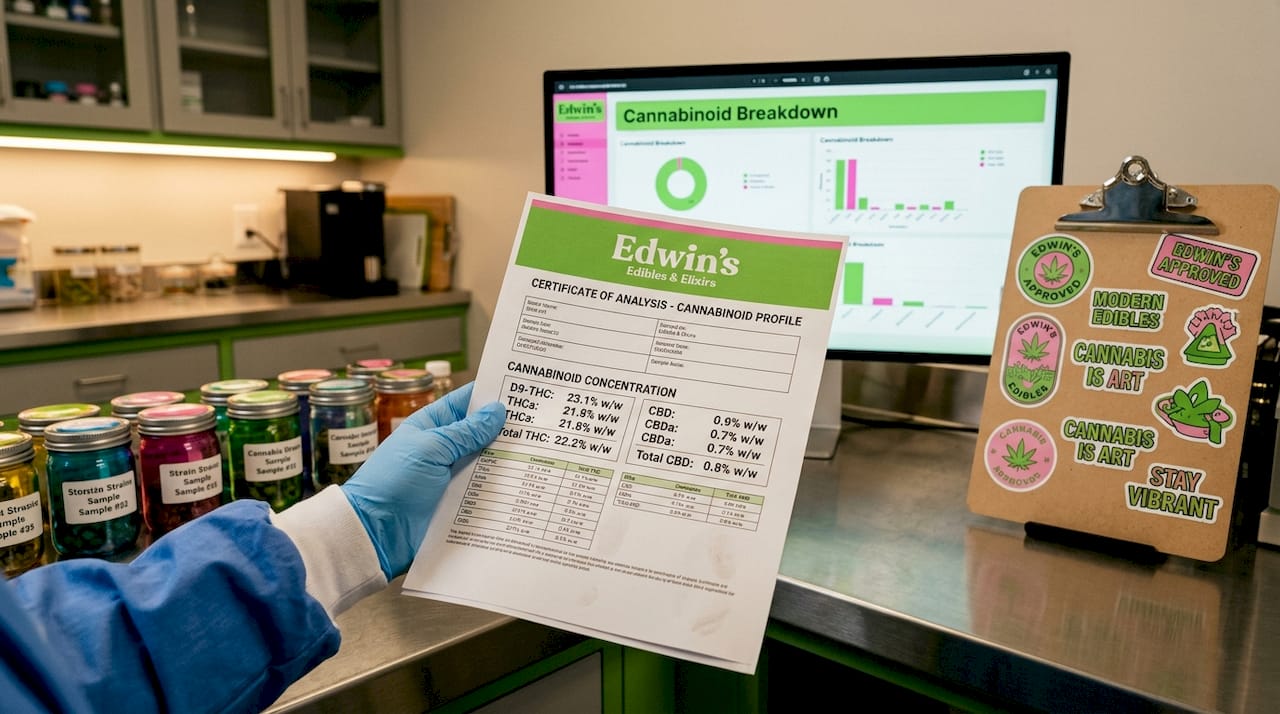
A Certificate of Analysis is a third-party lab document that reports the exact cannabinoid content of a cannabis product, broken down by compound, batch and serving size. For commercially produced edibles, it is the most reliable tool available for edible potency measurement. COAs list total THC per serving, total THC per package and often include cannabinoid profiles for CBD, CBG and CBN as well.
Reading a COA correctly matters more than most consumers realize. A 2026 PLOS ONE study found that the median observed THC in Colorado edibles was approximately 9.3 mg against a 10 mg label claim, within the state’s legal ±15% tolerance. That gap is small on paper, but for someone microdosing at 2.5 mg per serving, a 7% variance changes the experience meaningfully.
Here is what to look for when reviewing a COA for an edible product:
Studies show consistent over-labeling of THC content in both flowers and edibles, driven partly by marketplace incentives. This means the number on the front of the package is often an optimistic estimate, not a guarantee. Understanding COA details gives you the real picture.
Pro Tip: Always request or download the batch-specific COA for your exact product, not the general product page COA. Batch-to-batch variation in cannabis production is real and a COA from three batches ago tells you very little about what is in your hand today.
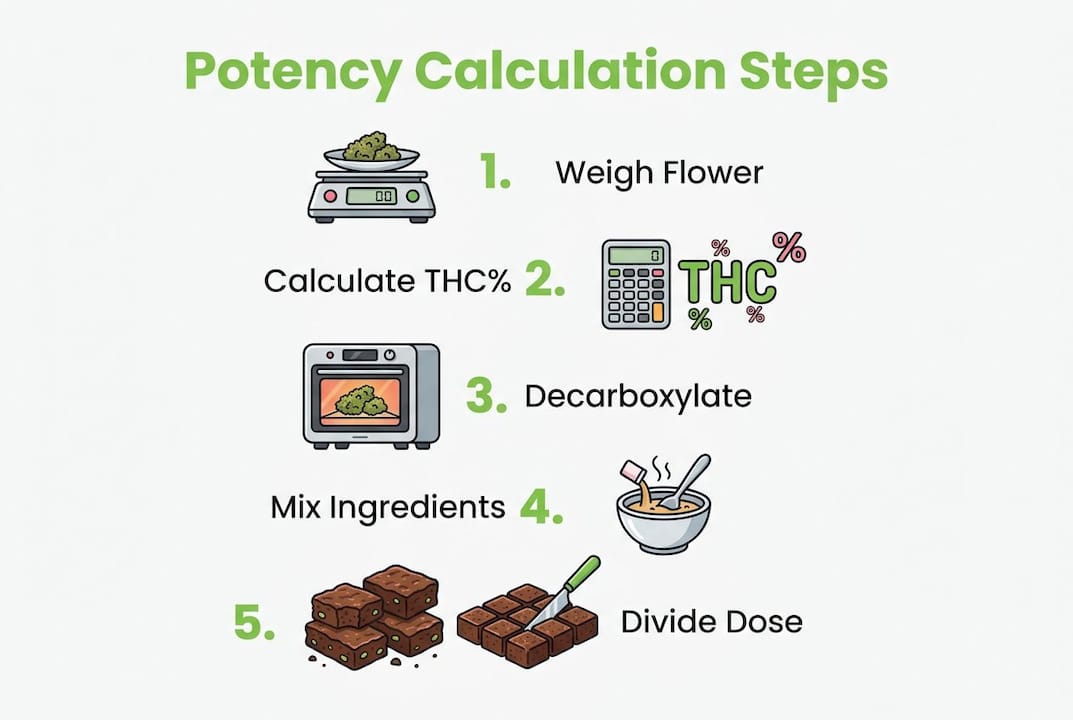
When you make edibles at home, no lab has tested your final product. The only way to estimate potency is through a structured potency calculation for edibles that accounts for cannabinoid chemistry and real-world losses during cooking.
Follow these steps precisely:
Here is a quick reference table for a common home infusion scenario:
| Variable | Example value | Result |
|---|---|---|
| Flower weight | 3.5 g (3,500 mg) | Starting material |
| THCA% on label | 22%, Δ9-THC 1% | Total THC = (22 × 0.877) + 1 = 20.3% |
| Total potential THC | 3,500 × 0.203 | 710.5 mg |
| After 80% extraction | 710.5 × 0.80 | 568.4 mg |
| Servings in batch | 28 | ~20.3 mg per serving |
Pro Tip: If your flower label only shows a single “THC%” without separating THCA and Δ9-THC, use that number directly as your total THC percentage. It likely already reflects the converted value, but confirm with your dispensary to avoid double-converting.
Even a perfectly executed calculation or a freshly printed COA cannot guarantee that every bite of your edible contains exactly the stated milligrams. Several variables introduce real-world variance between your estimate and what you actually consume.
Decarboxylation completeness is the single biggest wildcard in homemade edibles. THCA converts to psychoactive Delta 9 THC only when exposed to sufficient heat for sufficient time. Under-decarboxylated flower leaves a significant portion of THCA unconverted, meaning your edible delivers far less active THC than calculated. THCA activation through proper decarboxylation is central to achieving expected psychoactive potency.
Extraction efficiency is equally unpredictable. The 80% figure is a useful starting point, but butter extractions, coconut oil infusions and ethanol tinctures each behave differently. Time, temperature and the fat content of your carrier all shift the actual transfer rate. A rushed 30-minute butter infusion will pull significantly less THC than a slow 4-hour process at a controlled temperature.
Additional sources of variance include:
“Lab testing is the only method that confirms true final potency. Homemade estimates cannot account for every variable in the cooking and infusion process.” — CED Clinic
The most common consumer mistake is using the raw THCA percentage from a flower label without applying the 0.877 conversion. Skipping this step inflates your potency estimate by roughly 12%, which is a meaningful error when you are targeting a precise microdose of 2.5 mg or 5 mg.
Both methods have a legitimate place in measuring edible strength and the smartest approach combines them rather than choosing one exclusively.
| Method | Accuracy | Cost | Accessibility | Best use case |
|---|---|---|---|---|
| Third-party lab COA | High (±15% legal tolerance) | Included in product price | Immediate for commercial products | Verifying commercial edible potency |
| Homemade math calculation | Moderate (±20-30% realistic) | Free | Always available | Estimating homemade edible dosing |
| Direct edible batch lab test | Highest | $50-$150 per test | Limited to licensed labs | Confirming homemade or commercial batch |
Lab testing is the gold standard for confirming actual potency, but the cost and access barriers make it impractical for most home cooks. Commercial products backed by third-party COAs give you the next best level of confidence, provided you verify the batch number matches your package. Experts consistently recommend batch-specific COAs over label averages for the most accurate edible potency reading.
Homemade calculations are genuinely useful for establishing a starting dose range, but treat the result as an estimate with a margin of error, not a precise measurement. If your math says 20 mg per serving, the real number could reasonably fall anywhere between 14 mg and 26 mg depending on your decarboxylation quality and extraction method. That range matters enormously for new consumers or anyone with low tolerance.
The practical combination: use your homemade calculation to set an initial dose, start at 50% of that calculated amount and adjust based on your response over multiple sessions. For commercial products, always pull the COA and cross-reference the batch number before relying on the label claim alone.
Accurate edible potency determination requires combining batch-specific COA verification with the THCA-to-THC conversion formula and an 80% extraction efficiency multiplier to produce a reliable dose estimate.
| Point | Details |
|---|---|
| COAs are your first tool | Always match the batch number on your COA to the package before trusting the potency claim. |
| Apply the 0.877 conversion | Multiply THCA% by 0.877 before calculating total THC to avoid a 12% overestimation error. |
| Use 80% extraction efficiency | Apply this multiplier to homemade infusion calculations to account for real-world transfer losses. |
| Variability is unavoidable | Uneven mixing, storage and decarboxylation completeness all shift actual per-serving potency. |
| Start at half your estimate | Whether using a COA or a calculation, begin at 50% of your target dose and adjust from there. |
I have seen countless consumers spend hours researching strains and flavor profiles, then glance at the label for two seconds and assume the mg number is gospel. That backwards approach is where most bad edible experiences begin.
The label is a starting point, not a contract. A 2026 PLOS ONE study confirmed what experienced consumers already suspected: the actual THC in commercial edibles regularly differs from the stated amount, even within legal tolerances. For someone targeting 5 mg, a 15% variance is the difference between a relaxing evening and an anxious one.
What I have found actually works is treating potency determination as a two-step process. First, pull the COA and confirm the batch. Second, if you are making your own, run the math with the 0.877 conversion and the 80% efficiency factor, then cut your first dose in half. The “start low, go slow” principle is not just cautious advice. It is the only rational response to the genuine uncertainty in edible dosing. Technology like online potency calculators can help you run the numbers faster, but they cannot eliminate the underlying variability in your ingredients and process. Knowing that going in makes you a smarter, safer consumer.
— Jamison
At Edwin’s Edibles & Elixirs, we believe that informed consumption is the foundation of every great edible experience. Our cannabis edibles guide walks you through potency, dosing and product selection in plain language, so you can shop and consume with real confidence. Every product in our lineup is backed by third-party lab testing, with COAs available so you always know exactly what you are getting. Whether you are exploring our fast-acting THC gummies powered by TiME INFUSION® technology or our organic CBD options, our consumption guide helps you find the right dose for your goals. Come explore what thoughtful, quality-first cannabis looks like.
Edible potency refers to the concentration of active cannabinoids, primarily Delta 9 THC or CBD, measured in milligrams per serving of a cannabis-infused product. It determines how strong the effects of a single serving will be.
Look for the milligrams of THC per serving and total milligrams per package. Always cross-reference these numbers with the product’s batch-specific COA, since label claims can vary from actual content by up to ±15% under legal tolerances.
Decarboxylation completeness and extraction efficiency are the two biggest sources of variance. Incomplete decarboxylation leaves THCA unconverted, reducing potency, while uneven mixing in the final recipe creates serving-to-serving differences even within the same batch.
The standard formula is: Total THC = (THCA% × 0.877) + Δ9-THC%. The 0.877 factor accounts for the molecular mass lost when THCA converts to active Delta 9 THC during decarboxylation. Skipping this step overestimates potency by approximately 12%.
Lab testing is the only method that confirms true final potency in any edible, homemade or commercial. For home cooks, mathematical estimation provides a useful starting range, but treating that estimate as exact without lab confirmation carries real dosing risk.