
Finding trustworthy CBD can feel confusing when every brand claims to be the purest. For health-conscious Americans, the label ‘organic’ signals more than buzzwords—it means safety and clean sourcing from start to finish. Choosing organic CBD means you are prioritizing products free from synthetic chemicals, verified through strict oversight and third-party testing. This guide clears up common myths and highlights what separates true organic CBD from the rest, helping you feel confident in your wellness choices.
| Point | Details |
|---|---|
| Understanding Organic CBD | Organic CBD is derived from hemp grown without synthetic pesticides, artificial fertilizers, or harmful chemicals, ensuring a purer product. |
| Importance of Certification | USDA organic certification verifies compliance with strict standards, protecting consumer health and ensuring product integrity. |
| Common Misconceptions | CBD has therapeutic properties, but it is not a miracle cure, and product quality can vary significantly, making it critical to choose certified organic options. |
| Legal Framework | While hemp-derived CBD with less than 0.3% THC is federally legal, state regulations vary, so check local laws before purchasing. |
Organic CBD starts with understanding what CBD actually is. CBD (cannabidiol) is a major non-intoxicating compound found in the cannabis plant that doesn’t produce a high or alter your mental state.
Unlike THC, which creates psychoactive effects, CBD offers different properties that have generated growing interest among health-conscious consumers. It can be derived from hemp plants or produced in laboratories, giving manufacturers flexibility in sourcing.
When we add “organic” to the equation, you’re looking at CBD produced without synthetic pesticides, artificial fertilizers, or harmful chemicals. That purity matters significantly for your health.
Organic CBD comes from hemp plants grown under strict standards that prohibit certain synthetic inputs. Here’s what separates it from conventional CBD:
When choosing CBD, organic certification signals that every step—from seed to shelf—prioritizes your safety and product quality.
Misunderstandings about CBD persist, even as the market expands. Let’s address the biggest ones:
Misconception #1: CBD is just medical, THC is just recreational. This isn’t accurate. Both CBD and THC have therapeutic qualities, though they work differently in your body and produce different effects. CBD doesn’t create intoxication, while THC does.
Misconception #2: CBD cures everything quickly. CBD isn’t a miracle cure. It won’t address all ailments and results vary based on individual biology, dosage and product quality. Realistic expectations matter.
Misconception #3: All CBD products are the same. Quality varies dramatically. Organic CBD undergoes rigorous testing and follows strict cultivation standards. Non-organic products may contain residual pesticides, heavy metals, or inconsistent cannabinoid levels.
Misconception #4: Organic certification doesn’t matter. It absolutely does. Certification means independent verification of growing practices, ensuring you’re getting what you paid for.
Misconception #5: Hemp-derived CBD isn’t legal. Hemp-derived CBD with less than 0.3% THC is federally legal in the United States. However, state laws vary, so checking local regulations matters.
Choosing organic CBD means choosing products tested for purity and produced responsibly. When you consume CBD, you want to know exactly what’s entering your body—no surprise pesticides, no unlisted additives.
Organic standards create accountability throughout production. Farmers follow documented practices, manufacturers maintain clean facilities and products get verified by third parties. This chain of custody protects you.
Pro tip: When evaluating organic CBD products, look for certificates of analysis (COAs) from independent labs that verify potency and test for contaminants like pesticides, heavy metals and solvents.
USDA organic certification isn’t a label slapped on a product—it’s a rigorous verification process that takes months and involves multiple checkpoints. Understanding how it works helps you see why organic CBD commands premium pricing.
The USDA National Organic Program sets federal standards that all certifiers must follow. This means every organic CBD product, regardless of where it’s sold, meets the same baseline requirements.
Becoming certified organic requires producers to follow a structured path. Here’s what the process actually looks like:
This isn’t a one-time checkbox. Producers must renew annually, pay ongoing fees and submit updated documentation proving continued compliance.
Compare key certification steps and their focus:
| Certification Step | Main Focus Point | How It Protects Consumers |
|---|---|---|
| Application & Plan | Documentation of farming practices | Ensures intent to comply |
| On-Site Inspection | Checks compliance in real time | Detects any off-label activities |
| Records Review | Verifies sourcing and input details | Prevents introduction of contaminants |
| Ongoing Renewal | Requires annual updates and fees | Maintains continued accountability |
When accredited certifiers conduct inspections, they’re verifying real compliance, not just reading paperwork. They examine soil health, pest management practices and input sourcing.
Inspectors verify that:
They’re not just asking questions—they’re physically examining fields, reviewing purchase records and testing soil when necessary.
Organic certification means compliance with USDA sustainability and soil health standards that protect both the environment and your product’s integrity. These standards address biodiversity, water conservation and long-term soil quality.
Producers must document everything. Every fertilizer source, every pest management decision, every crop rotation gets recorded. This documentation creates accountability and traceability.
Organic certification adds genuine market value because it represents verifiable compliance with federal standards, not just marketing claims.
When you buy organic CBD, you’re getting a product from a producer who passed inspection and maintains ongoing documentation. They can’t cut corners or hide practices—the records prove what they did.
This transparency protects you. You know the hemp was grown without synthetic chemicals and you have documentation to back it up.
Pro tip: Ask for your CBD product’s certifier name and certification number, then verify it on the USDA’s organic integrity database to confirm the certification is current and legitimate.
Organic CBD farming isn’t just about skipping synthetic pesticides—it’s a comprehensive system designed to produce clean, potent cannabinoids while protecting soil and preventing contamination. Every step from seed to harvest follows strict protocols.
Hem actually absorbs contaminants from soil through a process called phytoremediation. This makes organic farming practices crucial for CBD production, since the plant naturally concentrates whatever exists in the growing environment.
Organic hemp growers must follow USDA National Organic Program standards that prohibit synthetic pesticides, fertilizers, bioengineering, radiation and sewage sludge. Only inputs on the USDA’s National List are permitted.
Organic CBD farming focuses on:
These practices create a self-sustaining agricultural system rather than one dependent on chemical interventions.
Successful organic CBD production starts with selecting appropriate genetics optimized for CBD yield while maintaining organic compliance. Growers choose between clones (genetic copies of proven high-CBD plants) or seedlings grown from certified organic seeds.
Planting methods matter. Some producers use plasticulture—laying plastic mulch to control soil temperature and suppress weeds without herbicides. Others rely on cover crops and natural weed suppression techniques.
Organic CBD farming requires planning every detail months in advance because organic practices can’t be rushed or improvised mid-season.
Timing the flowering cycle is critical for two reasons: THC compliance and cannabinoid optimization. Growers carefully monitor plants to ensure they stay below the legal 0.3% THC threshold while maximizing CBD content.
Harvest timing determines final cannabinoid profiles. Harvesting too early leaves potential potency on the table. Harvesting too late risks THC creep as the plant matures. Organic growers use visual observation and testing to dial in the perfect window.
After harvest, organic standards continue through processing. Extraction equipment must be clean and free from synthetic contaminants. Post-harvest handling follows strict documentation requirements proving organic integrity from field to finished product.
Pro tip: Request a copy of your CBD product’s farming and processing documentation—reputable brands readily provide harvest dates, extraction methods and organic certifier names as proof of genuine organic standards.
The legal landscape for organic CBD involves multiple layers of regulation. You need to understand federal rules, state-level requirements and FDA oversight to know what you’re actually buying.
The 2018 Farm Bill changed everything by legalizing hemp cultivation—cannabis plants containing less than 0.3% THC. This opened the door for hemp-derived CBD to move across state lines and enter mainstream commerce.
Hemp-derived CBD products with less than 0.3% THC remain federally legal under the Farm Bill, but that’s just the baseline. The FDA regulates CBD when it appears in food, supplements and cosmetics, creating overlapping regulatory authority.
To label a CBD product as USDA organic requires more than just following farm practices:
Without official USDA organic certification, companies cannot legally use the organic label, regardless of their actual practices.
Here’s where it gets tricky. While federal law permits hemp-derived CBD, state regulations vary dramatically. Some states embrace hemp cultivation and CBD products. Others restrict or prohibit them entirely.
Before purchasing organic CBD, verify your state’s specific rules about possession, purchase and use. What’s legal federally might still violate state law in your location.
USDA organic certification for CBD demands strict quality standards covering cultivation without synthetic chemicals, approved organic practices and complete documentation. Producers must develop detailed organic system plans documenting soil fertility management, pest control strategies and harvesting processes.
This certification builds genuine consumer trust. Given that hemp naturally absorbs contaminants from soil, rigorous organic handling during production protects you from heavy metals and pesticide residues.
True organic CBD certification requires federal verification—not just brand promises or marketing claims.
The FDA hasn’t approved CBD as a food ingredient, yet thousands of CBD products exist in foods and drinks. This regulatory gray area creates uncertainty about labeling standards and product claims.
The FDA can take action against companies making unsubstantiated health claims about CBD. Legitimate organic CBD brands stay cautious about what they claim their products can do.
Pro tip: Before buying, verify the brand’s USDA certification number on the USDA organic integrity database, check your state’s CBD laws and confirm the product has third-party lab testing results showing THC content and contaminant levels.
Mislabeling is rampant in the CBD market. Studies consistently show that products don’t match their labels, creating real health and safety concerns for consumers who believe they’re getting what they paid for.
The unregulated nature of CBD means companies can make claims without verification. This gap between marketing and reality is why purity and third-party testing matter so much.
Most CBD products contain inaccurate cannabinoid content, with potency deviating by at least 10% from label claims. Some products contain far less CBD than advertised, while others exceed stated amounts, creating unpredictable dosing.
Worse than inaccurate potency are hidden contaminants:
These aren’t theoretical risks. Research analyzing over 200 CBD products found most contained at least one contaminant at concerning levels.
Regulatory gaps allow non-compliant products to enter the market without consequence. Brands face minimal oversight, so cost-cutting becomes tempting. Lower-quality suppliers cut corners on testing and use cheaper extraction methods.
Some companies simply lack quality control systems. Others knowingly mislabel to command premium pricing on inferior products.
The CBD market’s lack of standardized testing and clear labeling creates an environment where poor-quality products thrive alongside legitimate ones.
Mislabeled products share common warning signs. Products with no third-party testing are immediate red flags. Brands that make exaggerated health claims without scientific backing often cut corners elsewhere too.
Inconsistent pricing across retailers suggests quality issues. If a brand’s CBD gummies sell for $5 at one retailer and $50 at another without explanation, something’s wrong.
Organic CBD offers clearer accountability than conventional alternatives. Organic certification requires third-party verification, regular inspections and documented practices. Non-organic CBD products lack this oversight.
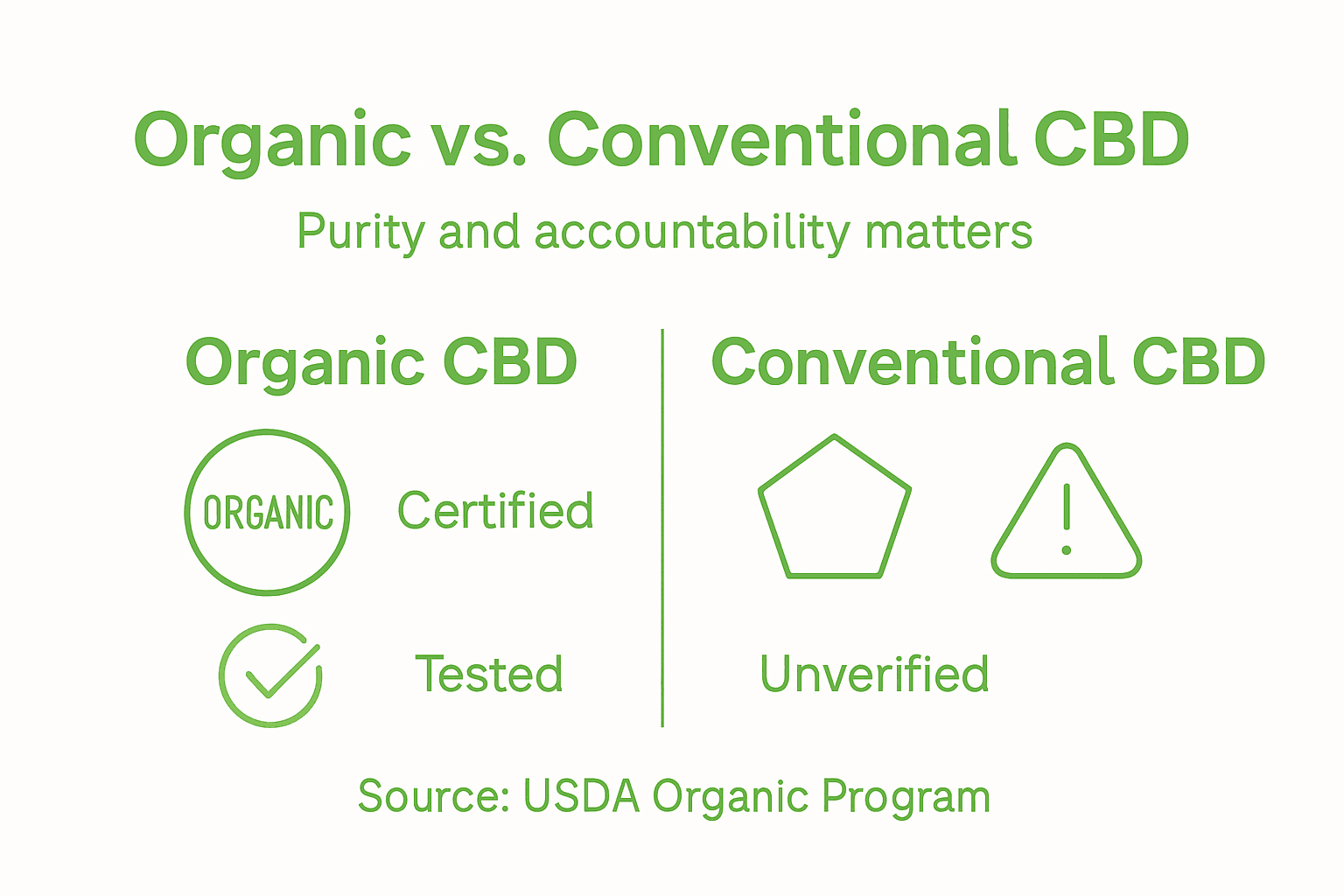
Conventional CBD might cost less initially, but hidden contaminants create long-term health risks. Organic certification adds cost but eliminates many contamination sources at the source.
Here’s how organic and conventional CBD compare for consumers:
| Aspect | Organic CBD Benefits | Conventional CBD Drawbacks |
|---|---|---|
| Contaminant Risk | Very low due to regulations | Higher chance of residues |
| Traceability | Full certification, paperwork | Often incomplete records |
| Environmental Impact | Promotes soil health, biodiversity | Can harm soil, fewer safeguards |
| Cost and Value | Premium price, fewer risks | Lower price, higher uncertainty |
| Consumer Trust | Backed by third-party audits | Trust varies by brand |
Reputable brands answer these questions without hesitation:
Brands that dodge these questions aren’t worth your money.
Pro tip: Request the certificate of analysis before purchasing and verify the test dates are recent (within 6 months), check that testing covered potency and contaminants and confirm the lab is independent and accredited.
The article underscores the importance of choosing organic CBD to ensure purity, safety and genuine wellness benefits without hidden contaminants or synthetic chemicals. If you seek organic certification, transparent third-party testing and carefully documented farming and processing standards, your search ends here. Edwin’s Edibles & Elixirs offers premium, small-batch hemp-derived CBD gummies crafted with proprietary TiME INFUSION® technology that delivers fast-acting, reliable effects crafted for your wellness journey.
Don’t settle for products with uncertain quality or unverified claims. Discover our full assortment of fast-acting THC gummies, traditional gummies and organic CBD options designed to empower your dosing decisions and enhance your relaxation or recreation experience. Visit Edwin’s Edibles & Elixirs today to access detailed product descriptions and learn more about the benefits of choosing truly organic CBD. Take control of your wellness with confidence now by exploring our collection and placing your order at EE&E.
Organic CBD is cannabidiol extracted from hemp plants that are grown without synthetic pesticides, fertilizers, or harmful chemicals, ensuring a purer product.
Organic certification guarantees that the CBD has been produced under strict agricultural standards, which prohibits certain harmful inputs, providing assurance of purity and quality for consumers.
You can verify the quality of CBD products by looking for certificates of analysis (COAs) from independent labs, which confirm potency and test for contaminants like pesticides and heavy metals.
Organic CBD comes from hemp grown under strict regulations, with minimal contamination risk and full traceability. Conventional CBD may contain harmful residues due to less stringent farming practices.