
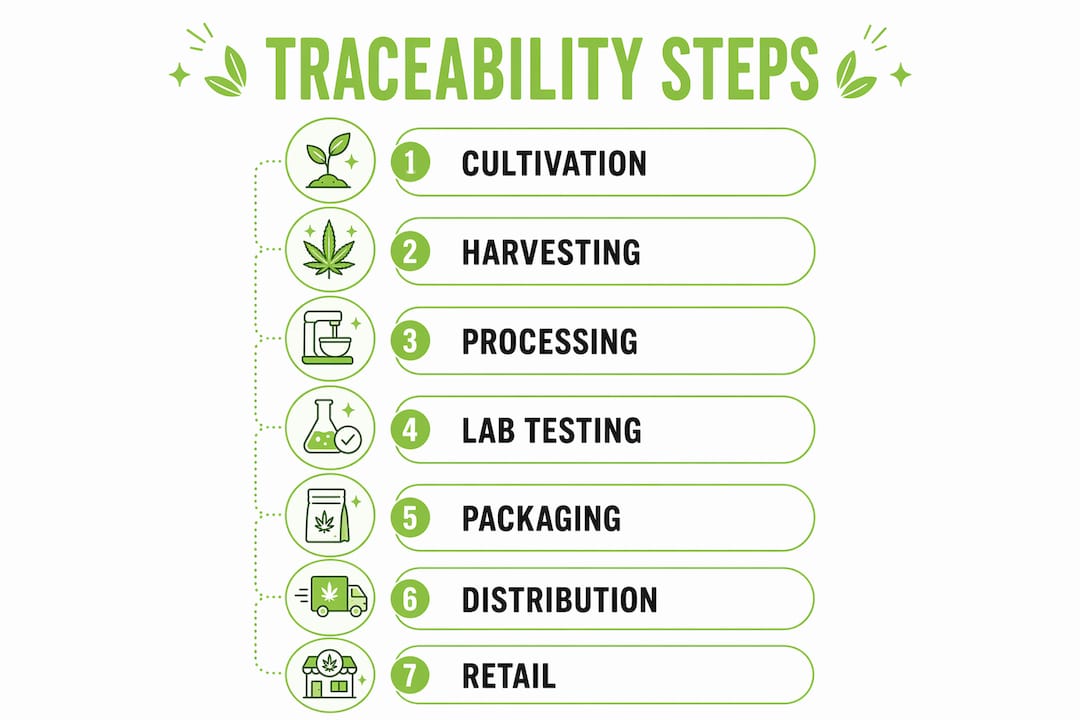
Traceability in hemp products is the documented, step-by-step tracking of every stage a hemp product passes through, from seed cultivation to the shelf where you buy it. The industry term for this practice is “seed-to-shelf traceability,” and it gives you verifiable proof that what’s on the label matches what’s in the product. Every batch identifier, lab result and Certificate of Analysis (COA) is a link in that chain. Without it, you have no way to confirm whether your Delta 9 gummy or CBD tincture was grown cleanly, processed safely, or tested honestly. The importance of hemp traceability has never been greater and understanding it puts real power in your hands as a consumer.
Seed-to-shelf traceability records every lifecycle stage of a hemp product, linking physical goods to third-party lab results that confirm the absence of pesticides and contaminants. That documentation chain typically covers five stages: cultivation, extraction, manufacturing, distribution and retail. Each stage generates records that must connect to the next, creating an unbroken paper trail.
The anchor of that trail is the batch or lot number, a unique identifier printed on every product package. That number ties directly to a COA issued by an independent, accredited laboratory. The COA confirms cannabinoid potency (how much Delta 9, CBD, or other compounds are present) and screens for heavy metals, pesticides, residual solvents and microbial contaminants. Matching the batch number on your package to the COA on the brand’s website is the single most practical thing you can do to verify a product’s safety.
Technology makes this matching process faster and more reliable. QR codes on packaging link directly to live COA documents. RFID tags track physical inventory through warehouses and distribution centers. State-mandated track-and-trace systems like Metrc log every movement and lab result in real time. The key is that packaging labels, lab reports and internal production records must all reference the same batch identifier. When those three sources align, the traceability chain is intact.
Pro Tip: Before buying any hemp edible or beverage, scan the QR code on the package or search the brand’s website for the batch number. If no COA appears, or if the batch number on the package doesn’t match the COA, treat that as a red flag.
The regulatory picture for hemp traceability has grown significantly more detailed heading into 2026. States like Tennessee and Georgia now enforce supply chain licensing, age verification at retail and paper-trail compliance for intoxicating hemp products, even where universal seed-to-sale software is not yet mandated. This means brands selling Delta 9 THC edibles and beverages face a patchwork of state-level requirements that demand both documentation discipline and technological readiness.
The most significant federal layer comes from the FDA’s FSMA 204 rule. FSMA 204 requires electronic, sortable records linking Critical Tracking Events (CTEs), Key Data Elements (KDEs) and Traceability Lot Codes (TLCs) for food and hemp beverage supply chains. For brands producing hemp-infused drinks or edibles, this means every transformation of raw biomass into a finished product must be logged with a primary lot code that connects production batches to barcodes and COAs. This is not optional paperwork. It is a federal food safety mandate.
Here is how the two major regulatory frameworks compare for hemp edible and beverage brands in 2026:
| Framework | Scope | Key Requirement | Who It Affects |
|---|---|---|---|
| FSMA 204 (FDA) | Food and hemp beverages | Electronic CTEs, KDEs and TLCs | Hemp beverage and edible manufacturers |
| State track-and-trace (e.g., Metrc) | Intoxicating hemp products | Unique batch IDs, real-time movement logs | Cultivators, processors, retailers |
| State COA mandates | All ingestible hemp products | Batch-specific lab results at point of sale | All hemp product brands |
One of the more complex challenges brands face is “dual traceability.” This means maintaining private food-grade lot coding that satisfies FSMA 204 while simultaneously syncing with state Metrc systems that use their own identifiers. Ingestible hemp products face higher scrutiny than topicals, requiring tracking of Critical Tracking Events from biomass transformation through final retail packaging. Topical hemp products currently operate under lighter documentation requirements, but that gap is narrowing.
Pro Tip: Hemp compliance requirements vary significantly by state. If you want a clear breakdown of the legal framework affecting the products you buy, the hemp compliance overview at Edwin’s Edibles & Elixirs is a practical starting point.
Hemp product transparency is not a marketing feature. It is a safety mechanism. Consumers can verify product batch numbers and review third-party lab COAs showing cannabinoid profiles and contaminant screening and matching that label to a COA confirms safety and potency claims directly. This matters because the hemp market still includes products that make unverified claims about potency or purity.
The benefits of traceability in hemp extend beyond individual product verification. Without batch-to-package linkage, safety issues require costly broad recalls instead of targeted action. When a brand can trace a contamination problem to a specific cultivation batch or processing run, only the affected units get pulled. Without that linkage, an entire product line may need to be recalled, which is disruptive for brands and alarming for consumers who bought unaffected products. Traceability significantly reduces recall scope and cost by enabling rapid identification of affected batches.
Here is what you should look for when reviewing a COA as a consumer:
“Traceability is the difference between a brand telling you their product is safe and actually proving it. A COA from an accredited lab, linked to the batch number on your package, is that proof.”
Understanding why CBD products are tested gives you the full picture of what each panel on a COA is actually measuring and why it matters for your health.
Pro Tip: Save the COA for any hemp product you buy regularly. If a brand updates its formulation or switches suppliers, comparing COAs across batches will show you exactly what changed.
The operational backbone of how hemp is traced relies on a combination of software platforms, standardized identifiers and laboratory accreditation. Metrc assigns unique identifiers to every regulated unit, logging movements and lab results in real time throughout the supply chain. Cannabis Tracking System (CTS) platforms serve a similar function in states that have not adopted Metrc. Both integrate COA uploads with batch IDs to support compliance and enable targeted recalls.

GS1 identifiers, the global standard for product barcodes, provide a universal language for lot coding that works across retail systems. When a brand uses GS1 barcodes alongside a primary Traceability Lot Code (TLC), batch-level integrity is maintained because that single TLC is consistently referenced on packaging, lab COAs and internal documents. Fragmented data, where the package says one batch number and the COA says another, is the most common traceability failure point.
| Technology | Function | Consumer Benefit |
|---|---|---|
| Metrc / CTS | Real-time state track-and-trace | Confirms product moved through licensed supply chain |
| QR codes | Links packaging to live COA documents | Instant lab result access at point of purchase |
| GS1 barcodes | Standardized lot coding across retail systems | Consistent batch identification across retailers |
| ISO 17025 labs | Accredited third-party testing | Credible, reliable COA results |
| FSMA 204 TLC | Primary lot code linking all records | Single reference point connecting all documentation |
ISO 17025 lab accreditation is a key compliance benchmark for verifying that lab tests linked to product batches are credible and reliable. A COA from a non-accredited lab carries far less weight because the testing methodology has not been independently validated. The role of lab testing in cannabis edibles safety explains precisely why accreditation status is the first thing to check on any COA you review.
The strongest hemp suppliers in 2026 use end-to-end batch traceability and ISO 17025 COA verification as a baseline for compliance and buyer confidence. Undocumented supply chains are increasingly uninsurable and losing retail placement. That market pressure is accelerating traceability adoption faster than regulation alone ever could.
Traceability in hemp products is the documented chain connecting cultivation, processing and lab testing to the specific batch number on your package and verifying that chain is the most direct way to confirm product safety.
| Point | Details |
|---|---|
| Seed-to-shelf documentation | Every stage from cultivation to retail must be recorded and linked by a unique batch or lot number. |
| COA verification | Match the batch number on your package to an ISO 17025 accredited lab COA to confirm potency and contaminant results. |
| 2026 regulatory requirements | FSMA 204 and state systems like Metrc require electronic lot codes, Critical Tracking Events and real-time movement logs. |
| Targeted recall capability | Batch-level traceability limits recalls to affected units, protecting consumers and reducing brand disruption. |
| Dual-traceability standard | Leading brands now maintain both private food-grade lot coding and state track-and-trace compliance simultaneously. |
Most people buying hemp edibles or Delta 9 beverages never look at a COA. They read the label, check the flavor and move on. I understand that. But after spending years watching this industry grow, I am convinced that traceability is the single most powerful tool consumers have and almost nobody uses it.
Independent third-party lab verification is the foundation of consumer trust and it goes well beyond what any regulatory body currently requires. The brands that publish live, batch-specific COAs and maintain clean Metrc records are not just compliant. They are making a statement about how seriously they take your health. That distinction matters enormously when you are putting something in your body.
The future of this space is dual traceability, where private food-grade lot coding and state track-and-trace systems work together. Brands that build that infrastructure now will be the ones still standing when federal hemp regulations tighten. My honest advice: treat a brand’s traceability practices as a proxy for everything else they do. If they cannot show you where their product came from and what is in it, that tells you everything you need to know.
— Jamison
At Edwin’s Edibles & Elixirs, we believe you deserve to know exactly what you are consuming and where it came from. Our hemp-derived Delta 9 THC products and organic CBD gummies are produced in small batches with batch-specific COAs from accredited labs, so you can verify every product before you buy. If you are new to hemp edibles or want to understand how to choose products with confidence, our cannabis edibles guide covers everything from sourcing and safety to dosing and effects. We also explain how our hemp sourcing connects directly to the quality and effects you experience. Transparency is not a checkbox for us. It is the foundation of everything we craft.
Traceability in hemp products means every stage of a product’s lifecycle, from cultivation through retail, is documented and linked by a unique batch identifier. Consumers can use that identifier to access a third-party COA confirming potency and contaminant screening results.
Hemp is traced using batch or lot numbers assigned at cultivation that carry through extraction, manufacturing and packaging. Technologies like Metrc, QR codes and GS1 barcodes connect those identifiers to lab results and state track-and-trace records in real time.
A COA (Certificate of Analysis) is a lab report from an independent, accredited testing facility that confirms a hemp product’s cannabinoid levels and screens for pesticides, heavy metals and microbial contaminants. Matching the COA to the batch number on your package is the most direct way to verify a product is safe.
Many states now require batch-specific COAs and scannable QR codes for intoxicating hemp products and the FDA’s FSMA 204 rule mandates electronic lot code records for hemp beverages and edibles. Requirements vary by state, so checking your state’s specific rules is the most reliable approach.
Look for a batch number on the package, a matching COA from an ISO 17025 accredited lab and a QR code or website link that takes you directly to that COA. If the brand also discloses its hemp sourcing and manufacturing practices, that is a strong indicator of genuine transparency.