
You’ve probably heard claims about water soluble THC and wondered if cannabis can actually dissolve in water. The short answer is no, but the technology behind these products is fascinating and genuinely useful. THC is naturally hydrophobic, meaning it repels water. What companies call water soluble THC is actually nanoemulsified THC, tiny particles suspended in liquid that your body absorbs faster and more efficiently than traditional edibles. This article breaks down the science, benefits and practical considerations so you can decide if these fast-acting products fit your wellness routine.
| Point | Details |
|---|---|
| Nanoemulsified THC not soluble | What is sold as water soluble THC is actually nanoemulsified THC, consisting of tiny particles suspended in liquid rather than true chemical solubility. |
| Faster onset and absorption | Nanoemulsified particles increase surface area and bypass much of the liver metabolism, yielding quicker effects than oil based edibles. |
| Higher bioavailability | The small particles allow more delta nine THC to reach the bloodstream before metabolism, increasing overall bioavailability. |
| Cost and stability issues | Production is more expensive and formulations can be unstable over time, affecting shelf life and dosing. |
The term water soluble THC creates confusion because it’s scientifically inaccurate. THC is a lipophilic compound, meaning it bonds with fats and oils, not water. True water solubility would require changing THC’s molecular structure, which would fundamentally alter its effects on your body.
What manufacturers actually create is nanoemulsified THC. This process breaks THC oil into incredibly small particles, typically 20-200 nanometers in size, that can disperse evenly throughout water-based liquids. Think of it like homogenized milk, where fat particles stay suspended in liquid rather than separating into cream.
The nanoemulsion process uses several techniques:
Common emulsifiers include lecithin (derived from soy or sunflower), polysorbate compounds and natural gum arabic. These substances have one end that attracts water and another that attracts oil, creating a protective shell around each THC particle. This shell keeps particles separated and evenly distributed throughout the liquid.
The size matters enormously. Particles in the 20-200 nanometer range are small enough to remain suspended indefinitely in properly formulated products. They’re also small enough to pass through biological membranes much more easily than larger oil droplets.
Pro Tip: When comparing products, look for transparency about the emulsification process and particle size. Quality manufacturers provide this information because it directly impacts product performance.
This distinction between true solubility and nanoemulsion isn’t just semantic. Understanding differences between CBD and THC edibles and how they’re formulated helps you make informed choices about which products will work best for your needs. The terminology confusion leads some consumers to expect instant effects or assume these products work fundamentally differently than they actually do.
Once you consume nanoemulsified THC, those tiny particles interact with your body very differently than traditional edibles. The small particle size creates a massive surface area relative to volume, which dramatically improves absorption efficiency.

Nano-sized THC particles get absorbed through mouth and stomach lining, bypassing much of the liver’s first-pass metabolism that normally breaks down THC. With traditional edibles, your liver converts delta-9 THC into 11-hydroxy-THC before it reaches your bloodstream. This process takes time and reduces the amount of active THC that reaches your system.
Nanoemulsified THC takes a different route:
The practical benefits show up clearly in the numbers. Studies demonstrate onset times of 10-30 minutes versus 45-120 minutes for oil-based formulations. Bioavailability jumps to 40-90% compared to just 4-20% with traditional edibles.
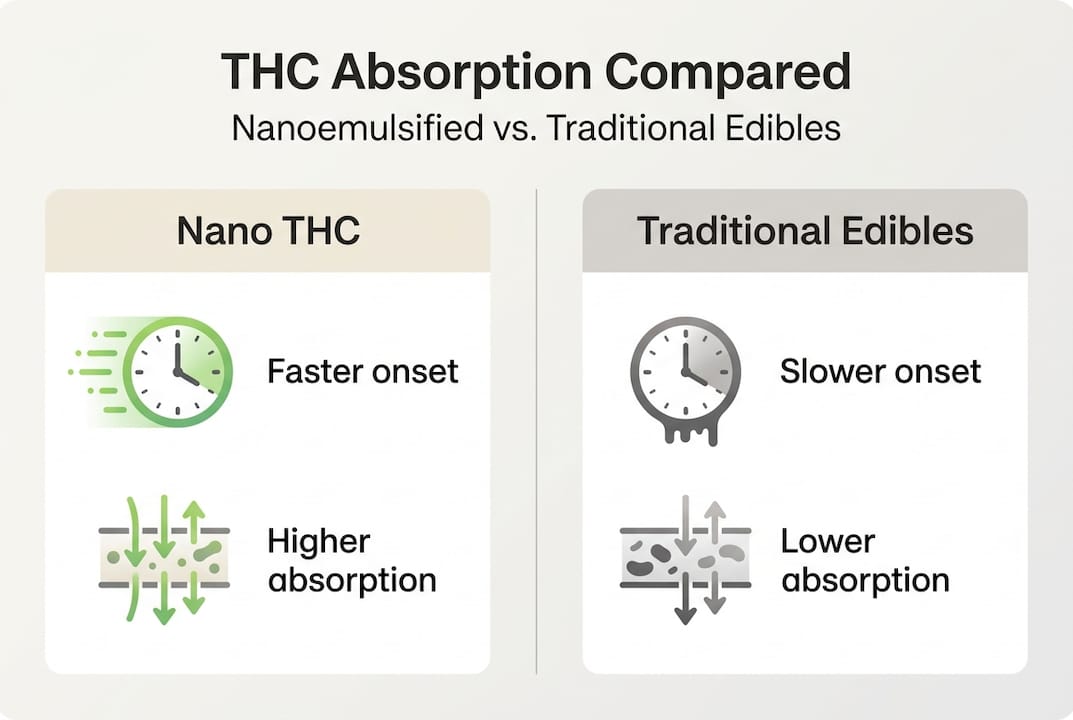
| Metric | Nanoemulsified THC | Traditional oil-based THC |
|---|---|---|
| Onset time | 10-30 minutes | 45-120 minutes |
| Peak effects | 30-60 minutes | 2-3 hours |
| Duration | 2-4 hours | 4-8 hours |
| Bioavailability | 40-90% | 4-20% |
| Metabolism route | Direct absorption + some liver | Primarily liver first-pass |
This faster THC absorption in edibles means you can gauge effects more quickly and adjust your dose if needed. With traditional edibles, you might wait two hours before realizing you need more, then accidentally overconsume when both doses hit simultaneously.
The shorter duration cuts both ways. If you want relief that lasts all day, traditional edibles work better. But for targeted use, like easing into sleep or managing acute discomfort, the 2-4 hour window provides effects without lingering grogginess.
Pro Tip: The improved bioavailability of THC in edibles means you need less total THC to achieve the same effects. Start with half your usual dose when trying nanoemulsified products for the first time.
Your individual metabolism still matters. Factors like stomach contents, hydration and your endocannabinoid system’s sensitivity all influence how quickly and intensely you feel effects. But the enhanced absorption creates more consistent experiences across different users compared to traditional edibles, where variability can be extreme.
Creating stable nanoemulsified THC products isn’t simple or cheap. The technology sounds impressive, but it comes with significant practical limitations that affect both manufacturers and consumers.
Stability remains the biggest technical challenge. Emulsions are thermodynamically unstable without precise formulation, meaning particles naturally want to clump together and separate from the water phase. Manufacturers must carefully balance:
Poorly formulated products will separate over time, with THC particles settling or floating. This creates inconsistent dosing, where the first sip might contain far more or less THC than the last. Shaking helps temporarily, but truly unstable formulations will fail regardless.
The production costs run 30-50% higher than traditional oils. Specialized equipment, quality emulsifiers, extensive testing and higher rejection rates during quality control all add up. These costs get passed to consumers, making nanoemulsified products noticeably more expensive per milligram of THC.
Some common misconceptions need clearing up. Nano THC is not more potent per milligram. A 10mg dose of nanoemulsified THC contains the same amount of THC as a 10mg traditional gummy. The difference lies in how much your body actually absorbs and uses. You might feel stronger effects from the nano version, but that’s efficiency, not potency.
Variability still occurs based on individual metabolism and stomach contents. Taking nanoemulsified THC on an empty stomach versus with a fatty meal can produce different onset times and intensities. Your liver enzyme levels, body weight and tolerance all play roles.
Drug testing remains a concern. Nanoemulsified THC shows up on drug tests just like any other THC product. The delivery method doesn’t change the fact that you’re consuming THC, which metabolizes into compounds that standard tests detect. If you face drug screening, these products carry the same risks as traditional edibles.
| Factor | Nanoemulsified THC | Traditional oil-based THC |
|---|---|---|
| Production cost | 30-50% higher | Baseline |
| Formulation stability | Requires precise balance | Generally stable |
| Dose efficiency | Higher (less waste) | Lower (more first-pass loss) |
| Price per mg THC | Higher | Lower |
| Onset predictability | More consistent | More variable |
| Storage sensitivity | Temperature and light sensitive | Relatively stable |
Consider safe THC dosing for edibles especially important with fast-acting formulations. The quick onset can tempt you to redose too soon, but effects continue building for 30-60 minutes after you feel the initial wave. Patience prevents overconsumption.
Deciding between nanoemulsified and traditional THC edibles depends entirely on your specific needs and situation. Neither option is universally better, they serve different purposes.
Water soluble THC products excel when you want:
Traditional oil-based edibles make more sense for:
When selecting a specific product, evaluate these factors systematically. Check the total THC content and serving size to understand actual dosing. Peer-reviewed research recommends water soluble THC for quick onset needs and traditional oils for longer duration. Look at third-party lab results that verify both potency and the absence of contaminants.
Read ingredient lists carefully. Quality nanoemulsified products use natural emulsifiers and minimal additives. Avoid formulations with excessive artificial flavors or colors that might indicate lower-quality base ingredients.
Consider the consumption format. Beverages, tinctures and fast-acting gummies all use nanoemulsion technology but offer different experiences. Beverages provide the most gradual absorption as you sip. Tinctures held under your tongue absorb fastest. Gummies fall somewhere between.
Start with lower doses than you’d use with traditional edibles. The improved bioavailability means 5mg of nanoemulsified THC might feel like 10-15mg of traditional THC. Give yourself at least 45 minutes before considering a second dose, even though onset is faster.
Pro Tip: Store nanoemulsified products in cool, dark places and consume within the manufacturer’s recommended timeframe. The emulsion can degrade faster than traditional oils, reducing both potency and effectiveness.
Timing your consumption strategically maximizes benefits. Take nanoemulsified THC 15-20 minutes before you want effects to begin. For sleep, that means taking it as you start your bedtime routine rather than right as you get in bed. For social events, time it so peak effects align with the main activity.
Explore comprehensive guides on fast-acting edibles to understand all your options. Different products use various technologies and nanoemulsion is just one approach to faster onset. Learning how to choose cannabis edibles based on your individual needs helps you find products that actually deliver the experience you want.
Edwin’s Edibles & Elixirs specializes in fast-acting cannabinoid products that leverage advanced nanoemulsification technology. Our TiME INFUSION® process creates consistent, reliable experiences with onset times that let you plan your day confidently. Whether you prefer beverages, gummies, or tinctures, we’ve engineered each product for optimal absorption and effect.
Our fast-acting edibles guide walks you through the science and helps you select products that match your wellness goals. We source organic, hemp-derived Delta 9 THC and craft small batches to ensure quality. Every product includes detailed dosing information and third-party lab results.
Explore our complete cannabis edibles guide to understand how different formulations work, or dive into choosing the right cannabis edibles for your specific needs. We’re committed to education and transparency, helping you make informed decisions about your wellness routine.
No, THC cannot truly dissolve in water due to its hydrophobic nature. Water soluble THC products use nanoemulsion technology to suspend tiny THC particles (20-200 nanometers) in liquid, similar to how milk suspends fat particles. The particles stay dispersed but aren’t chemically dissolved.
Yes, nanoemulsified THC typically produces effects in 10-30 minutes compared to 45-120 minutes for traditional oil-based edibles. The smaller particle size allows faster absorption through mucous membranes in your mouth and digestive tract, bypassing some liver metabolism that slows traditional edibles.
Yes, nanoemulsified THC shows up on drug tests exactly like traditional THC products. The delivery method doesn’t change the fact that you’re consuming THC, which your body metabolizes into compounds that standard tests detect. If you face drug screening, avoid all THC products regardless of formulation.
Start with about half your usual dose when trying nanoemulsified THC for the first time. The bioavailability is 40-90% compared to 4-20% for traditional edibles, meaning your body absorbs and uses much more of the THC you consume. You can always take more after 45 minutes if needed.
Production costs for nanoemulsified THC run 30-50% higher than traditional oils due to specialized equipment, quality emulsifiers, extensive stability testing and higher rejection rates during quality control. These manufacturing expenses get passed to consumers, making the products more expensive per milligram of THC despite improved efficiency.