
You and your friend share the exact same edible, same dose, same evening. An hour later, they’re giggling on the couch while you feel barely anything. Or maybe it’s the opposite: they’re perfectly relaxed and you’re overwhelmed. Sound familiar? The truth is, no universal high exists because your genes, biology and even your mood all shape what THC actually does inside your body. Understanding why this happens isn’t just interesting science; it’s the key to making smarter, more enjoyable choices every time you consume cannabis.
| Point | Details |
|---|---|
| Genetics drive differences | Your genes and endocannabinoid system mean THC’s effects are personalized to your biology. |
| Metabolism and method matter | How you consume THC—and whether you’re a slow or fast metabolizer—dramatically reshape your experience. |
| Physiology and habits impact response | Factors like body fat, hormones, stress and sleep all influence how THC feels and lasts. |
| Mindset and tolerance shape outcomes | Your environment, expectations and past THC use can change both the pleasant and challenging effects. |
| Personalization is key | Experimentation and adjusting for your own body and context offer the best and safest THC experiences. |
Your body is not a blank slate when THC arrives. It meets a highly personal internal landscape and that landscape decides almost everything about what happens next.
At the foundation is your endocannabinoid system (ECS), a network of receptors spread throughout your brain and body. Think of it as a tuner on an old radio: some people’s tuners are dialed to high sensitivity, others to low. The ECS governs mood, appetite, pain and memory and THC plugs directly into its CB1 and CB2 receptors to create its effects. What makes things personal is that cannabinoid receptor genetics vary from person to person, particularly in the CNR1 gene that controls how many receptors you have and how responsive they are.
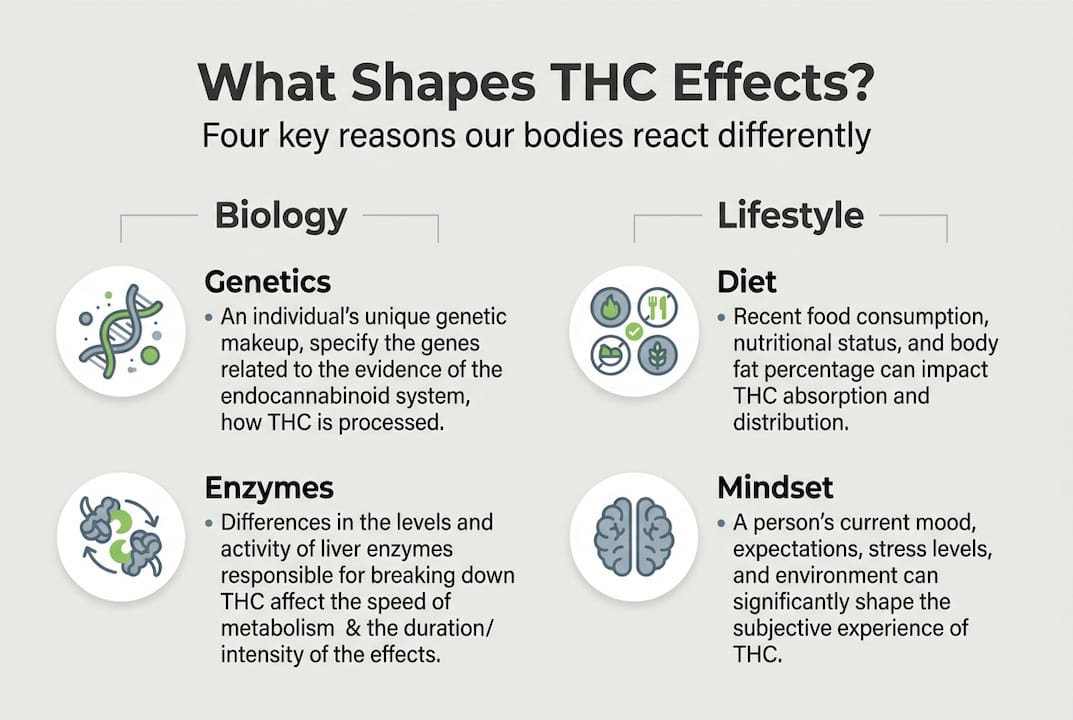
Then there’s the enzyme layer. Your liver uses enzymes, especially CYP2C9 and CYP3A4, to break THC down. Fast metabolizers clear THC quickly, feeling effects that are shorter and milder. Slow metabolizers hold onto THC longer, experiencing stronger and more prolonged effects. Roughly 20 to 30% of people fall into the slow metabolizer category, which explains why some people feel wrecked from a dose that barely touches someone else.
Here’s a quick look at how these biological differences stack up:
| Factor | Fast metabolizer | Slow metabolizer |
|---|---|---|
| THC clearance | Rapid (shorter effects) | Slow (longer effects) |
| Effect intensity | Milder | Stronger |
| Risk of overconsumption | Lower | Higher |
| Estimated prevalence | 70-80% of people | 20-30% of people |
Key ECS variables that shape your experience include:
Pro Tip: If you consistently feel THC more intensely than others at the same dose, there’s a real chance you’re a slow metabolizer. Starting with a lower dose and waiting longer before redosing is the smartest move you can make. Learning how THC works in your body gives you a strong foundation for making those calls confidently.
Understanding the CBD vs THC differences also helps here, since CBD can actually moderate some of THC’s stronger effects by interacting with the same receptor system.
With biology covered, let’s look at how practical choices, specifically how you take THC, amplify these personal differences in very real ways.
The route of consumption may be the single biggest variable you can actually control. Smoking or vaping delivers THC directly to your bloodstream through the lungs, producing effects within minutes that typically peak and fade within one to three hours. Edibles take a completely different path. They travel through your digestive system and liver, where THC converts into 11-OH-THC, a metabolite that crosses the blood-brain barrier more efficiently and hits harder. Edibles undergo first-pass liver metabolism to this potent form, with bioavailability of just 4 to 12%, but a fatty meal can boost that absorption by roughly 2.5 times.

THC beverages, like our fast-acting drinks at Edwin’s Edibles & Elixirs, can behave differently again, especially when formulated with absorption technology that speeds onset compared to traditional edibles.
Here’s how the main delivery methods compare:
| Method | Onset time | Duration | Intensity |
|---|---|---|---|
| Inhalation | 2 to 10 minutes | 1 to 3 hours | Moderate, controllable |
| Traditional edibles | 30 to 120 minutes | 4 to 8 hours | Strong, less predictable |
| THC beverages (fast-acting) | 15 to 45 minutes | 2 to 5 hours | Moderate, faster feedback |
The steps that shape your edible experience most:
“The edible experience is not just about the milligrams on the label. It’s about what your body does with those milligrams once they arrive.”
Pro Tip: Never judge an edible’s strength on an empty stomach versus a full one. Eating a high-fat snack before your edible can dramatically change how strong it feels. Understanding THC absorption in edibles helps you predict and control your experience far better. For deeper guidance, explore maximizing edible effects and the full breakdown of edibles vs smoking effects.
Physical differences aren’t the whole story; our daily routines and backgrounds also make a surprising impact on how THC lands.
One underappreciated factor is body composition. THC is lipophilic, meaning it loves fat. It gets stored in fat cells and released slowly over time, which means people with higher body fat percentages may experience effects that last longer or feel delayed. This also plays a role in how long THC remains detectable in the body, which matters for both wellness planning and drug testing awareness.
Hormones are another powerful variable. Estrogen enhances THC sensitivity while cortisol (your stress hormone) depletes anandamide, your body’s natural feel-good endocannabinoid. So a stressful day can actually make THC feel less pleasant or more anxious. Sleep deprivation upregulates CB1 receptors, making them more sensitive, which is why a sleepy person often feels THC more intensely.
Key daily factors that shift your THC experience:
Research also points to meaningful sex-based differences in THC sensitivity, with females showing greater sensitivity in some studies, partly due to estrogen’s interaction with the ECS. Slow metabolizer status also appears more prevalent among women in cannabis use disorder cases, suggesting that dose recommendations shouldn’t be one-size-fits-all across sexes.
Pro Tip: Pay attention to how you feel before you consume. If you’re sleep-deprived or stressed, your THC experience will likely feel more intense or emotionally charged. Tracking these variables helps you understand THC tolerance and adjust your approach accordingly.
While your body plays a role, your mindset and context unlock or block THC’s full range of effects in ways that are easy to underestimate.
The cannabis community has long talked about “set and setting,” and science backs it up. Set and setting, mood and expectations modulate perception of THC’s effects, sometimes as powerfully as the dose itself. If you’re anxious going in, THC is more likely to amplify that anxiety. If you’re relaxed and in a comfortable environment, the same dose can feel warm and pleasant.
THC also follows a biphasic pattern, meaning it behaves differently at low versus high doses:
This biphasic behavior explains why some people swear THC gives them energy while others insist it puts them to sleep. Both experiences are valid; they’re just operating at different points on the dose curve.
Tolerance is another dynamic force. Regular use causes CB1 receptors to downregulate, meaning they become less responsive over time. But here’s the encouraging part: tolerance reverses quickly through receptor repopulation, often within just a few days to a few weeks of a break. Many experienced users are surprised to find their “newbie” sensitivity returns faster than expected after a short pause.
“Your best THC experience isn’t about finding the strongest product. It’s about finding the right dose for your current state of mind and body.”
For practical guidance on finding your personal sweet spot, our resources on tolerance and THC effects and THC dosing tips are a great place to start.
So what does all this complexity mean for you in the real world? We think it means one thing clearly: the idea that THC works the same for everyone is not just wrong, it’s actually harmful to the experience.
When people expect cannabis to hit them the way it hits a friend, they often overdose chasing that effect, or feel disappointed when their experience is quieter. Others feel anxiety and assume something is wrong with them, when in reality their biology just responds differently. Comparing your experience to someone else’s is a setup for frustration.
The real shift happens when you treat cannabis as personal. Start low, track how your body responds across different conditions and adjust based on what you actually feel, not what you expect to feel. The differences between edibles and smoking alone can completely change your relationship with THC. Your ideal experience will look different from anyone else’s and that’s not a problem. That’s the whole point.
If you’re ready to take charge of your cannabis journey, here’s where to start. At Edwin’s Edibles & Elixirs, we believe informed consumers have the best experiences. That’s why we pair our premium, small-batch Delta 9 THC products with real educational resources to help you find what works for your body and goals.
Explore our cannabis edibles guide to understand your options, then dig into our optimal edible consumption resource for practical dosing wisdom. When you’re ready to shop with confidence, our guide to choosing edibles makes it easy to match the right product to your lifestyle. Your personalized THC experience starts here.
Yes. Due to genetics, metabolism, mindset and hormone levels, the same amount of THC can energize one person while relaxing or overwhelming another. Genetics and ECS baseline set the foundation and body fat, sex and hormones fine-tune the rest.
Yes. Just a short break of a few days to a few weeks can reset your sensitivity because CB1 receptors repopulate quickly, restoring much of your original responsiveness to THC.
Edibles often feel more potent because the liver converts THC into 11-OH-THC via first-pass metabolism, a stronger form that crosses the blood-brain barrier more easily, making each milligram feel more impactful.
Yes. THC is stored in fat cells, so people with more body fat often experience prolonged and sometimes delayed effects as THC releases gradually back into the bloodstream.
Absolutely. Since everyone’s ideal THC amount is different, starting with a small dose and waiting before adding more is the safest and most reliable way to find your personal sweet spot.