
If you’ve ever picked a product labeled “sativa” expecting energy or “indica” expecting sleep, only to feel something completely different, you’re not alone. The truth is, over 90% of commercial strains are hybrids, meaning the clean sativa/indica split you see on packaging is mostly a marketing shorthand. Real effects come from a far more complex mix of cannabinoids, terpenes and genetics. Understanding hybrids isn’t just for growers or scientists. It’s the key to choosing edibles and infused products that actually deliver the experience you want.
| Point | Details |
|---|---|
| Hybrids are the market norm | Over 90% of cannabis strains are hybrids, enabling tailored effects and flavors to match consumer needs. |
| Cannabinoids and terpenes matter | Your experience hinges on THC, CBD and terpene profiles—not on indica or sativa labels. |
| Lab reports provide clarity | Reviewing lab reports for cannabinoid and terpene content ensures predictable, safe outcomes in edibles. |
| Balanced hybrids enhance wellness | Hybrids with balanced THC and CBD ratios can offer pain relief and protect cognition in infused products. |
| Advanced genetics boost consistency | Polyhybrids and stabilized F1s deliver reliable effects and higher yields in premium edibles. |
A hybrid cannabis strain is exactly what it sounds like: a plant bred from two or more different cannabis varieties. Crossbreeding different cannabis varieties allows cultivators to combine the most desirable traits from each parent, whether that’s a specific flavor, higher potency, faster growth, or a particular effect profile.
The process works like this: breeders select parent plants with complementary traits and cross-pollinate them. The resulting seeds carry genetic material from both parents. Over multiple generations, breeders refine those traits through selective breeding until the strain performs consistently.
Here’s what breeders typically target when creating a new hybrid:
You can explore cannabis hybrid creation in more depth to see how breeders stack these traits across generations. The result is a market where nearly every strain you encounter, from gummies to infused drinks, is built on hybrid genetics. Our hybrid edible selection guide breaks down how those genetics translate into real product choices.
“Hybrid cannabis strains are created by crossbreeding different cannabis varieties to combine desirable traits, resulting in plants with unique combinations of effects, flavors and growth characteristics.”
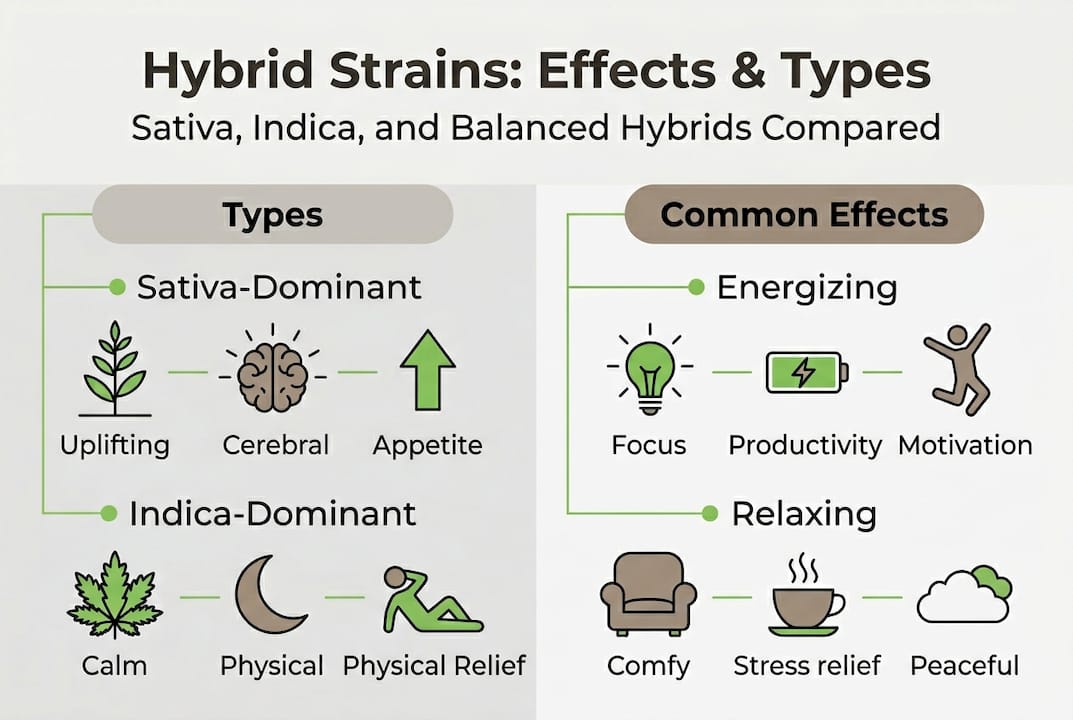
Not all hybrids are created equal. Hybrids are categorized as sativa-dominant, indica-dominant, or balanced and each category tends to produce a different experience. That said, these categories are starting points, not guarantees.

Here’s a quick comparison to orient you:
| Category | Dominant traits | Common effects | Best for |
|---|---|---|---|
| Sativa-dominant | Energizing, cerebral | Focus, creativity, mood lift | Daytime use, social settings |
| Indica-dominant | Relaxing, body-heavy | Calm, sleep support, tension relief | Evening use, unwinding |
| Balanced hybrid | Mixed, nuanced | Moderate body and mind effects | Flexible, all-day use |
For edibles and infused products, these categories matter because the onset and duration of effects differ from smoking. Edibles metabolize through the liver, converting THC into a more potent compound called 11-hydroxy-THC. This means a sativa-dominant edible can feel more intense and longer-lasting than the same strain smoked.
Key things to know about hybrid categories in edible formats:
According to market hybrid statistics, the vast majority of products on dispensary shelves today are hybrid-based, which means understanding these categories is no longer optional. It’s essential. For a side-by-side breakdown of the broader spectrum, the indica vs sativa comparison is a solid reference.
Here’s the part most product labels skip entirely. Effects are driven by cannabinoids and terpenes, not by whether something is labeled sativa or indica. The indica/sativa myth has been widely debunked in scientific literature, yet the labels persist because they’re simple to market.
Cannabinoids are the chemical compounds that interact with your body’s endocannabinoid system. THC produces the psychoactive high, while CBD modulates and often softens those effects. The ratio between them shapes your experience more than the strain name ever could.
Terpenes are aromatic compounds found in cannabis and many other plants. They don’t just create flavor and smell. They actively influence how cannabinoids behave in your body, a phenomenon called the entourage effect.
| Terpene | Aroma | Associated effects |
|---|---|---|
| Myrcene | Earthy, musky | Sedating, muscle relaxation |
| Limonene | Citrus | Mood elevation, stress relief |
| Pinene | Pine | Alertness, memory retention |
| Caryophyllene | Spicy, peppery | Anti-inflammatory, calm |
| Linalool | Floral, lavender | Anxiety relief, sleep support |
Pro Tip: When shopping for hybrid edibles, look for products that list their terpene profile alongside cannabinoid percentages. A gummy with 5mg THC and a high myrcene content will feel very different from one with the same THC and dominant limonene. Understanding how to combine CBD and THC for optimal effects is one of the most practical skills you can develop as a cannabis consumer.
This is exactly why premium edibles stand apart from generic products. When a brand formulates with specific cannabinoid ratios and terpene profiles in mind, the result is a predictable, repeatable experience rather than a guessing game.
Let’s talk about what the science actually shows. A 2025 study published in Frontiers in Psychology provides some of the clearest data yet on how hybrid strains affect the body and mind.
Here’s what the research found:
Pro Tip: If you’re new to hybrid edibles or sensitive to THC, start with a 1:1 ratio product. You get the therapeutic benefits without the cognitive fog that high-THC products can cause. Check out the hybrid edible benefits page for a breakdown of how different ratios serve different goals.
“The evidence is clear: cannabinoid ratios, not strain labels, determine both the therapeutic value and the risk profile of any hybrid product.”
For a deeper look at how experts interpret these findings, the hybrid effects expert resource at Kanab offers accessible explanations grounded in current research.
If you’ve ever wondered why two products with the same strain name can feel completely different, genetics instability is often the answer. Polyhybrids increase complexity by combining traits from three or more parent strains, while F1 hybrids (first-generation crosses) offer uniformity but can be unpredictable in later generations.
Here’s a breakdown of the key genetic concepts:
For premium edible production, stability matters enormously. A batch of gummies made from an unstable hybrid can vary in potency and terpene content from run to run. That’s why lab testing for edibles safety is non-negotiable for any brand serious about consistency.
Pro Tip: Before buying any hybrid edible, check whether the brand publishes lab reports. A certificate of analysis (COA) confirms the actual cannabinoid and terpene content in that specific batch. Learning to understand lab reports for cannabis edibles takes about 10 minutes and can save you from a lot of disappointing or overwhelming experiences.
For a technical deep dive into how breeders manage these variables, the hybridization techniques resource from FloraFlex is worth bookmarking.
All the genetics knowledge in the world only matters if you can apply it at the point of purchase. Here’s a practical framework for choosing hybrid edibles with confidence.
Step-by-step selection process:
For premium edibles and infused products, selecting hybrids with specific terpene profiles and balanced THC:CBD ratios consistently produces the best outcomes. Generic strain names without supporting data are not enough to make a confident choice.
Additional tips for smart hybrid edible selection:
Our hybrid edible selection guide walks through these steps in detail and the premium cannabis edibles page explains what separates quality products from the rest.
Now that you know how to read a hybrid strain and what to look for in a product, the next step is finding edibles that actually meet that standard. At Edwin’s Edibles & Elixirs, every product is small-batch, hemp-derived and built around specific cannabinoid and terpene profiles. Our cannabis edibles guide is a great starting point if you’re still building your foundation. When you’re ready to shop with intention, the choosing cannabis edibles resource helps you match products to your goals. And for hybrid-specific decisions, our hybrid edible selection guide gives you a clear, step-by-step path to the right product every time.
Hybrids combine traits from multiple cannabis varieties to create tailored effect profiles, while pure landraces are rare and lack the consistency or customization that modern hybrids offer.
No. Labels are unreliable predictors of effects in over 60% of cases according to analysis by Leafly. Cannabinoid and terpene profiles are far more accurate guides.
Prioritize products with balanced THC:CBD ratios and a listed terpene profile and always verify the cannabinoid content with a third-party lab report before purchasing.
Yes. 1:1 THC:CBD hybrids show measurable pain relief without the memory impairment associated with THC-dominant products, according to published clinical research.
Polyhybrids allow breeders to stack multiple desirable traits into one strain, while F1 hybrids offer uniformity and consistent potency, both of which are critical for reliable edible production.