
Most people assume that if an edible is sitting on a dispensary shelf or landing in their mailbox from a reputable online store, it must be safe. That assumption can cost you. A COA (Certificate of Analysis) is an independent lab report that tells you exactly what is in your edible, from cannabinoid potency to pesticide levels. Without one, you are essentially trusting a label. This guide walks you through what a COA is, why it matters more than most edible buyers realize and how to read one like a pro so every edible experience you have is as safe and satisfying as it should be.
| Point | Details |
|---|---|
| COAs verify safety | A COA is an independent lab report proving edible safety and content accuracy. |
| Look for full-panel tests | The best COAs verify potency, contaminants and terpene content, not just THC. |
| Always match COA and batch | Check that the COA’s batch number and date align with your edible’s packaging. |
| Regular COA checks prevent risk | Making a habit of reviewing COAs helps avoid unsafe or mislabeled products. |
Let’s clear something up right away. A COA is not just a piece of paperwork brands attach to look credible. A COA is a lab report from an independent, certified third-party lab that verifies the quality, potency and safety of cannabis products including edibles. That independence is the whole point. When the lab has no financial stake in the product, its results are trustworthy.
Understanding the COA importance for edibles specifically is critical because, unlike smoking or vaping, edibles move through your digestive system. Dosing accuracy matters enormously. A gummy that claims 10mg of Delta 9 THC but actually contains 25mg can turn a relaxing evening into an overwhelming experience. COAs are the only way to verify that the label matches reality.
Here is what a full-panel COA typically tests for:
“A product without a COA is a product without accountability.”
On the regulatory side, states mandate full testing for licensed cannabis products, but unregulated markets lack those standards and the FDA oversees food chemical safety without directly regulating cannabis edibles. That gap is exactly why demanding a COA is your responsibility as a consumer. The lab testing role in edible safety fills the regulatory void that federal law has yet to close.
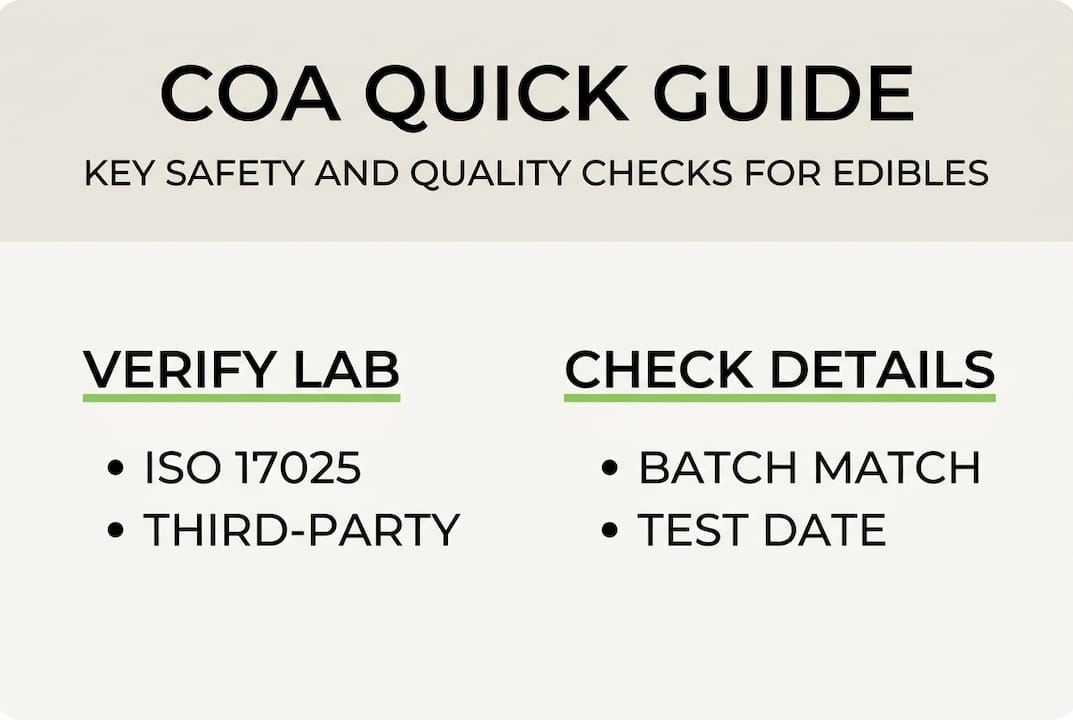
Pro Tip: Always check that the COA comes from a lab accredited by ISO 17025, the international standard for testing laboratory competence. This accreditation signals the lab follows rigorous quality protocols.
Now that you know what a COA is, let’s walk through how to make sense of one for any edible. Most COAs follow a similar layout and once you recognize the sections, reading them becomes second nature.
Step-by-step guide to reading a COA:
Here is a quick comparison of what separates a trustworthy COA from a questionable one:
| Feature | Strong COA | Weak or suspicious COA |
|---|---|---|
| Lab accreditation | ISO 17025 certified | No accreditation listed |
| Test date | Within 12 months | Outdated or missing |
| Testing scope | Full panel (all categories) | Potency only |
| Batch number match | Matches product label | Missing or mismatched |
| Contaminant results | ND or below limits | Vague or absent |
| Testing method listed | HPLC or GC specified | Method not stated |
For interpreting lab reports accurately, always cross-reference the batch number on the COA with the batch number printed on your product packaging. They must match. If they do not, the COA may not apply to what you are holding.
Pro Tip: Use the COA to guide your edible dosing and safety decisions. If the COA shows 8mg THC per gummy instead of the labeled 10mg, adjust your serving size accordingly rather than guessing.
Once you recognize the main sections, understanding quality indicators can help you avoid subpar edibles. This is where reading a COA shifts from basic literacy to genuine expertise.

Start with the THC math. Total THC equals THC plus THCA multiplied by 0.877. That 0.877 conversion factor accounts for the molecular weight lost when THCA decarboxylates into active THC during digestion or heating. If a brand only lists THC without accounting for THCA, their potency claim may be understated or overstated depending on the product format.
Terpenes are another quality signal most buyers overlook. Terpene content above 2% is generally considered a marker of a well-cultivated, quality source material. High terpene levels suggest careful growing, harvesting and processing. Low or absent terpene data on a COA often means the product was made from lower-grade extract.
Here is a breakdown of key quality indicators and what they signal:
| Indicator | What it means | Why it matters |
|---|---|---|
| Terpene content >2% | High-quality source material | Better flavor and entourage effect |
| Full-panel testing | Brand prioritizes safety | Protects against hidden contaminants |
| Potency within 10% of label | Accurate manufacturing | Reliable dosing every time |
| Heavy metals below limits | Clean growing environment | No long-term health risk |
| Pesticides: ND | Organic or clean cultivation | No chemical exposure |
Red flags to watch for on any COA:
The value of third-party testing cannot be overstated. Brands that invest in full-panel COAs are telling you something important: they stand behind what is in their products. Use this CBD gummies checklist approach for any edible, not just gummies, to evaluate quality before you buy.
Knowing what to look for allows you to take these practical steps before your next edible purchase. Verification is not complicated, but it does require a few deliberate habits.
How to verify a COA before buying:
If a brand cannot or will not provide a COA, walk away. No COA means no accountability and no accountability means you are taking an unnecessary risk with your health and your experience.
Pro Tip: Screenshot or save the COA before you consume any edible. If you ever have an unexpected reaction, having the lab report on hand helps you and any medical professional understand exactly what was in the product.
For anyone safely trying edibles for the first time, verifying the COA is as important as starting with a low dose. Both habits together create a foundation for consistently positive experiences.
Here is our honest take after years of crafting and curating premium edibles: most buyers skip the COA entirely and we understand why. It feels like homework when you just want to enjoy a gummy. But that shortcut is where things go wrong.
We have seen products on the market with labels that bore no resemblance to what was actually inside. We have heard from customers who had unpredictable experiences with other brands before finding us and almost every time, the missing link was a COA they never thought to ask for. Demanding COAs from every brand you buy from is not paranoia. It is the single most powerful habit a cannabis edible consumer can build.
The edible market is still maturing. Federal regulation is inconsistent. That means the burden of verification falls on you and the COA is your best tool. Consumers who read COAs regularly make smarter purchases, dose more accurately and build genuine trust with the brands they choose. That is not just safety. That is confidence.
At Edwin’s Edibles & Elixirs, transparency is not a marketing line. Every product we offer comes with a current, full-panel COA from an accredited third-party lab, because we believe you deserve to know exactly what you are enjoying. Whether you are exploring cannabis edibles explained for the first time or you are a seasoned enthusiast looking for small-batch quality you can trust, we make it easy. Browse our Delta 9 THC gummies and experience the confidence that comes with knowing every batch has been independently verified. Your safety and satisfaction are always our priority.
You can typically find the COA on the brand’s website or by requesting it directly from the retailer. Reputable vendors make COAs easily accessible for every batch, because a COA is only reliable when it comes from a verified third-party lab.
Most states require COAs for licensed cannabis products, but unregulated markets lack standards and the FDA does not directly regulate cannabis edibles, so gray market goods may lack valid third-party verification entirely.
Focus on the test date, batch number match, third-party lab accreditation and whether the report covers a full panel over potency-only testing for maximum safety assurance.
Yes. The COA shows cannabinoid levels in mg per serving and per package, giving you the information you need to make confident, informed dosing decisions every time.