
Hemp legality in 2025 is defined by the 2018 Farm Bill’s threshold of delta-9 THC at or below 0.3% on a dry weight basis, making hemp federally legal and distinct from marijuana under the Controlled Substances Act. What is hemp legality in 2025, practically speaking? It is a regulatory environment in active transition. P.L. 119-37, the FY2026 Agriculture Appropriations Act, rewrites the federal definition of hemp to include total THC, covering both delta-9 THC and THCA, with that change taking effect November 12, 2026. For consumers, retailers and legal professionals operating right now, 2025 sits in a critical window where the current standard still applies but enforcement priorities are already shifting.
The 2018 Farm Bill defines hemp as Cannabis sativa L. with a delta-9 THC concentration at or below 0.3% on a dry weight basis, removing it from the definition of marijuana under federal controlled substances law. That standard remains the governing law throughout 2025. This means a product can be sold, transported and consumed legally at the federal level as long as its delta-9 THC content stays within that threshold, regardless of what other cannabinoids it contains.
The critical gap in this standard is that delta-9 testing alone misses intoxicating cannabinoids like THCA, which converts to delta-9 THC when heated. A product with very low delta-9 THC but high THCA can pass the current federal test while still producing significant psychoactive effects. This is the loophole the 2026 definition change directly targets.
The FY2026 total THC amendment shifts the legal threshold to include both delta-9 THC and THCA combined, capped at 0.3%. That change does not apply yet in 2025, but federal enforcement agencies are already treating intoxicating hemp derivatives with heightened scrutiny. The Congressional Research Service recommends viewing 2025 hemp compliance through the lens of the current delta-9 standard while preparing for total THC expectations ahead of the November 2026 effective date.
Here is what the two standards mean side by side:
Pro Tip: If you are sourcing or selling hemp products in 2025, request Certificates of Analysis (COAs) that report both delta-9 THC and total THC values. This positions you for compliance under both the current and upcoming standards.
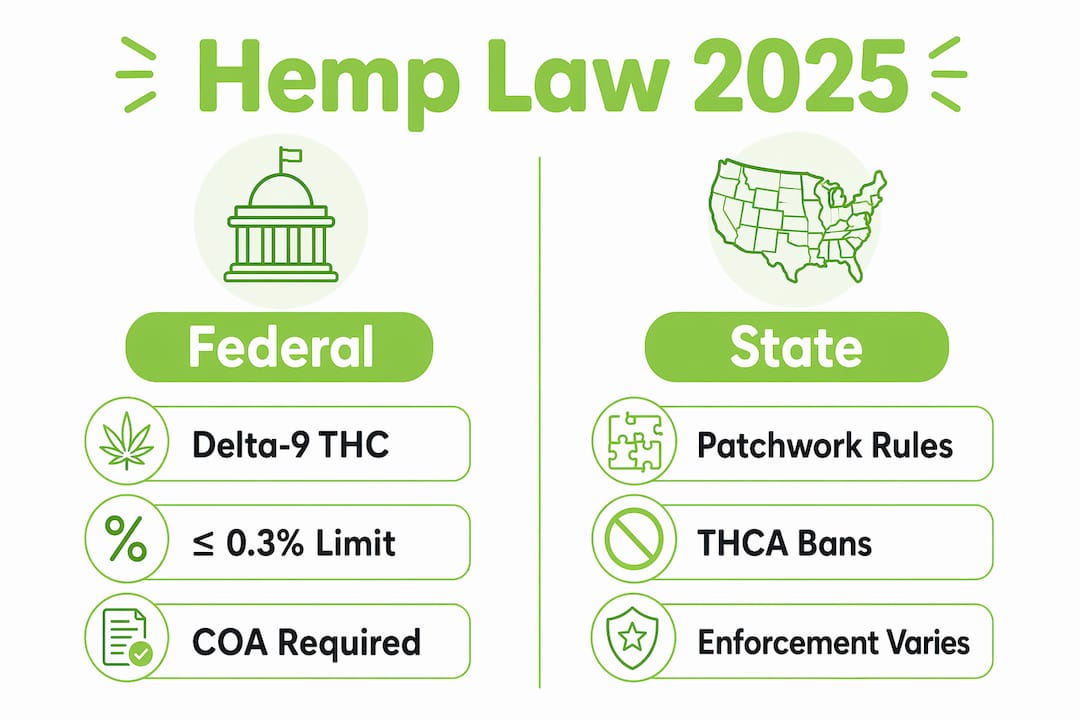
State-level hemp regulation in 2025 is a patchwork and the variation creates real legal exposure for anyone moving products across state lines. Some states follow the federal delta-9 THC standard closely, while others have moved ahead of federal law to restrict or ban intoxicating hemp derivatives entirely.

Tennessee is the clearest example of aggressive state action. Tennessee’s THCA ban takes effect July 1, 2026, targeting hemp products that produce intoxicating effects, including THCA flower. Before enforcement, THCA products reportedly accounted for roughly 75% of Tennessee hemp sales. That figure illustrates how commercially significant these products are and how disruptive state-level restrictions can be.
The table below shows how selected state approaches compare to the current federal standard:
| Jurisdiction | Current standard | THCA status | Direction of change |
|---|---|---|---|
| Federal (2025) | Delta-9 THC ≤0.3% | Legal if delta-9 compliant | Tightening in Nov 2026 |
| Tennessee | Delta-9 THC ≤0.3% | Banned starting July 2026 | Ahead of federal timeline |
| States with no added restrictions | Delta-9 THC ≤0.3% | Legal if delta-9 compliant | Monitoring federal changes |
| States with intoxicating cannabinoid bans | Stricter than federal | Restricted or banned | Already enforcing total THC logic |
The enforcement reality in 2025 is that even products compliant under the 2018 Farm Bill standard can trigger legal problems at the state level. An Oklahoma case in 2025 illustrated this starkly: an owner-operator was jailed for hauling hemp products that met the federal delta-9 THC threshold, with the dispute centering on THCA content and contested testing methods. The case underscores that documentation and testing methodology are not administrative details. They are legal defenses.
Retailers operating in multiple states face the most exposure. A product that is fully legal to sell in one state may be contraband 50 miles away. Legal professionals advising hemp businesses in 2025 need to map each state’s current statute, not assume federal compliance equals universal compliance.
For health-conscious consumers, the most important thing to understand is that legal hemp status reflects THC measurement under a specific testing standard. It does not guarantee a product is non-intoxicating. A hemp product compliant under the 2018 delta-9 standard can still contain substantial THCA or delta-8 THC, both of which produce psychoactive effects. Consumers who want non-intoxicating products need to read COAs carefully, not rely on the word “legal” as a proxy for “mild.”
For retailers and producers, the compliance risks in 2025 fall into three categories:
For legal professionals, the transition period creates a dual-standard environment where advice must account for both the current delta-9 rule and the incoming total THC rule simultaneously. Contracts, compliance programs and licensing agreements drafted in 2025 should include provisions that address the November 2026 definition change explicitly.
Pro Tip: Legal advisors should build a regulatory calendar that flags the November 12, 2026 effective date, Tennessee’s July 1, 2026 THCA ban and any state-specific legislative sessions where hemp bills are pending. Reactive compliance is far more expensive than proactive monitoring.
The federal enforcement focus in 2025 has shifted toward psychoactive hemp derivatives, including delta-8 THC and THCA products, even before the formal 2026 rule change. The Trump administration has claimed new legal authority to target intoxicating hemp products, signaling that enforcement will not wait for the November 2026 date to arrive.
The November 12, 2026 effective date for the total THC definition is the single most important date in hemp compliance planning right now. Here is a structured approach for producers, consumers and legal advisors to act on before that date:
The regulatory transition risk is real and accelerating. Federal enforcement agencies are not waiting for November 2026 to act against intoxicating hemp products. Stakeholders who treat 2025 as a grace period do so at significant legal and financial risk.
Hemp legality in 2025 is governed by the 2018 Farm Bill’s delta-9 THC standard, but the November 2026 total THC definition change and accelerating federal enforcement make proactive compliance the only responsible strategy.
| Point | Details |
|---|---|
| Current federal standard | Hemp is legal federally in 2025 if delta-9 THC stays at or below 0.3% dry weight. |
| Incoming total THC rule | P.L. 119-37 adds THCA to the THC calculation, effective November 12, 2026. |
| State law patchwork | Tennessee bans THCA products from July 2026; other states vary widely from federal standards. |
| Enforcement is already shifting | Federal agencies are targeting intoxicating hemp derivatives before the 2026 rule takes effect. |
| Documentation is your defense | COAs reporting both delta-9 and total THC values are the primary legal protection in 2025. |
I have watched the hemp space evolve through multiple regulatory cycles and the 2025 moment feels different from prior transitions. The 2018 Farm Bill created a legal framework that was, frankly, underspecified. The delta-9 THC standard made sense as a starting point, but it left a wide opening for products that are intoxicating in every practical sense while remaining technically compliant on paper. The market filled that opening aggressively with THCA flower, delta-8 concentrates and other derivatives that exploit the measurement gap.
What concerns me most in 2025 is not the November 2026 deadline itself. It is the enforcement posture that is already in place before that deadline arrives. The Oklahoma case is not an outlier. It is a preview. An operator with federally compliant products, proper paperwork and legitimate business operations still ended up in jail because state enforcement and federal definitions are not synchronized. That gap is where real people get hurt.
My advice to anyone operating in this space right now is to stop treating legal compliance as a checkbox and start treating it as a living document. The hemp regulatory environment is not stable. It is moving and the direction is toward tighter restrictions, not looser ones. The businesses and consumers who will navigate this well are the ones who invest in understanding the law today, not the ones who wait for enforcement to teach them the lesson.
For health-conscious consumers specifically, I want to be direct: the word “legal” on a hemp product label tells you about a measurement standard. It does not tell you about intoxication potential, product safety, or what will happen when you cross a state line with it. Read the COA. Understand what you are consuming. That is not paranoia. It is informed decision-making.
— Jamison
Navigating hemp legality in 2025 is genuinely complex, but it does not have to stop you from enjoying high-quality, compliant hemp-derived products. At Edwin’s Edibles & Elixirs, we take compliance seriously at every step, from sourcing organic hemp to third-party testing every batch of our small-batch Delta 9 THC edibles and Organic CBD gummies. Our cannabis edibles guide walks you through exactly what legal hemp-derived edibles are, how they work and what to look for on a COA before you buy. If you want to go deeper on the regulatory side, our legal Delta 9 THC guide breaks down how hemp-derived THC stays compliant under current federal law. We believe an informed customer is the best kind and we are here to make that education as enjoyable as the products themselves.
Hemp is federally legal in 2025 under the 2018 Farm Bill if it contains delta-9 THC at or below 0.3% on a dry weight basis. This standard remains in effect until the total THC definition change takes effect on November 12, 2026.
THCA hemp products are federally legal in 2025 as long as the product’s delta-9 THC concentration stays within the 0.3% threshold. However, some states, including Tennessee, are banning THCA products ahead of the federal timeline and federal enforcement agencies are already scrutinizing intoxicating hemp derivatives.
P.L. 119-37 amends the federal definition of hemp to require that total THC, meaning delta-9 THC plus THCA combined, stays at or below 0.3%. This takes effect November 12, 2026 and will make many currently compliant THCA products federally illegal.
State hemp laws vary significantly and can be stricter than federal standards. A product that is federally compliant under the 2018 delta-9 THC standard may still be illegal in states that have enacted their own restrictions on THCA or other intoxicating cannabinoids.
Certificates of Analysis from accredited third-party labs that report both delta-9 THC and total THC values are the primary legal protection for hemp producers, transporters and retailers in 2025. Disputes over testing methodology and COA accuracy have already resulted in contested seizures and criminal charges.