
Pure CBD isolate is defined as cannabidiol in its most refined crystalline form, typically a white to off-white powder with a purity of at least 98% and often reaching 99% or higher. Unlike full-spectrum or broad-spectrum CBD products, isolate contains no THC, terpenes, flavonoids, or other plant compounds. That single fact makes it the go-to choice for anyone who wants the difference between CBD and THC to matter in a very practical way: zero intoxication, zero detectable THC on a lab report. The UK Food Standards Agency formally characterizes CBD isolate as a novel food ingredient, which signals that regulators treat it as a distinct and specific product category rather than a generic supplement.
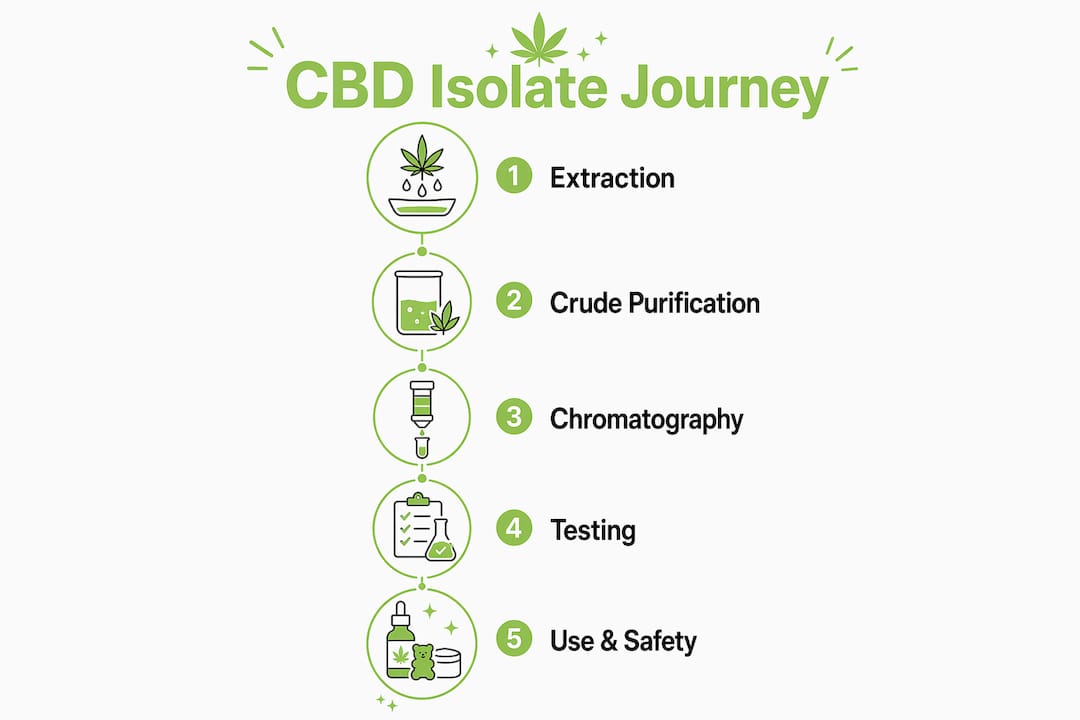
CBD isolate starts its life as raw hemp biomass. The extraction process that turns plant material into a near-pure crystalline compound involves several distinct steps and understanding them helps you judge the quality of any product you buy.
The first stage is CO2 or ethanol extraction, which pulls a broad spectrum of cannabinoids, terpenes and plant waxes from the hemp plant. CO2 extraction is the industry standard for premium products because it avoids solvent residues and gives manufacturers precise control over temperature and pressure. Ethanol extraction is faster and more scalable but requires additional refinement steps to remove residual solvent.
The crude extract that comes out of this first stage still contains THC, minor cannabinoids, chlorophyll and waxes. Manufacturers then run the extract through a series of purification steps: winterization (chilling the extract in alcohol to precipitate waxes), filtration and decarboxylation to activate the CBD. The result is a distillate that is rich in CBD but not yet isolated.
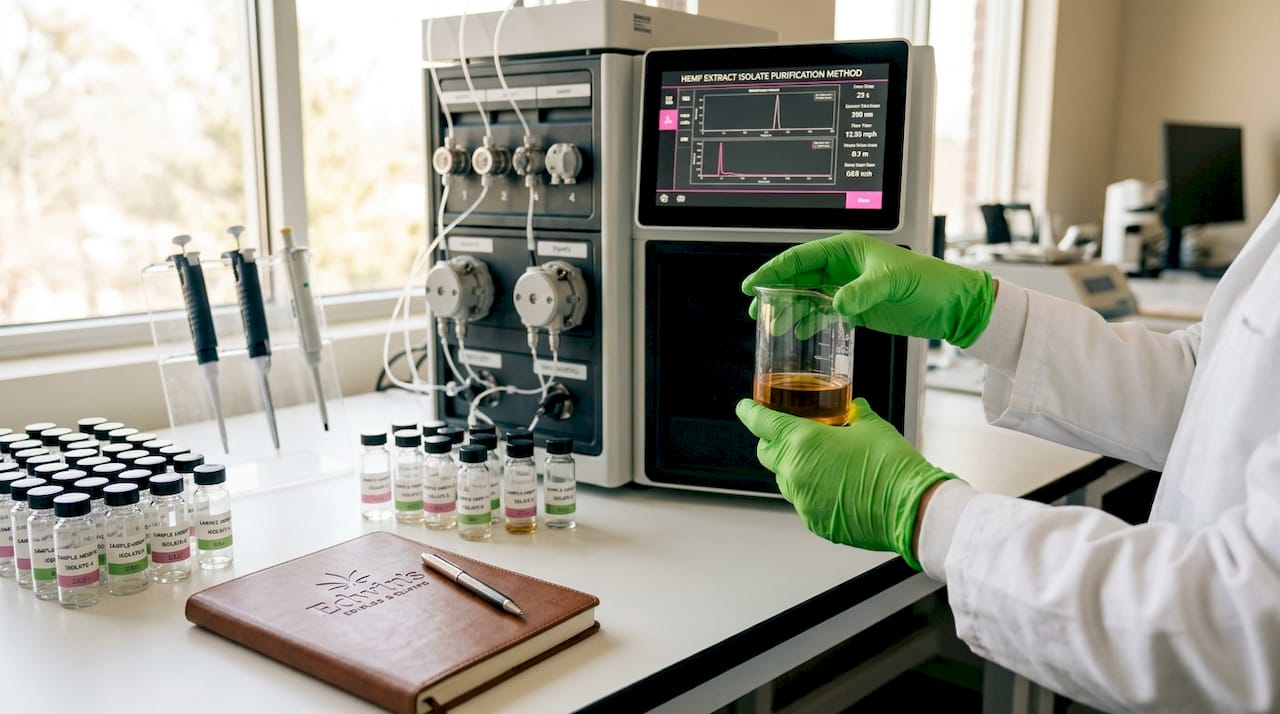
The final step is chromatography, which separates CBD from every remaining compound at the molecular level. What comes out is a crystalline CBD powder that is free from THC, terpenes and flavonoids. Reputable manufacturers then send this powder to an independent laboratory for a Certificate of Analysis (COA) confirming purity and the absence of heavy metals, pesticides and residual solvents.
Pro Tip: Always request a COA from a third-party lab, not just an in-house test result. The COA should show CBD potency, THC levels at a sensitive detection threshold (ideally below 0.01%) and a full panel for contaminants.
Legal compliance and personal safety are two separate questions and both deserve a direct answer.
On the legal side, the 2018 Farm Bill defines hemp as cannabis containing no more than 0.3% delta-9 THC by dry weight. Hemp-derived CBD isolate that meets this threshold is not classified as a controlled substance under federal law in the United States. That said, state laws vary and the 0.3% limit applies to the source plant, not necessarily to every finished product on the shelf. Independent lab testing is the only reliable way to confirm that a specific batch of CBD isolate stays within legal limits.
On the safety side, the UK Food Standards Agency’s novel food assessment concluded that 10 mg per day does not pose safety risks for healthy adults under assessed conditions. That figure is meaningful context, not a universal prescription. Dosing needs vary based on body weight, metabolism and the reason for use.
Key safety points every consumer should know:
“Daily safe intake levels for CBD isolate depend heavily on context, quality and regulatory submissions, cautioning against one-size-fits-all dosing.” — UK Food Standards Agency safety assessment insight
The lab testing role in confirming these safety parameters cannot be overstated. A COA from an accredited lab is the single most reliable document a consumer can review before purchasing any CBD isolate product.
CBD isolate vs full spectrum is one of the most searched comparisons in the hemp space and the distinction is straightforward once you understand what each product contains.
| Product type | CBD | THC | Terpenes and flavonoids | Other cannabinoids |
|---|---|---|---|---|
| CBD isolate | Yes (98%+) | None | None | None |
| Broad-spectrum | Yes | None (removed) | Yes | Yes (minor) |
| Full-spectrum | Yes | Yes (up to 0.3%) | Yes | Yes |
CBD isolate contains only cannabidiol, making it the cleanest option for anyone who needs to avoid THC entirely. Full-spectrum products retain all naturally occurring cannabinoids, terpenes and flavonoids from the hemp plant, including trace amounts of THC. Broad-spectrum sits in between, offering the full plant profile with THC removed through additional processing.
The concept of the “entourage effect” is the main argument for choosing full-spectrum or broad-spectrum over isolate. The theory holds that cannabinoids, terpenes and flavonoids work better together than any single compound does alone. Research on this effect is still developing and the evidence is not yet definitive. For consumers who want to explore broad-spectrum CBD without committing to a full-spectrum product, broad-spectrum is a practical middle ground.
CBD isolate’s appeal is precision. You know exactly what you are getting, the dose is predictable and there is no risk of THC accumulation from daily use. For athletes subject to drug testing, people in professions with zero-tolerance THC policies, or anyone sensitive to other cannabinoids, isolate is the logical choice.
Pro Tip: If you are new to CBD and want to avoid any psychoactive risk while still exploring hemp-derived wellness, start with a verified CBD isolate product at a low dose (5 to 10 mg) and adjust based on your response over two to four weeks.
The benefits of CBD isolate are grounded in both clinical evidence and widespread consumer use. The most clinically validated application is seizure reduction. The FDA approved Epidiolex, a 100 mg/mL CBD oral solution, for Lennox-Gastaut syndrome and Dravet syndrome. This is purified cannabidiol at pharmaceutical grade, which is the closest analog to CBD isolate in a regulated medical context. That approval matters because it confirms that highly purified CBD has measurable therapeutic effects under controlled conditions.
Beyond clinical use, consumers report using CBD isolate for:
CBD isolate products are available in oils, capsules, gummies, vaporizer liquids and topical creams. Each format has a different onset time and bioavailability. Sublingual oils absorb faster than edibles, while topicals work locally without entering the bloodstream. Knowing what is CBD isolate used for in your specific context helps you choose the right format and dose.
One point worth stating clearly: CBD isolate is not a cure for any condition and the FDA has not approved it for any use beyond Epidiolex’s specific indications. Treat it as a wellness supplement with a credible safety profile, not a pharmaceutical replacement.
Pure CBD isolate is the most precisely defined CBD product available and its value depends entirely on the quality controls behind its production.
| Point | Details |
|---|---|
| Purity standard | CBD isolate is at least 98% pure cannabidiol, often 99%, in crystalline powder form. |
| Extraction process | CO2 or ethanol extraction followed by chromatography removes all THC, terpenes and plant matter. |
| Legal threshold | Hemp-derived CBD isolate must come from plants with no more than 0.3% delta-9 THC under the 2018 Farm Bill. |
| Safety guidance | The UK FSA assessed 10 mg per day as safe for healthy adults; vulnerable groups should consult a doctor. |
| Isolate vs full-spectrum | Isolate contains only CBD; full-spectrum includes THC and terpenes; broad-spectrum removes THC but keeps other compounds. |
I have spent enough time in the hemp space to say this plainly: the word “pure” on a CBD isolate label means almost nothing without documentation to back it up. Any manufacturer can print it. What actually matters is the COA from an accredited third-party lab and most consumers never ask for one.
Here is what I have found in practice. Products that genuinely hit 99% CBD purity and test below 0.01% THC are not hard to find, but they require you to do one extra step: look up the batch-specific lab report, not the generic one posted on the website six months ago. Batch-to-batch consistency is where quality control either holds or falls apart.
The other thing I want to flag is dosing confidence. The UK FSA’s 10 mg per day guidance is a conservative regulatory floor, not a ceiling for everyone. Experienced users and clinical applications use much higher amounts. But if you are starting out, that conservative number is a reasonable anchor. Work up slowly, track your response and verify CBD product quality before you commit to any brand long-term.
My honest recommendation: treat CBD isolate as a precision tool. It is the right choice when you need predictability, THC avoidance, or a clean baseline. It is not automatically better than full-spectrum or broad-spectrum. It is just different and knowing that difference is what makes you a smarter consumer.
— Jamison
At Edwin’s Edibles & Elixirs, we believe that knowing what goes into your body is non-negotiable. Every product we craft goes through rigorous quality checks and we back our CBD gummies and edibles with transparent lab documentation so you can shop with confidence. Whether you are curious about CBD isolate edibles or want to explore our full range of hemp-derived wellness products, we make it easy to find something that fits your lifestyle. Our cannabis edibles guide is a great place to start if you want to understand your options before you buy. We are here to help you make informed choices, one delicious bite at a time.
CBD isolate extract is cannabidiol that has been separated from all other hemp plant compounds through multi-step extraction and chromatography, resulting in a crystalline powder that is at least 98% pure CBD with no THC, terpenes, or flavonoids.
The UK Food Standards Agency assessed that up to 10 mg per day poses no safety risk for healthy adults under reviewed conditions. Pregnant women, nursing mothers and people on prescription medications should consult a healthcare provider before use.
CBD isolate contains no THC, so a high-quality, verified product should not trigger a positive result on a standard THC drug test. However, this only holds if the product has been independently tested and confirmed THC-free at a sensitive detection threshold.
CBD isolate contains only cannabidiol at 98% or higher purity, while full-spectrum CBD retains all naturally occurring cannabinoids including up to 0.3% delta-9 THC, along with terpenes and flavonoids from the hemp plant.
CBD isolate can be used sublingually as an oil, consumed in edibles or capsules, applied topically, or inhaled via vaporizer. Sublingual and inhaled formats offer faster onset, while edibles and capsules provide slower, longer-lasting effects.