
Nearly all hemp edibles and wellness products on shelves today are on a collision course with federal law. ~95% of current products will be non-compliant after November 2026, exposing producers, retailers and even consumers to serious legal risk. The rules have changed dramatically and the old playbook no longer works. Whether you buy hemp gummies for wellness, enjoy THC-infused drinks, or simply want to understand what’s legal, this guide walks you through exactly what hemp compliance means, how enforcement works and what you need to do to stay on the right side of the law.
| Point | Details |
|---|---|
| 2026 hemp law overhaul | Nearly all current edibles and wellness products will be non-compliant after November 2026 due to stricter THC limits. |
| Strict testing and sampling | USDA and DEA enforce detailed sampling and lab protocols to verify THC levels before production and sale. |
| Microdose THC container limits | All consumer hemp products must now meet a strict 0.4 mg total THC/container threshold. |
| Edge cases complicate compliance | THCA conversion, synthetics and state-federal law conflicts create legal gray zones and selective enforcement. |
| Expert action steps | Only purchase from brands with current, certified lab testing results to reduce risk and stay compliant. |
Now that you know most products are at risk, let’s clarify what hemp compliance really means. At its core, hemp compliance refers to following every federal and state rule that governs how hemp is grown, processed, tested and sold. The USDA defines compliance as meeting all requirements around production, processing, testing and sale, with total THC at or below 0.3% on a dry-weight basis. After 2026, that calculation now includes THCA, delta-8 and other cannabinoids previously overlooked.
The legal line between hemp and marijuana comes down to one number: 0.3% total THC. Under the Controlled Substances Act, anything above that threshold is classified as marijuana, a Schedule I controlled substance. That classification carries serious consequences, including criminal liability for producers and sellers. Understanding hemp-derived THC changes is now essential for anyone in this space.
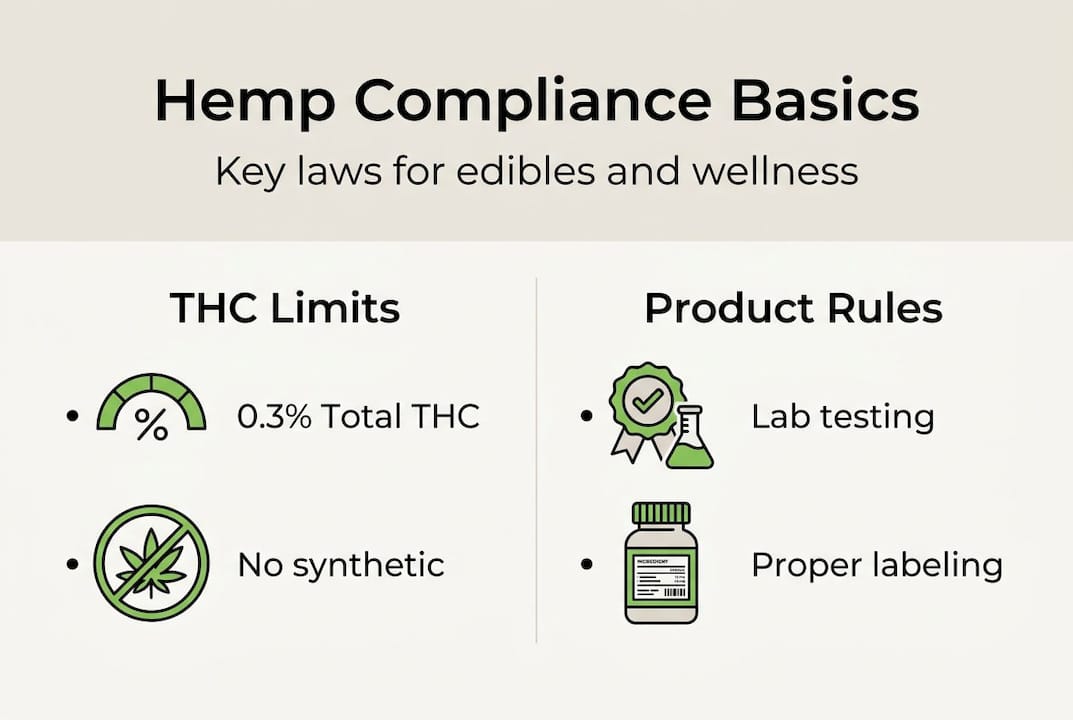
Compliance is not just a federal concern. The USDA sets baseline rules, the FDA governs finished consumer products and individual states or Tribal nations can add their own layers of requirements. Some states have stricter contaminant limits, additional labeling mandates, or outright bans on certain cannabinoids. Knowing what is legal THC in the U.S. has never been more complex.
Here is a quick comparison of how the standards have shifted:
| Compliance metric | Pre-2026 standard | Post-2026 standard |
|---|---|---|
| THC limit | ≤0.3% delta-9 THC (dry weight) | ≤0.3% total THC including THCA, delta-8 |
| CBD in food/supplements | Widely sold, loosely regulated | Prohibited under FDA drug preclusion rule |
| Synthetic cannabinoids | Sold in gray market | Federally banned |
| Container THC limit | Not defined for finished products | ≤0.4 mg total THC per container |
| Non-compliant product outcome | Warning letters, seizure risk | Mandatory destruction, Schedule I classification |
Key pillars of hemp compliance include:
Non-compliant products are not just pulled from shelves. They are classified as Schedule I marijuana under federal law, which means criminal exposure for everyone in the supply chain.
Defining compliance is only half the story. You are also subject to strict, technical testing and sampling requirements that determine whether your crop or product passes or fails. The enforcement process is more rigorous than most people realize and one misstep can cost an entire harvest.
Under USDA mandated protocols, hemp crops must be sampled 15 to 30 days before harvest. Only the flowering material is collected, since that is where cannabinoid concentrations are highest. Samples must then be sent to a DEA-registered laboratory for analysis using validated methods.
The two primary testing methods are:
Here is a summary of key testing benchmarks:
| Testing factor | Requirement |
|---|---|
| Sampling window | 15 to 30 days before harvest |
| Lab registration | DEA-registered and validated |
| Measurement uncertainty | Must be reported and factored into pass/fail |
| Non-compliant lot outcome | Mandatory destruction |
| Record retention | Minimum 3 years |
For finished edibles, the same rigor applies. We strongly recommend reviewing the lab testing role for edibles and understanding how hemp sourcing and quality affect your final product’s compliance standing. You can also review the official testing protocols in the Code of Federal Regulations for the full technical picture.
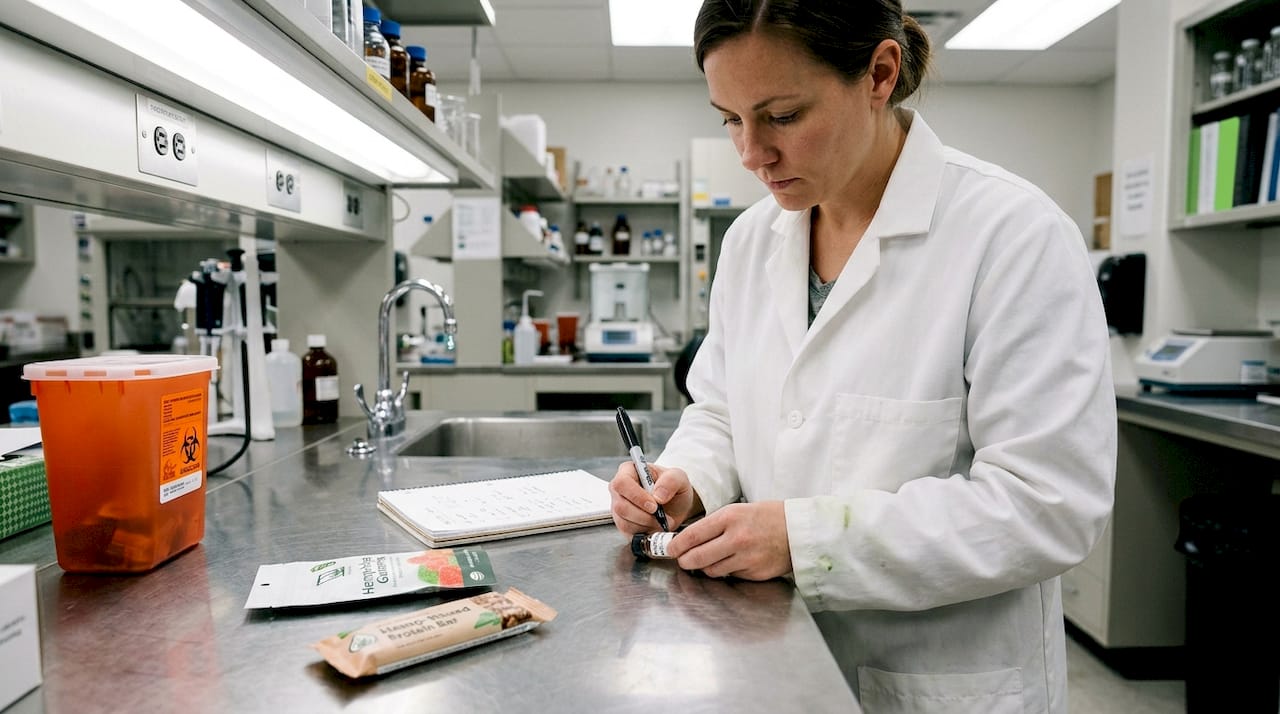
Pro Tip: Keep a dedicated testing logbook for every batch, including lab certificates, chain-of-custody forms and sampling dates. This is your first line of defense in any audit or enforcement action.
Production compliance means nothing if the final products do not meet consumer-facing rules. This is where most brands are getting caught off guard and where the stakes are highest for everyday buyers.
The post-2026 federal standard sets a hard limit of 0.4 mg total THC per container for all finished hemp products. That is an extremely low threshold. A single 10 mg Delta 9 gummy, which is standard in the current market, exceeds this limit by 25 times. Most products sold today simply cannot meet this standard without a complete reformulation.
CBD faces its own wall. The FDA has long maintained that CBD cannot legally be added to food or dietary supplements because it is already the active ingredient in an approved drug (Epidiolex). FDA warning letters have been issued to brands making unapproved health claims and there is no approved safety pathway for ingestible CBD in conventional food. This blocks a massive segment of the current wellness market.
Key stat: An estimated 95% of current hemp edibles and wellness products will fail the new 2026 federal standards. That is not a fringe concern. It is an industry-wide reckoning.
State and Tribal rules add another layer. Many states require:
For consumers, the smartest move is to only buy from brands that publish current, third-party lab results. Use our legal hemp edibles guide to understand what compliant products look like and check the 2026 hemp edibles status for the latest updates on what is and is not legal right now.
Pro Tip: Always request a certificate of analysis (COA) from a DEA-registered lab before purchasing any hemp edible or supplement. If a brand cannot provide one, walk away.
Even with clear standards, the reality is full of gray zones, edge cases and regulatory disagreements. Understanding these nuances is critical for anyone navigating this space in 2026.
The biggest edge case is THCA. In its raw form, THCA is not psychoactive. But when heated (smoked, vaped, or baked into edibles), it converts to THC via decarboxylation. The new federal rules count THCA toward the total THC threshold, which closes the loophole that allowed high-THCA flower to be sold as legal hemp.
Delta-8 THC, which is typically synthesized from CBD through a chemical conversion process, is now federally banned. Synthetic or chemically modified cannabinoids are explicitly excluded from the legal hemp definition post-2026. Several states had already moved to ban delta-8 before the federal rule caught up.
“Industry pushes back on overreach… enforcement is selective.” Many producers argue the new rules go too far and enforcement resources at the FDA, DEA and state level are genuinely limited. Selective enforcement is real, but it is not a compliance strategy.
State-federal conflicts remain a live issue. Some states still permit delta-8 sales. Others have legalized adult-use cannabis entirely, creating a patchwork of rules that confuses buyers and sellers alike. The state-federal hemp law conflicts are well documented and the USDA acknowledges that states may impose stricter standards than federal law.
Key edge cases to watch:
Understanding the full history behind these rules, including the pivotal 2018 Farm Bill changes, helps explain why the current regulatory landscape is so layered and, at times, contradictory.
Here is what most compliance guides miss: the technical rules matter, but the real story is how the industry, lawmakers and consumers are responding to a landscape that shifted dramatically in 2026.
Pre-2026 compliance strategies are now obsolete. Brands that built their entire product lines around 10 mg Delta 9 gummies or high-THCA flower are facing a choice: reformulate or exit the market. Many are pivoting toward microdose formats, functional beverages, or state-licensed cannabis markets where higher THC limits apply.
For consumers, the most powerful action is simple. Only buy from brands that provide current, DEA-certified lab results with every product. Do not rely on packaging claims alone. The brands that are investing in transparent testing are the ones worth trusting.
Watch for state-level reform bills and advocacy group activity. Several states are pushing back on the federal container limits, arguing they are too restrictive for responsible adult use. The regulatory picture will keep evolving and staying informed is your best protection. Our legal hemp edibles strategy guide is a great place to start building that knowledge base.
Pro Tip: Subscribe to USDA and FDA hemp regulatory update feeds. When rules change, you want to know within days, not months.
If you want to see what compliant options look like in practice, start your search here. At Edwin’s Edibles & Elixirs, we craft small-batch, hemp-derived Delta 9 THC products and organic CBD gummies with full transparency and rigorous third-party testing. Every product we offer is designed with compliance and quality in mind, so you can enjoy the experience without the worry. Explore our cannabis edibles guide to understand your options, or check out our delta-8 vs delta-9 comparison to make an informed choice. Ready to shop? Browse our full selection of hemp-based edibles and discover what compliant, premium cannabis wellness truly feels like.
Compliance is measured by ensuring total THC, including delta-9, THCA and other FDA-designated cannabinoids, does not exceed 0.4 mg per container, tested in DEA-approved labs. This is a much stricter standard than what most products currently meet.
CBD gummies can only be sold if the total THC per container does not exceed 0.4 mg and all ingredients pass FDA and state testing standards. Most current CBD gummy products will not meet this threshold without significant reformulation.
If a product exceeds legal THC limits, it must be destroyed and is classified as Schedule I marijuana under federal law, exposing producers to criminal liability. There is no appeal or remediation pathway once a lot fails.
Synthetic or chemically modified cannabinoids such as delta-8 made from CBD are banned at the federal level after November 2026. Some states may still permit them under state law, but federal prohibition applies nationwide.
States can add stricter rules or ban certain cannabinoids, but federal law sets the baseline for compliance nationwide and overrides conflicting state allowances. Always check both federal and your specific state’s rules before selling or purchasing hemp products.